“ Though John Graham was a man of the world, there was no taint of worldliness about him; he knew the world, because he had lived somewhat in it, but more, perhaps, because he had studied the lives of the world's people. The painting of a picture was to him of more importance than its sale; the conception of a work more than its accomplishment. His enthusiasm was apt to wane as his picture neared completion. ”
John Graham
Definition and stakes
The theme of “John Graham” has been addressed by authors such as . It is often associated with terms like Edinburgh, Alexander, university, church and Scotland.
Quotes about “John Graham”
“ HONORED MISTRESS DEERING,--I lay myself at your feet, and with myself a pretty bit of game I have just killed, thinking that the fair Venetian might fancy a venison steak for her breakfast. I kiss your hand, dear my lady, and am your most unworthy but loyal servitor,JOHN GRAHAM. "Of course, knew it was Graham, queer creature. Wonder why he did not stop and take breakfast with us. He is an unaccountable fellow.""What did you call him?""Graham; his full name is John Douglass Graham. Just like a hero's in a novel. But Graham never does anything very heroic, I fancy." ”
“ The few women for whom he cared were elderly people, whose life-battles had been fought and won; who sat enthroned in the calm of that peaceful period when youth is no longer regretted nor old age feared. Such women he could paint without bitterness; and his portrait of his mother was a masterpiece of exquisite sentiment. No woman that he had ever met disliked John Graham; if he was distant and cold, he was honest and courteous, and a gentleman in the deepest sense of the word. He was too chivalrous to revenge himself on any individual; his grief was too great to stoop to anything so mean. ”
Emily Sarah Holt, Ashcliffe Hall: A tale of the last century (1870)
“ Thérèse hath given me the pieces for the bodice." [1] John Graham, of Claverhouse, Viscount of Dundee, was the eldest son of Sir William Graham and Lady Jane Carnegy his wife. He was a descendant of the royal line of Scotland, through his ancestress the Princess Mary, daughter of King Robert III. He fell at Killicrankie, July 16, 1689. In person he was eminently beautiful, in politics devoutly loyal; in character, a remarkable instance of the union of the softest and most genial manners with the sternest courage and most revolting cruelty in action. ”
 Anna Katharine Green,
Room Number 3, and Other Detective Stories
Anna Katharine Green,
Room Number 3, and Other Detective Stories
“ I immediately acted upon this [Pg 170] knowledge. Assuming a slight disguise, I repeated my former stroll through Printing House Square, looking into each doorway as I passed. John Graham was in one of them, staring in his old way at the passing crowd, but evidently seeing nothing but the images formed by his own disordered brain. A manuscript roll stuck out of his breast-pocket, and from the way his nervous fingers fumbled with it, I began to understand the restless glitter of his eyes, which were as full of wretchedness as any eyes I have ever seen. ”
Robert Chambers, Domestic Annals of Scotland from the Reformation to the Revolution (1859)
“ The Earl of Airth had procured letters of caption against John Graham of Duchrae, and Thomas Graham, his son, and studied to obtain an opportunity of putting them in execution. Learning that Thomas Graham was to have a child baptised at the kirk of Aberfoyle, and judging that the whole family might probably be found together on such an occasion, he proceeded thither (February 13, 1671) with Alexander Mushet, messenger, and a strong party of his friends and dependents, all well armed. ”
Jr. Thomas Dixon, The Traitor: A Story of the Fall of the Invisible Empire
“ He had not been there before since the day her body was carried from the hall five years ago and laid to rest in the family vault in the far corner of the lawn. Ah, that awful day! Could he ever forget it? The day old Butler brought his deputy marshals and evicted his father and mother from the home they loved as life itself! The Graham house had always been a show place in the town of Independence. Built in 1840, by John’s grandfather, Robert Graham, the eccentric son of Colonel John Graham of Revolutionary fame, it was a curious mixture of Colonial and French architecture. ”
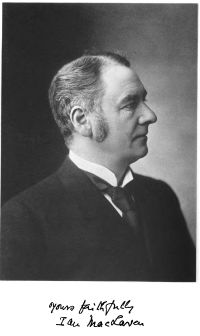 Ian Maclaren,
Graham of Claverhouse
Ian Maclaren,
Graham of Claverhouse
“ And the more faultless and brilliant the hero, the better goes the tale, and the louder the applause. Certainly John Graham is the central figure in this history, and so rich is the color of the man and so intense his vitality, that other personages among whom he moves become pale and uninteresting. ”
Ian Maclaren,
Graham of Claverhouse
“ Wild partisans, to whom every man is either white as snow or black as pitch, have gone mad over Graham, making him out, according 218 to their craze, either an angel or a devil, and forgetting that most men are half and between. But it must be also said that those who hold John Graham to have been a Jacobite saint are the more delirious in their minds, and hysterical in their writing, for they will not hear that he ever did anything less than the best, or that the men he persecuted had any right upon their side. ”
Ian Maclaren,
Graham of Claverhouse
“ So he died for his side, and I helped him to his death; some day I may die for my side, and his friends will help me to my death. It is a dark day and a troubled nation. Henry Pollock and John Graham have both been thorough. God is our judge, wha kens but He may accept us baith? 184 But I cannot deny he was a saint, as ye once said of him, and that I shall never be, neither shall you, Jean Graham, my love and my heart’s delightThis is sore writing to me, but I would rather ye had it from my hand than from another’s, and I fear me ye will hear bitter words in Dundee of what has been done. ”
 Edward Payson Roe,
His Sombre Rivals
Edward Payson Roe,
His Sombre Rivals
“ But the characteristic which won Graham's interest most strongly was her abounding mirthfulness. It ran through all her words like a golden thread. The instinctive craving of every nature is for that which supplements itself, and Graham found something so genial in Miss St. John's ready smile and laughing eyes, which suggested an over-full fountain of joyousness within, that his heart, chilled and repressed from childhood, began to give signs of its existence, even during the first hour of their acquaintance. ”
Ian Maclaren,
Graham of Claverhouse
“ He goeth, but he shall not return, his doom is fixed.” An approving murmur from the hearers showed what the Scots folk thought of John Graham. Grimond would fain have turned and answered this Jeremiah and his chorus with a touch of the sword, but his commander forbade him sharply. “We have other men to deal with,” he said to Grimond, “than country fanatics, and our work is before us in Edinburgh.” ”
James Carson Elliott, The Southern Soldier Boy: A Thousand Shots for the Confederacy
“ John W. Graham, the son of an illustrious father, who served his State as Governor and United States Senator, William A. Graham. Major Graham, [Pg 59] promoted from Captain of Company D, was quite young, stout and hardy, always at his post except when disabled by wounds—full of youth and enthusiasm, he always proved himself the bravest of the brave. He is a prominent lawyer in his native town, Hillsboro. ”
Various, The Atlantic Monthly, Volume 14…
“ Judged by any right test of greatness, Graham was more a man than was Napoleon or John Howard. He that ruled his stomach was greater than he who took a city. Béranger's Roi d'Yvetot, who ate four meals a day,—the Esquimaux, with his daily twenty-pound quantum of train-oil, gravy, and tallow-candles,—the alderman puffing over callipash and callipee,—the backwoodsman hungering after fattest of pork,—such men as these were no common sinners: they were assassins who struck at the very fountain of life, and throttled a human stomach. ”
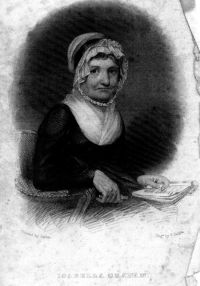 Isabella Graham,
The Power of Faith
Isabella Graham,
The Power of Faith
“ He was a man truly qualified for his station. He instructed his pupils with zeal; led even their amusements; and to an exemplary piety added the faithful counsel of a friend. He loved, and was therefore beloved. Under his superintendence John Graham improved rapidly, and gained the affections of his teacher and companions. Happy for him had he continued in such a suitable situation. He was removed to Edinburgh to receive a more classical education. ”
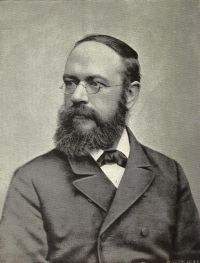 William Jerome Harrison,
Dictionary of National Biography…
(1890)
William Jerome Harrison,
Dictionary of National Biography…
(1890)
“ The post secured him a livelihood, and permitted him to engage in original research. After seven years of hard labour at his Glasgow post, Graham became professor of chemistry at University College, London (succeeding Dr. Edward Turner in 1837) , and he held that chair with great distinction until 1855, when the government appointed him master of the Mint in succession to Sir John Herschel. He had for many years acted as non-resident assayer. Graham continued to preside at the Mint until his death at his residence in Gordon Square, London, 11 Sept. 1869. He was never married. ”
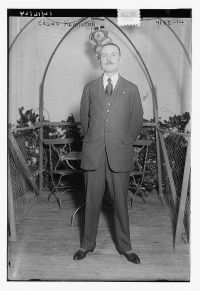 Cosmo Hamilton,
The Sins of the Children: A Novel
Cosmo Hamilton,
The Sins of the Children: A Novel
“ By the way, I'm a bit anxious about Graham. His letters have a queer undercurrent in them.I'm going to the National Gallery, the British Museum and South Kensington to-morrow, and in the evening I'm dining at the Trocadero with eight men who were up at St. John's with me. They're all working in London and hate it, after Oxford. It seems odd to me not to be there myself and I miss it mighty badly sometimes. All the same it's great to feel that one's a man at last, with real work to do and that apartment waiting for us to win. ”
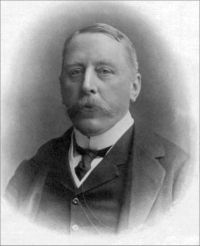 John Alexander Fuller Maitland,
Dictionary of National Biography…
(1885)
John Alexander Fuller Maitland,
Dictionary of National Biography…
(1885)
“ G. Graham, discovered his passion for music, and, being himself an enthusiastic amateur, gave him much encouragement. On 31 July 1758 he was nominated for a scholarship at King's College, Cambridge. But he was not admitted to the college till 4 May 1760. About this time he obtained a university scholarship. He took the degree of B.A. in 1764, and of M.A. in 1767. During his term of residence in Cambridge he got up and himself conducted a performance of the ‘Messiah’ in his native town, that occasion being the first on which an oratorio had been performed north of the Trent. ”
Charles Greville, The Greville Memoirs, Part 2 (of 3…
“ It is pretty evident that Graham (after his wont) is afraid of not being beforehand with public opinion or clamour, and that he is ready to advocate some Radical, or at any rate Liberal measure. Lord John seems to be conscious that this is a very grave matter, but he says he thinks he can frame a good measure, and he intends to busy himself about it. I called on Labouchere at Stoke on Thursday morning, and had some talk with him about it. ”
Charles Greville, The Greville Memoirs, Part 2 (of 3…
“ THE PEELITES NEGOTIATE WITH THE WHIGS.I found Graham in very low spirits, and full of disquiet and apprehensions about the future prospects of the country. This is generally his disposition, and he has communicated 383 much of his alarm and anxiety to me. On Friday morning, after Locke King's division, and before he knew anything of John Russell's intention, I received a note from him in these terms: 'My anticipations are most gloomy. I foresee nothing but confusion; there are no means of escaping it; everything will be shaken, and something more than a Government, I fear, will fall. ”
Edward Payson Roe,
His Sombre Rivals
“ Before Graham repassed under the apple-tree boughs he had fully decided to win at least Miss St. John's gratitude.CHAPTER III THE VERDICT OF A SAGE When Graham reached his room he was in no mood for sleep. At first he lapsed into a long revery over the events of the evening, trivial in themselves, and yet for some reason holding a controlling influence over his thoughts. Miss St. John was a new revelation of womanhood to him, and for the first time in his life his heart had been stirred by a woman's tones and glances. ”
 Charlotte Brontë,
Villette
(1855)
Charlotte Brontë,
Villette
(1855)
“ "Much better", I said calmly. "Much better, I thank you, Dr. John". For, reader, this tall young man—this darling son—this host of mine—this Graham Bretton, was Dr. John: he, and no other; and, what is more, I ascertained this identity scarcely with surprise. What is more, when I heard Graham's step on the stairs, I knew what manner of figure would enter, and for whose aspect to prepare my eyes. The discovery was not of to-day, its dawn had penetrated my perceptions long since. Of course I remembered young Bretton well; and though ten years (from sixteen to twenty-six) ”
Various, Graham's Magazine, Vol. XX, No… (1842)
“ Others may choose a more bustling life; but I have had my share of that! Give me a quiet, happy home, for there only is true happiness to be found.Musing thus, I was unconscious of the entrance of an intruder, until I heard a slight cough beside me, and looking up, I saw my faithful servant John standing over my chair. He laid on my lap, at the instant, a copy of Graham’s Magazine for December. As John did so, he heaved a sigh, and then, as if something was on his mind, busied himself in arranging various articles in the room. ”
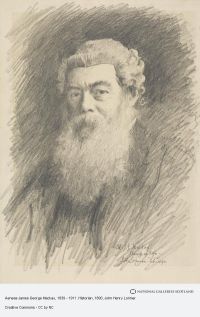 Aeneas James George Mackay,
Dictionary of National Biography…
(1890)
Aeneas James George Mackay,
Dictionary of National Biography…
(1890)
“ Three years later he succeeded Kennedy, who died in July 1465, in the primacy of Scotland. Soon after his succession to St. Andrews, Graham went to Rome to avoid the enmity of the Boyds, then at the height of their power in the Scottish court, and to procure his confirmation by the pope, and he remained abroad till the fall of the Boyds in 1469. He was present as conservator in a provincial council held in Scotland in July 1470, by which an end was put to the dispute between John Lochy, the rector of the university of St. Andrews, and the college of St. ”
Dougal Graham, The Collected Writings of Dougal Graham…
“ Mess John. Woman you may go home and see what ye have to do; ye have a very bad tongue: it’s no you we are to take account of.Mith. Ay, ay, ye that’s ministers and modest fouk may say sae, but if my son had tane as good tent o’ his tail, as I can do o’ my tongue, there had na been sae muckle about it, a wheen silly loons kens na what they were made for, or how to guide a thing whan they get it.Mess John. Put her out, she’s going to speak baudy.Mith. O ay, stir, I’se gang out, but I’ll hae my bairn out wi’ me. ”
Dougal Graham, The Collected Writings of Dougal Graham…
“ It is a chap-book which has been long popular, and one which has given rise to a variety of speculations, not only as to its authorship but also as to who was really the person whose ‘exploits’ are professedly recorded in its pages. As to the first of these points, Motherwell said he would not be surprised if Graham were its author; and M‘Vean heads his list of Dougal’s works with it. Fraser, on the other hand, argues against it being the composition of Graham, the ground he takes up being the same as that already quoted in relation to The History of Buckhaven and Simple John. ”
John Graham Gillam, Gallipoli Diary (1918)
“ Black night soon falls upon us, changing at short intervals momentarily into day as the forked flashes of lightning stab the earth, sky, and sea. The beach men, bending double under the downfall of water and the struggle against the wind as they walk, appear in vivid detail and disappear in the fraction of a second as the lightning plays overhead. ”
Dougal Graham, The Collected Writings of Dougal Graham…
“ As there are no good grounds for questioning the statement that Graham’s birth-place was Raploch, may it not be considered a feasible idea, in view of Spence’s remark, that our author’s parents removed to Campsie, and that he went with them? How long Dougal remained with the farmer is unknown. Of an unsettled disposition, he, like his creation John Cheap, made himself a chapman when very young, in great hopes of being rich when he became old ”
Dougal Graham, The Collected Writings of Dougal Graham…
“ After a careful comparison of the English chap-book, Simple Simon, with Simple John, we cannot but admit the statement that ‘the prefatory matter is quite in Graham’s style, and could not have been written by an Englishman;’ but we are not prepared to admit that Graham ‘most certainly stole’ the main body of the work. What Professor Fraser assumes to have been stolen must have been, though he does not explicitly say so, the ‘Twelve Misfortunes,’ for he admits that the preface is original and Scotch. ”
Dougal Graham, The Collected Writings of Dougal Graham…
“ None of them appear to have been published under Graham’s own name, but were either issued anonymously or under a cognomen which would probably be well understood in his own time as referring to him, such as ‘The Scots’ Piper,’ ‘John Falkirk,’ and ‘Merry Andrew at Tamtallon.’An advertisement which appeared in the Glasgow Journal of 14th June, 1764, has raised the question of Graham’s domestic relations. Everything known points to the conclusion that he never entered into the conjugal yoke. ”
