“ The tomb of Adam, which is of meaner workmanship, lies not far from them, at the furthest extremity to the north. Arculf also saw poorer and smaller monuments of the three women, Sarah, Rebecca, and Leah, who were here buried in the earth. The hill of Mamre is a mile to the south-west of these monuments, and is covered with grass and flowers, with a flat plain at the summit; on the north side of which is a church, in which is still seen, rooted in the ground, the stump of the oak of Mamre, called also the oak of Abraham, because under it he received the angels. ”
Mamre
Definition and stakes
The theme of “Mamre” has been addressed by authors such as Franz Delitzsch, Mrs. Hugh Fraser, Bede, Anonymous and Annie Fields. It is often associated with terms like Abraham, Madras, Maremma, city and oak.
Quotes about “Mamre”
 Franz Delitzsch,
Biblical Commentary Old Testament…
(1885)
Franz Delitzsch,
Biblical Commentary Old Testament…
(1885)
“ The cave was before, i.e., probably to the east of, the grove of Mamre, which was in the district of Hebron. This description cannot be reconciled with the tradition, which identifies Mamre and the cave with Ramet el Khalil, where the strong foundation-walls of an ancient heathen temple (according to Rosenmüller's conjecture, an Idumaean one) are still pointed out as Abraham's house, and where a very old terebinth stood in the early Christian times ”
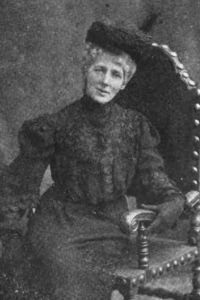 Mrs. Hugh Fraser,
Italian Yesterdays, vol. 1
Mrs. Hugh Fraser,
Italian Yesterdays, vol. 1
“ I could not help reflecting how few direct ways true love has of manifesting itself—for one and the same was the thought of Abraham, insisting on buying and holding for his very own the field of Mamre, to bury Sara in—and the preoccupation of the highly cultured Greek to enshrine the remains of his beloved Annia, where, by all human prevision, they could never be disturbed. ”
 Bede,
The Book of the Holy Places — Chapters 1 - 30 …
Bede,
The Book of the Holy Places — Chapters 1 - 30 …
“ Chapter IX the valley of Mamre. But the plague from the east of Hebron, the field of the same met in regards to the cave of Machpelah before Mamre, which Abraham purchased from the shameless Hethite for a possession of a twofold burial. ”
Anonymous, Cultus Arborum: A Descriptive Account of Phallic Tree Worship
“ The plain of Mamre also occurs, and wherever it does should be oak or ash groves. Genesis [Pg 77] xviii., 1, for instance, where it is recorded that the angels announced to the patriarch the birth of Isaac. This oak, Jewish tradition says was, long after Abraham’s time, held as an object of veneration, indeed Bayle in his “Historical and Critical Dictionary,” article “Abraham,” says:—“This puts me in mind of the oak of Mamre, under which Abraham is said sometimes to have cooled himself. This oak, they tell you, was standing in the reign of Constantine.” ”
“ At the extremity of this road, on the west side, is the tomb of Rachel, rudely built of stones, without any ornament, presenting externally the form of a pyramid. Her name, placed there by her husband Jacob, is still shown upon it.Hebron, which is also called Mamre, has no walls, and exhibits [7] only the ruins of the ancient city; but there are some ill-built villages and hamlets scattered over the plain, and inhabited by a multitude of people. To the east is a double cave, looking towards Mamre, where are the tombs of the four patriarchs, Abram, Isaac, Jacob, and Adam the first man. ”
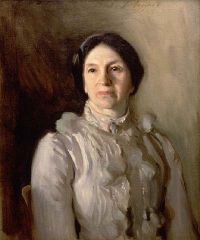 Annie Fields,
Authors and Friends
Annie Fields,
Authors and Friends
“ Our home is like a martin-box.... I cannot tell you the quaint odd peace we have here in living under the oak. 'Behold, she dwelleth under the oak at Mamre.' All that we want is friends, to whom we may say that solitude is sweet. We have some neighbors, however, who have made pretty places near us. Mr. Stowe keeps up a German class of three young ladies, with whom he is reading Faust for the nine hundred and ninety-ninth time, and in the evening I read aloud to a small party of the neighbors. ”
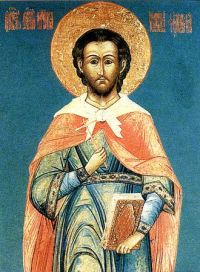 Justin Martyr,
Ante-Nicene Fathers Vol. I — Dialogue with Trypho
(1885)
Justin Martyr,
Ante-Nicene Fathers Vol. I — Dialogue with Trypho
(1885)
“ And Moses says that God appeared also to Abraham near the oak in Mamre, when he was sitting at the door of his tent at mid-day. Then he goes on to say: ‘And he lifted up his eyes and looked, and, behold, three men stood before him; and when he saw them, he ran to meet them.’ [498] After a little, one of them promises a son to Abraham: ‘Wherefore did Sarah laugh, saying, Shall I of a surety bear a child, and I am old? Is anything impossible with God? At the time appointed I will return, according to the time of life, and Sarah shall have a son. ”
Philip P. Wells, Bible Stories and Religious Classics
“ Our Lord said to Abram: Lift up thine eyes and see directly from the place that thou art now in, from the north to the south, and from the east to the west. All this land that thou seest I shall give thee, and to thy seed for evermore. I shall make thy seed as powder or dust of the earth, who that may number the dust of the earth shall number thy seed. Arise therefore and walk the land in length and in breadth, for I shall give it to thee. Abram moved then his tabernacle and dwelled in the valley of Mamre, which is in Hebron, and set there his tabernacle. ”
 John Ruskin,
Fors Clavigera (Volume 6 of 8)
(1871)
John Ruskin,
Fors Clavigera (Volume 6 of 8)
(1871)
“ I should feel it a pleasure if I could be of use.” [170] [171] 1 Abram’s mountain home seems to have been much like Horace’s, as far as I can make out: but see accounts of modern travellers. Our translation “in the plain of Mamre” (Genesis xiii. 28; xiv. 13) is clearly absurd; the gist of the separation between Lot and Abram being Lot’s choice of the plain, as ‘the Paradise of God,’ and Abram’s taking the rock ground. ”
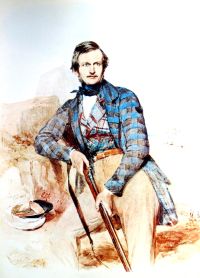 Sir William Cornwallis Harris,
The Highlands of Ethiopia
Sir William Cornwallis Harris,
The Highlands of Ethiopia
“ Surrounded by the former capital of Shoa, it occupies the bleak summit of one of the loftiest mountains in the range, and commands a magnificent prospect over the greater portion of Efát. Mamrat, now diminished from thirteen to one thousand feet, no longer loomed a giant. Through the clouds which flitted across its stern bosom lay revealed the only path by which the royal treasures are accessible; and the white peak of Wóti, rising from dense masses of timber, and terminating in a basaltic column, now formed the most conspicuous feature in the rugged landscape. ”
 Marie Louise de la Ramée,
In Maremma
(1882)
Marie Louise de la Ramée,
In Maremma
(1882)
“ True, Maremma was so lonely, so wide, so virgin in its water-fed greenery, so severed by its season of disease from all the moving world, that such a life here was less strange than it would have been elsewhere, and the native mountaineer in the hillside woods, and the shepherd from the north on the rich grasslands, were nomads as utterly as ever were their forefathers in days when Pan and Faunus were the gods of the forest and pasture. ”
The Book of the Thousand Nights and a Night… (1885)
“ Badr replied, “From the city of this witch”; and the old man said, “Thou art my guest to-night.” He consented and went with him; but by the way behold, they met an old woman, who wept when she saw the mule, and said, “There is no god but the God! Verily, this mule resembleth my son’s she-mule, which is dead, and my heart acheth for her; so, Allah upon thee, O my lord, do thou sell her to me!” He replied, “By Allah, O my mother, I cannot sell her.” But she cried, “Allah upon thee, do not refuse my request, for my son will surely be a dead man except I buy him this mule.” ”
Henry Salt, A voyage to Abyssinia — Chapter 9 (1814)
“ In the course of the afternoon we went about half a mile, along the banks of the river Mareb, to visit an old ruin, seen from a considerable distance, called the monastery of Abba Asfé. The chief part of the remains consists of an ancient stone building, of an oblong square shape, about sixty feet long, and forty-five wide, standing on the centre of an eminence, partly surrounded by trees, and commanding a beautiful prospect, in which the river Mareb makes a conspicuous object, winding its circuitous course through the valley. ”
Marie Louise de la Ramée,
In Maremma
(1882)
“ She went into the third chamber, and there she found the wooden coffin untouched, the flowers she had laid there undisturbed, and the lamp burning steadily. She left it, and ascended the stairs, and looked over the moors. The day was dying down, and the grand red glory of the west blinded her for a moment as she looked on it from the gloom of the tombs. There are no sunsets more gorgeous than those on the sea of the Maremma, and their pomp of gold and purple is a mockery of kings. ”
Marie Louise de la Ramée,
In Maremma
(1882)
“ The air, too, which gives 'distemper if not death' to the stranger, began to work its evil way on him. He began to lose strength, to feel chilly, to have a touch of fever; the burning suns on the rank soil began to pour their poison into his northern blood. She met him on the twelfth day of his stay at Telamone as she came home towards sunset with wild strawberries and blackberries as her afternoon's gleaning. She looked at him and smiled a little. 'Maremma makes you ill,' she said with unconcealed contentment; 'you are very unwise to stay in it. The sun is always angry with strangers. ”
Glyn Barlow, The Story of Madras
“ The fact is that Madras was so frequently troubled by successive Mohammedan enemies—the King of Golconda; Da-ud Khan, Nawab of the Carnatic; Haidar Ali, Sultan of Mysore; his son Tipu, and others—that the Company was disposed to regard all 'Moors' with mistrust, so much so that they discouraged Mohammedan residents; and a measure was passed with the special intention 'to prevent the Moors purchasing too much land in the Black Town.' There are large crowds of Mohammedans in Madras now, grouped especially in Chepauk and the adjoining Triplicane and Royapettah ”
Marie Louise de la Ramée,
In Maremma
(1882)
“ The peril of last night will renew itself when I am not there. He may kill you and himself, perhaps, but there will be no other way of escape.' 'That will be as it must be; men have hidden all their life, I think, in Maremma. There are many stories———' 'I do not wish to say what hurts you; we will not speak of him; but listen—for yourself, This man is dear to you—dear, no doubt, through his beauty and his misfortunes—but what future will he give you, with what misery does he not dower you? ”
Marie Louise de la Ramée,
In Maremma
(1882)
“ The unbroken silence, the cold water, the salutary herbs, all served to contribute to his victory over the fever-fiend of Maremma, and little by little he grew sensible of other things than those deadly chills, those waves of lava heat, which turn by turn had filled his entire consciousness so long. Then he saw that a woman all alone had done this great service for him, and hidden him from his pursuers, and kept vigil by him through many weary days and nights. ”
W. Dittmer, Te Tohunga: The ancient legends and traditions of the Maoris
“ Little only is known of the sacred wisdom of the Maoris. The dread of the old gods is still living in the hearts of the Maoris, but the last hour has come for them as they now bend their tattoed heads over the fire and murmur regretfully of the great Past. ”
Marie Louise de la Ramée,
In Maremma
(1882)
“ She was absorbed in her efforts to help him; she did not notice that he was a man young, and wonderfully handsome, with the beauty of the Greek ideal; beauty which not exposure, or imprisonment, or shame, or terror, or privation, or the ghastly horrors of the galleys had had any power to destroy, though they had wasted, darkened, and dimmed it, as dust and ill-usage obscure the soilless glory and fine lines of the marble god. Of all this she saw nothing, thought nothing; it was enough for her that he was hunted and in fear, like the beasts and the birds of the Maremma. ”
Glyn Barlow, The Story of Madras
“ Madras has memorials indeed. Madras is an historical museum, where the sightseer may spend many and many an hour—in street and in building—studying old-world exhibits, and living for the while in the fascinating past. Madras is not an ancient city; its foundation is not ascribed to some mythic king who ruled in mythic times; it has no hoary ruins, too old to be historic and too legendary to be inspiring. But Madras is old enough for its records to be romantic, and at the same time is young enough for its earliest accounts of itself to be—not unsatisfying fables, but interesting fact. ”
Glyn Barlow, The Story of Madras
“ A great many more of the streets and districts of Madras have history in their names; but the few that we have dealt with suffice to exemplify the manner of the expansion of the city of Madras. We can picture the rustic suppliers crowding into the city to sell the produce of their fields; we can picture the humble weavers migrating into the city with their wives and their children, and with their pots and their pans and their quaint machines, in response to the Company's tempting invitation ”
 Edmond Hamilton,
The Monster-God of Mamurth
(1935)
Edmond Hamilton,
The Monster-God of Mamurth
(1935)
“ Merchants, go not into the city of Mamurth, which lies beyond the mountain pass. For I, San-Drabat of Carthage, entering the city with four companions in the month of Eschmoun, to trade, on the third night of our stay came priests and seized my fellows, I escaping by hiding. My companions they sacrificed to the evil god of the city, who has dwelt there from the beginning of time, and for whom the wise men of Mamurth have built a great temple the like of which is not on earth elsewhere, where the people of Mamurth worship their god. ”
Sir William Cornwallis Harris,
The Highlands of Ethiopia
“ Coupled with the desire to obtain property, there ever exists an innate disinclination to part with the most trifling commodity; and even among the higher classes, a stick or a spear is sometimes peremptorily refused to parties who have previously loaded the ingrate with the richest imaginable presents.Our last march lay over the mountain mass of which Mamrat forms the main feature. The ascent in many parts is extremely tedious; and deep dells, intersecting the road, are traversed each by a clear streamlet, leaping from rock to rock in its downward course to vales far concealed from view. ”
Marie Louise de la Ramée,
In Maremma
(1882)
“ Her footfall was noiseless. He did not know that he was followed; that he had thus been followed all across the wastes of the Maremma. He passed without a moment's pause through the doorway; whenever he had struck a deathblow, he had always struck quickly as the eagle does. Within there was a vast and lofty hall, austere with sculpture, its floor mosaic, its ceiling frescoed; a staircase of immense width, made of marble, stretched upward between walls of marble; silver lamps swung from above and lighted it dully. It was deserted and silent ”
Marie Louise de la Ramée,
In Maremma
(1882)
“ Throughout Maremma, where love plays fast and loose, and the sower of the corn is seldom the reaper of it, and the hunter of one autumn is rarely the same as another—in Maremma, where the passions are lava and the faith is thistle-down,—the boldest and the lightest would never have dared an amorous word to the Musoncella. ”
Marie Louise de la Ramée,
In Maremma
(1882)
“ Without Saturnino Mastarna, the Maremma would be more than ever desolate. The province had always been full of sympathy with its great robber, whose popular boast it was that he never had wronged any poor man. All the creatures of the law, soldiers, guards, coastguards, and carabiniers, were hated and shunned throughout the province; got help from none, and were, again and again, baffled and laughed at by the shrewd finesse of the people in the woods, and on the shores. To cheat a sbirro was a loyal task that brought praise and honour to whosoever had accomplished it. ”
 Flora Annie Webster Steel,
King-Errant
Flora Annie Webster Steel,
King-Errant
“ No wonder his father, who ever had a pretty wit, called him Humâyon. That might portend the phœnix, the bird of good omen, besides half-a-dozen other side meanings, each charming in its way.But Babar, leaning over the happy mother said softly, "He shall be my protection in the future. Lo! Mahâm! I have put myself outside myself as they say in the child-stories of our youth. Who was't who put his life safe in a gold box? Well! my life is hid in my son's. So there, my wife, have a care of us both--for, verily in some ways, Mahâm, I need looking after like an infant." ”
 Isabella L. Bird,
Journeys in Persia and Kurdistan…
Isabella L. Bird,
Journeys in Persia and Kurdistan…
“ As I reached Merwana at 10 a.m., and the katirgis, after raging for an hour, refused to proceed, I took Mirza and Qasha Bardah, the priest under whose hospitable roof I lodged, with me, and went up the valley to Ombar, the abode of Hesso, with the vague hope of "doing something" for the poor people. The path lay among bright streams and flowery pastures, the sun was warm, the air sharp, the mountains uplifted their sunlit snows into a heaven of delicious blue, the ride was charming. ”
