“ When, therefore, Antonio mentioned Bishop Mackenzie and Dr Livingstone, a gleam of intelligent interest lit up Kambira’s swarthy countenance, and he was about to speak, but suddenly checked himself, and a stern frown chased the gleam away.“The Manganja,” he said, after a few moments’ silence, during which poor Antonio eyed him with some distrust, “know well that these men of God were not of the same country as the Arab and the Portuguese; that they hated slavery and loved the Manganja, and that the graves of some of them are with us now; but we know also that some white men are great liars. ”
Manganja
Definition and stakes
The theme of “Manganja” has been addressed by authors such as David Livingstone, R. M. Ballantyne, J. G. Wood, William Garden Blaikie and William Hunt. It is often associated with terms like people, iron, bishop, cotton and slave.
Quotes about “Manganja”
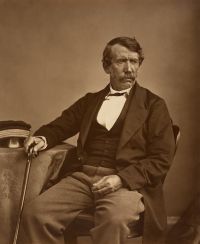 David Livingstone,
A Popular Account of Dr. Livingstone's Expedition to the Zambesi and Its Tributaries
David Livingstone,
A Popular Account of Dr. Livingstone's Expedition to the Zambesi and Its Tributaries
“ They often wear the hair collected in a mass on the upper and back part of the head, while it is all shaven off the forehead and temples. The Babisa and Waiau or Ajawa heads have more of the round bullet-shape than those of the Manganja, indicating a marked difference in character; the former people being great traders and travellers, the latter being attached to home and agriculture. The Manganja usually intrust their ivory to the Babisa to be sold at the Coast, and complain that the returns made never come up to the high prices which they hear so much about before it is sent. ”
David Livingstone,
A Popular Account of Dr Livingstone's Expedition to the Zambesi and its Tributaries…
(1894)
“ They give four yards of cotton cloth for a man, three for a woman, and two for a boy or girl, to be taken to the Portuguese at Mozambique, Iboe, and Quillimane.The Manganja were more suspicious and less hospitable than the tribes on the Zambesi. They were slow to believe that our object in coming into their country was really what we professed it to be. They naturally judge us by the motives which govern themselves. ”
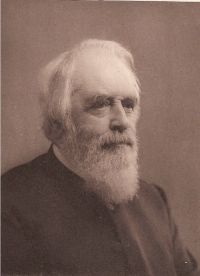 William Garden Blaikie,
The Personal Life of David Livingstone
William Garden Blaikie,
The Personal Life of David Livingstone
“ The aggressors were the neighboring warlike tribe of Ajawa, and their victims were the Manganja, the inhabitants of the Shiré Valley. The Bishop accepted the invitation of Chigunda, a Manganja chief, to settle at Magomero. It was thought, however, desirable for the Bishop and Livingstone first to visit the Ajawa chief, and try to turn him from his murderous ways. The road was frightful--through burning villages resounding with the wailings of women and the shouts of the warriors. ”
David Livingstone,
A Popular Account of Dr Livingstone's Expedition to the Zambesi and its Tributaries…
(1894)
“ The Ajawa having been defeated and driven off while we were on the Lake, had sent word that they desired to live at peace with the English. Many of the Manganja had settled round Magomero, in order to be under the protection of the Bishop; and it was hoped that the slave-trade would soon cease in the highlands, and the people be left in the secure enjoyment of their industry. The Mission, it was also anticipated, might soon become, to a considerable degree, self-supporting, and raise certain kinds of food, like the Portuguese of Senna and Quillimane. ”
David Livingstone,
A Popular Account of Dr Livingstone's Expedition to the Zambesi and its Tributaries…
(1894)
“ The accustomed presents are exchanged with civil ceremoniousness; until our men, wearied and hungry, call out, "English do not buy slaves, they buy food," and then the people bring meal, maize, fowls, batatas, yams, beans, beer, for sale.The Manganja are an industrious race; and in addition to working in iron, cotton, and basket-making, they cultivate the soil extensively. All the people of a village turn out to labour in the fields. It is no uncommon thing to see men, women, and children hard at work, with the baby lying close by beneath a shady bush. ”
David Livingstone,
A Popular Account of Dr Livingstone's Expedition to the Zambesi and its Tributaries…
(1894)
“ About two o'clock we saw the smoke of burning villages, and heard triumphant shouts, mingled with the wail of the Manganja women, lamenting over their slain. The Bishop then engaged us in fervent prayer; and, on rising from our knees, we saw a long line of Ajawa warriors, with their captives, coming round the hill-side. The first of the returning conquerors were entering their own village below, and we heard women welcoming them back with "lillilooings." The Ajawa headman left the path on seeing us, and stood on an anthill to obtain a complete view of our party. ”
J. G. Wood, The uncivilized races of men in all countries of the world… (1875)
“ The Waiyau have round, apple-shaped heads, understand the use of fire-arms, and with dash and courage easily overpower the Manganja, who use only bows and arrows, and are a more peaceable, as they are a more intelligent and ingenious race. ”
David Livingstone,
A Popular Account of Dr Livingstone's Expedition to the Zambesi and its Tributaries…
(1894)
“ The Manganja chiefs sell their own people, for we met Ajawa and slave-dealers in several highland villages, who had certainly been encouraged to come among them for slaves. The chiefs always seemed ashamed of the traffic, and tried to excuse themselves. "We do not sell many, and only those who have committed crimes." ”
William Hunt, Dictionary of National Biography… (1893)
“ Although he disliked the idea of making good his position by violence, he was persuaded by the friendly Manganja tribe to help them against the Ajawa, believing that the Manganja were simply distressed by a raid of the Ajawa, who were carrying off large numbers as slaves, whereas the war was in reality the result of a tribal movement, and the Ajawa were engaged in displacing their weaker neighbours (ib. pp. 860-3; Goodwin, Memoir of Bishop Mackenzie, pp. 320-2, 338) . ”
David Livingstone,
A Popular Account of Dr. Livingstone's Expedition to the Zambesi and Its Tributaries
“ Formerly all the Manganja were united under the government of their great chief, Undi, whose empire extended from Lake Shirwa to the River Loangwa; but after Undi’s death it fell to pieces, and a large portion of it on the Zambesi was absorbed by their powerful southern neighbours the Banyai. This has been the inevitable fate of every African empire from time immemorial. A chief of more than ordinary ability arises and, subduing all his less powerful neighbours, founds a kingdom, which he governs more or less wisely till he dies. ”
William Garden Blaikie,
The Personal Life of David Livingstone…
“ Before going near them the Bishop engaged in prayer, and during the prayer we could hear the wail for the dead by some Manganja probably thought not worth killing, and the shouts of welcome home to these bloody murderers. It turned out that they were only some sixty or seventy robbers, and not the Ajawa tribe; so we had a narrow escape from being murdered. "How are you doing? I fear from what I have observed of your temperament that you will have to strive against fickleness. ”
David Livingstone,
A Popular Account of Dr Livingstone's Expedition to the Zambesi and its Tributaries…
(1894)
“ Chibisa being well known as a great conjurer and general. The Ajawa ran off yelling and screaming, "Nkondo! Nkondo!" (War! War!) We heard the words of the Manganja, but they did not strike us at the moment as neutralizing all our assertions of peace. The captives threw down their loads on the path, and fled to the hills: and a large body of armed men came running up from the village, and in a few seconds they were all around us, though mostly concealed by the projecting rocks and long grass. In vain we protested that we had not come to fight, but to talk with them. ”
David Livingstone,
A Popular Account of Dr Livingstone's Expedition to the Zambesi and its Tributaries…
(1894)
“ We counselled them to unite against the common enemies of their country, and added distinctly that we English would on no account enter into their quarrels. On the Bishop inquiring whether, in the event of the Manganja again asking aid against the Ajawa, it would be his duty to accede to their request,--"No," replied Dr. Livingstone, "you will be oppressed by their importunities, but do not interfere in native quarrels." This advice the good man honourably mentions in his journal. ”
David Livingstone,
A Popular Account of Dr. Livingstone's Expedition to the Zambesi and Its Tributaries
“ It may not be granted that the same blood flows in all veins, or that all have descended from the same stock; but the traveller has no doubt that, practically, the white rogue and black are men and brothers.Pangola is the child or vassal of Mpendé. Sandia and Mpendé are the only independent chiefs from Kebrabasa to Zumbo, and belong to the tribe Manganja. The country north of the mountains here in sight from the Zambesi is called Senga, and its inhabitants Asenga, or Basenga, but all appear to be of the same family as the rest of the Manganja and Maravi. ”
William Hunt, Dictionary of National Biography… (1893)
“ After binding the Manganja not to enslave any captives they might mate, and to discourage slavery, Mackenzie and his party joined in the war. Their help enabled their allies to win a victory, which raised the number of blacks at the mission settlement to 150. Frequent appeals were made to Mackenzie by the Manganja for further help, and he again enabled them to rout their enemies, and gained fresh additions to his settlement. ”
David Livingstone,
A Popular Account of Dr Livingstone's Expedition to the Zambesi and its Tributaries…
(1894)
“ The soil was dry and hard, and covered with mopane-trees; but some of the Manganja were busy hoeing the ground and planting the little corn they had brought with them. The effects of hunger were already visible on those whose food had been seized or burned by the Ajawa and Portuguese slave-traders. The spokesman or prime minister of one of the chiefs, named Kalonjere, was a humpbacked dwarf, a fluent speaker, who tried hard to make us go over and drive off the Ajawa; but he could not deny that by selling people Kalonjere had invited these slave-hunters to the country. ”
J. G. Wood, The uncivilized races of men in all countries of the world… (1875)
“ When a Manganja dies, a great wailing is kept up in his house for two days; his tools and weapons are broken, together with the cooking vessels. All food in the house is taken out and destroyed; and even the beer is poured on the earth. ”
“ Slave-dealers had induced the Ajawa, a warlike tribe, to declare war against the people of the Manganja highlands. The Ajawa had done this before, and were but too ready to do it again. They invaded the land, captured many of the young people, and slew the aged. Those who escaped to the jungle found on their return that their crops were destroyed. Little seed remained in their possession, and before that was planted and grown, famine began to reduce the ranks, already thinned by war. ”
J. G. Wood, The uncivilized races of men in all countries of the world… (1875)
“ But, as it is very strong, and the fabrics made from it are very durable, the natives prefer it to the foreign plant. Almost every Manganja family of importance has its own little cotton patch, from half an acre to an acre in size, which is kept carefully tended, and free from weeds. The loom in which they weave their simple cloth is very rude, and is one of the primitive forms of a weaver’s apparatus. It is placed horizontally, and not vertically, and the weaver has to squat on the ground when engaged in his work. ”
David Livingstone,
The Last Journals of David Livingstone…
“ Makanjela's people cannot piss Mataka to go to the Manganja, so they do what they can by kidnapping and plundering all who fall into their hands.When I employed two of Mataka's people to go back on the 14th with food to the havildar and sepoys, they went a little way and relieved some, but would not venture as far as the Luatizé, for fear of losing their liberty by Makanjela's people. I could not get the people of the country to go back ”
David Livingstone,
A Popular Account of Dr Livingstone's Expedition to the Zambesi and its Tributaries…
(1894)
“ Greater care would be required on entering the Mazitu or Zulu country, for there the Government extends over very large districts, while among the Manganja each little district is independent of every other. The people here have not adopted the exacting system of the Banyai, or of the people whose country was traversed by Speke and Grant.In our way back from Chinsamba's to Chembi's and from his village to Nkwinda's, and thence to Katosa's, we only saw the people working in their gardens, near to the stockades. ”
David Livingstone,
A Popular Account of Dr Livingstone's Expedition to the Zambesi and its Tributaries…
(1894)
“ When we were with Motunda, on the 20th October, he told us frankly that all the native provisions were hidden in Kirk's Range, and his village being the last place where a supply of grain could be purchased before we reached the ship, we waited till he had sent to his hidden stores. The upland country, beyond the mountains now on our right, is called Deza, and is inhabited by Maravi, who are only another tribe of Manganja. The paramount chief is called Kabambe, and he, having never been visited by war, lives in peace and plenty. Goats and sheep thrive ”
David Livingstone,
The Last Journals of David Livingstone…
“ Not many women wear the lip-ring: the example of the Waiyau has prevailed so far; but some of the young women have raised lines crossing each other on the arms, which must have cost great pain: they have also small cuts, covering in some cases the whole body. The Maravi or Manganja here may be said to be in their primitive state. We find them very liberal with their food: we give a cloth to the headman of the village where we pass the night, and he gives a goat, or at least cooked fowls and porridge, at night and morning. ”
 James George Frazer,
The Golden Bough: A Study in Magic and Religion…
James George Frazer,
The Golden Bough: A Study in Magic and Religion…
“ On the day before the festival one of the fasting men cuts down the chosen mango tree in the jungle with a stone adze, which is never afterwards put to any other use; an iron tool may not be used for the purpose, though iron tools are now common enough in the district. In cutting down the mango they place nets on the ground to catch any leaves or twigs that might fall from the tree as it is being felled, and they surround the trunk with new mats to receive the chips which fly out under the adze of the woodman; for the chips may not drop on the earth. ”
“ But it was now twenty years since the Mangans had been established at Number Six, The Mall, Cluhir; the Doctor had come in for his father's money as well as his practice, and was respected as "a warm man"; the disagreeable ones had grown old, and people who are both old and disagreeable cannot expect to command a large audience. Mrs. Mangan, on the contrary, was neither the one nor the other, being, at this time, but little over forty, and as kindly, lazy, and handsome a creature as ever lived down spiteful gossip by good-nature. ”
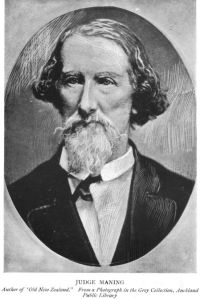 Frederick Edward Maning,
Old New Zealand: Being Incidents of Native Customs and Character in the Old Times
Frederick Edward Maning,
Old New Zealand: Being Incidents of Native Customs and Character in the Old Times
“ But they had mistaken the meaning of the monster review of the Taniwha. It was a leave-taking of his favourite warrior; for the Ngati Kuri were fated to die to a man on the next land they trod. A hundred and fifty men were they—the pick and prime of their tribe. All rangatira, all warriors of name, few in number, but desperately resolute, they thought it little to defeat the thousands of the south, and take the women and children as a prey! Having feasted and rejoiced at Tuhua, they sail for Motiti. This world was too small for them. They were impatient for battle. ”
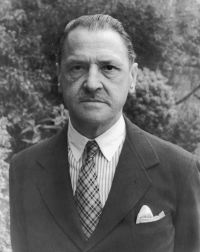 W. Somerset Maugham,
The Trembling of a Leaf: Little Stories of the South Sea Islands
W. Somerset Maugham,
The Trembling of a Leaf: Little Stories of the South Sea Islands
“ There is nothing the Kanaka can endure less than ridicule. It was not long before much angry talk passed among the sufferers. Manuma was no longer a hero; he had to put up with a good deal of plain speaking, and one day what Walker had suggested came to pass: a heated argument turned into a quarrel and half a dozen of the young men set upon the chief's son and gave him such a beating that for a week he lay bruised and sore on the pandanus mats. He turned from side to side and could find no ease. Every day or two the administrator rode over on his old mare and watched the progress of the road. ”
W. Somerset Maugham,
The Trembling of a Leaf: Little Stories of the South Sea Islands
“ Manuma had coached them well. They were quite calm, they did not attempt to argue—and argument is a passion with the Kanaka—they merely shrugged their shoulders: they would do it for a hundred pounds, and if he would not give them that they would do no work. He could please himself. They did not care. Then Walker flew into a passion. He was ugly then. His short fat neck swelled ominously, his red face grew purple, he foamed at the mouth. He set upon the natives with invective. He knew well how to wound and how to humiliate. He was terrifying. The older men grew pale and uneasy. ”
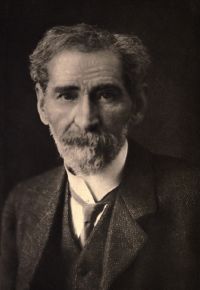 William Henry Hudson,
Green Mansions
(1904)
William Henry Hudson,
Green Mansions
(1904)
“ Drawing near I cried out in a somewhat feeble voice that I was seeking for Managa; whereupon a grey-haired man stepped forth, spear in hand, and replied that he was Managa, and demanded to know why I sought him. I told him a part of my story, enough to show that I had a deadly feud with Runi, that I had escaped from him after killing one of his people. ”
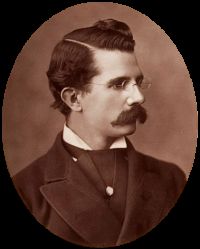 William Black,
Prince Fortunatus
William Black,
Prince Fortunatus
“ Mangan?" his companion asked, rather wonderingly."In every way. People are fond of him; he wins affection without trying for it; as I say, it all comes to him as if by natural right.""Yes, they say he is very popular in London, among those fine folk," observed Miss Francie, quite good-naturedly."Oh, I wasn't thinking of his fashionable friends," Mangan rejoined. "Being made much of by those people doesn't seem to me one of the great gifts of fortune. And yet I wonder it hasn't spoiled him. He doesn't seem the least bit spoiled, does he?" ”
