“ That Fitzpiers could allow himself to look on any other creature for a moment than Grace filled Melbury with grief and astonishment. In the pure and simple life he had led it had scarcely occurred to him that after marriage a man might be faithless. That he could sweep to the heights of Mrs. Charmond’s position, lift the veil of Isis, so to speak, would have amazed Melbury by its audacity if he had not suspected encouragement from that quarter. ”
Melbury
Definition and stakes
The theme of “Melbury” has been addressed by authors such as Thomas Hardy, Fanny Burney, Wilkie Collins, Emily Eden and H. B. Marriott Watson. It is often associated with terms like Melville, Winterborne, Fitzpiers, Herman and Pierre.
Quotes about “Melbury”
“ Examine Grace as her father might, she would admit nothing. For the present, therefore, he simply watched. The suspicion that his darling child was being slighted wrought almost a miraculous change in Melbury’s nature. No man so furtive for the time as the ingenuous countryman who finds that his ingenuousness has been abused. Melbury’s heretofore confidential candor towards his gentlemanly son-in-law was displaced by a feline stealth that did injury to his every action, thought, and mood. ”
 Thomas Hardy,
The Woodlanders
(1887)
Thomas Hardy,
The Woodlanders
(1887)
“ Melbury stood at the door of the timber-shed in the attitude of a man to whom such an arrival was a trifling domestic detail with which he did not condescend to be concerned. Yet he well divined the contents of that box, and was in truth all the while in a pleasant exaltation at the proof that thus far, at any rate, no disappointment had supervened. ”
“ Marty made as if to step forward for the pleasure of being recognized by Miss Melbury; but abruptly checking herself, she glided behind a carrier’s van, saying, dryly, “No; I baint wanted there,” and critically regarded Winterborne’s companion. It would have been very difficult to describe Grace Melbury with precision, either now or at any time. Nay, from the highest point of view, to precisely describe a human being, the focus of a universe—how impossible! ”
Thomas Hardy,
The Woodlanders
(1887)
“ Melbury had just entered the wood, and was winding along the cart-way which led through it, channelled deep in the leaf-mould with large ruts that were formed by the timber-wagons in fetching the spoil of the plantations, when all at once he descried in front, at a point where the road took a turning round a large chestnut-tree, the form of his own horse Blossom, at which Melbury quickened Darling's pace, thinking to come up with Fitzpiers. ”
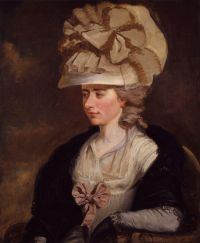 Fanny Burney,
The Wanderer
(1814)
Fanny Burney,
The Wanderer
(1814)
“ The impatient Harleigh besought Lord Melbury to be his agent, with the guardian and the uncle of his lovely sister. Lord Melbury joyfully complied. The affair, however momentous, was neither long nor difficult to arrange. The Bishop felt an implicit trust in the known judgment and tried discretion of his ward; and the Admiral held that a female, as the weaker vessel, could never properly, nor even honourably, make the voyage of life, but under the safe convoy of a good husband. ”
Thomas Hardy,
The Woodlanders
(1887)
“ The fact was that there shone upon Miss Melbury's face a species of exaltation, which saw no environing details nor his own occupation; nothing more than his bare presence."Why need you not ask?""Your face is like the face of Moses when he came down from the Mount."She reddened a little and said, "How can you be so profane, Giles Winterborne?""How can you think so much of that class of people? Well, I beg pardon; I didn't mean to speak so freely. How do you like her house and her?" ”
Thomas Hardy,
The Woodlanders
(1887)
“ This was what the household were actually talking of during Giles's cogitation without; and Melbury's satisfaction with the clear atmosphere that had arisen between himself and the deity of the groves which enclosed his residence was the cause of a counterbalancing mistiness on the side towards Winterborne."So thoroughly does she trust me," said Melbury, "that I might fell, top, or lop, on my own judgment, any stick o' timber whatever in her wood, and fix the price o't, and settle the matter. But, name it all! ”
Thomas Hardy,
The Woodlanders
(1887)
“ For this reason a curious kind of partnership existed between Melbury and the younger man—a partnership based upon an unwritten code, by which each acted in the way he thought fair towards the other, on a give-and-take principle. Melbury, with his timber and copse-ware business, found that the weight of his labor came in winter and spring. Winterborne was in the apple and cider trade, and his requirements in cartage and other work came in the autumn of each year. Hence horses, wagons, and in some degree men, were handed over to him when the apples began to fall ”
Thomas Hardy,
The Woodlanders
(1887)
“ Melbury searched the garden, the parsley-bed, and the orchard, but could find no trace of her, and then he made inquiries at the cottages of such of his workmen as had not gone to bed, avoiding Tangs's because he knew the young people were to rise early to leave. ”
“ Melbury’s respect for Fitzpiers was based less on his professional position, which was not much, than on the standing of his family in the county in by-gone days. That implicit faith in members of long-established families, as such, irrespective of their personal condition or character, which is still found among old-fashioned people in the rural districts reached its full intensity in Melbury. ”

“ Could he help it, if the same lady persisted in flirting with him? He ran away from her the next morning. Did you deserve to be told why he left us? Certainly not—after the vixenish manner in which you handed the bedroom candle to Miss Melbury. You foolish girl! Do you think I couldn’t see that you were in love with him? Thank Heaven, he’s too poor to marry you, and take you away from my children, for some time to come. There will be a long marriage engagement, even if he is magnanimous enough to forgive you. Shall I ask Miss Melbury to come back with him? ”
Thomas Hardy,
The Woodlanders
(1887)
“ The proposal pleased Melbury much. There could be hardly any danger in postponing any desirable change of air as long as the warm weather lasted, and for such a reason. Suddenly recollecting himself, he said, "Your time must be precious, doctor. I'll get home-along. I am much obliged to ye. As you will see her often, you'll discover for yourself if anything serious is the matter.""I can assure you it is nothing," said Fitzpiers, who had seen Grace much oftener already than her father knew of. ”
Thomas Hardy,
The Woodlanders
(1887)
“ Melbury was standing by, and exclaimed, contemptuously, "Tell her fortune, indeed! Her fortune has been told by men of science—what do you call 'em? Phrenologists. You can't teach her anything new. She's been too far among the wise ones to be astonished at anything she can hear among us folks in Hintock."At last the time came for breaking up, Melbury and his family being the earliest to leave, the two card-players still pursuing their game doggedly in the corner, where they had completely covered Giles's mahogany table with chalk scratches. ”
Fanny Burney,
The Wanderer; or, Female Difficulties…
“ Nor could she hesitate in accepting the offering, though the little gold-purse, which contained it, was marked with the cypher of Lord Melbury. It was presented in the name of his sister; a sister whom he revered as truly as he loved; such a name, therefore, sanctioned both the loan and the kindness. And the intimation, given by the young peer himself, of the equal influence over his mind possessed by Lady Barbara Frankland, proclaimed and proved the purity of his regard, and the innocence of his intentions. ”
Thomas Hardy,
The Woodlanders
(1887)
“ Though the Melburys themselves were unaware of the fact, there was every reason to believe—at least so the parson said that the owners of that little manor had been Melbury's own ancestors, the family name occurring in numerous documents relating to transfers of land about the time of the civil wars.Mr. Fitzpiers's dwelling, on the contrary, was small, cottage-like, and comparatively modern. ”
Fanny Burney,
The Wanderer; or, Female Difficulties…
“ Lord Melbury instantly went forth in search of one; and it was then, as this was the instrument which she had most particularly studied, that Ellis completed her conquest of their admiration; for with the harp she was prevailed upon to sing; and the sweetness of her voice, the delicacy of its tones, her taste and expression, in which her soul seemed to harmonize with her accents, had an effect so delightful upon her auditors, that Mrs Howel could scarcely find phrases for the compliments which she thought [Pg 105] merited; Lord Melbury burst into the most rapturous applause ”
 Emily Eden,
Miss Eden's Letters
Emily Eden,
Miss Eden's Letters
“ Mary seems quite delighted with her visit to Melbury, and even nearly reconciled to quitting Bowood, which she was very sorry to do. Sir George Paul, [39] nearly eighty years old, is very much struck with her, she says, and when she goes to the pianoforte puts on his spectacles, and sits opposite her, gazing on her beautiful countenance with great satisfaction. ”
“ Melbury’s lover, Winterborne’s aunt had married and emigrated with the brother of the timber-merchant many years before—an alliance that was sufficient to place Winterborne, though the poorer, on a footing of social intimacy with the Melburys. As in most villages so secluded as this, intermarriages were of Hapsburgian frequency among the inhabitants, and there were hardly two houses in Little Hintock unrelated by some matrimonial tie or other. ”
 H. B. Marriott Watson,
The Captain in Khaki
(1919)
H. B. Marriott Watson,
The Captain in Khaki
(1919)
“ Melbury explained to Josephine. "I should think he was all right. He is a gentleman and has a thousand a year." "Look at the stories in the paper every day," said cynical Josephine. But, after all, it was something to have a thousand a year and to be a gentleman, and so the affair was allowed to drift, only with the stipulation that Jack should formally call and go through the conventions suited to the case.No letters came to the house, for, as Evelyn explained, he wrote to her at the office, and he was now back in France. When he returned on leave again, he would call. ”
“ Melbury stood without speaking for some minutes, and then, as though he could not bring himself to proceed, turned to go away. Winterborne told one of his men to pack up the tools for the night and walked after Melbury. “Heaven forbid that I should seem too inquisitive, sir,” he said, “especially since we don’t stand as we used to stand to one another ”
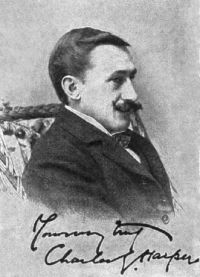 Charles G. Harper,
The Hardy Country: Literary landmarks of the Wessex Novels
Charles G. Harper,
The Hardy Country: Literary landmarks of the Wessex Novels
“ Returning to Evershot, or, as it is styled in the sources of our pilgrimage, “Evershead,” we come to Melbury Park, the seat of the Earl of Ilchester, and the principal scene of that charming story, The First Countess of Wessex, in the collection of “A Group of Noble Dames.” The great house of oddly diversified architecture, stands in the midst of this nobly wooded and strikingly varied domain, but can readily be seen, for the carriage-drive is a public right of way. ”
Charles G. Harper,
The Cambridge, Ely, and King's Lynn Road…
“ Melbourn has a beautiful church and church-tower, seen in the accompanying picture, but its other glory, the Great Elm that for many centuries spread a shade over the road by the church, is now only a memory,—a memory kept green by the sign of the inn opposite. Everyone in Melbourn lives on fruit. In other words, this is a great fruit-growing district. This village and its neighbour, Meldreth, specialise in greengages, and from the railway station that serves the two, many hundreds of tons of that fruit are despatched to London in the season. ”
 Leslie Stephen,
Dictionary of National Biography…
(1894)
Leslie Stephen,
Dictionary of National Biography…
(1894)
“ Many believed that Melville suffered more on account of his religion than of treachery to the country. John Johnston, D.D. [q. v.] , places him among his Scottish heroes (Heroes ex omni Historia Scotica lectissimi, 1603, pp. 28, 29) . Melville was twice married, first to Margaret, daughter of John Wemyss of that ilk, and secondly to Helen Napier, of the family of Merchiston, and he had a family of nine sons and three daughters. John, the eldest son of his second marriage, succeeded to the family estates; others of his sons were Robert, first lord Melville [q. v.] ”
 George Meredith,
Once a Week
(1860)
George Meredith,
Once a Week
(1860)
“ Melville, a ringleted English lady, or of Portuguese with the Countess, who likewise sipped chocolate and fingered dry toast, and was mournfully melodious. The Hon. Melville, as became a tall islander, carved beef, and ate of it, like a ruler of men. Beautiful to see was the compassionate sympathy of the Countess’s face when Rose offered her plate for a portion of the world-subjugating viand, as who should say: “Sweet child! thou knowest not yet of sorrows, thou canst ballast thy stomach with beef!” ”
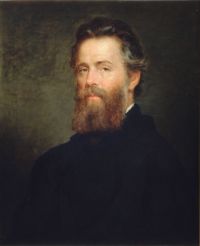 Herman Melville,
Redburn. His First Voyage — Chapter XLIV
Herman Melville,
Redburn. His First Voyage — Chapter XLIV
“ The cause of this sudden retreat, was a remarkably elegant coat and pantaloons, standing upright on the hotel steps, and containing a young buck, tapping his teeth with an ivory-headed riding-whip."Who was he, Harry?" said I."My old chum, Lord Lovely," said Harry, with a careless air, "and Heaven only knows what brings Lovely from London.""A lord?" said I starting; "then I must look at him again;" for lords are very scarce in Liverpool. ”
Herman Melville,
Pierre
(1923)
“ I knows the city; old maids lives here, and they are all to bed; rest is warehouses.' 'Will you stop the coach, or not?' cried Pierre, now incensed at his surliness in continuing to drive on. 'I obeys orders: the first house with a light; and 'cording to my reck'ning—though, to be sure, I don't know nothing of the city where I was born and bred all my life—no, I knows nothing at all about it—'cording to my reck'ning, the first light in this here street will be the watch-house of the ward—yes, there it is—all right! ”
William Morison, Andrew Melville
“ Melville continued in the Principalship of St. Mary's for upwards of a quarter of a century—from the close of 1580 to 1606, when he was summoned by the King to London, never to return to his native land.In St. Andrews and Glasgow he had not only teaching duties, he presided over the government of the University as well; and the same resolute respect for law, which set him so stoutly against the King's tyranny in the realm, made him a determined upholder [Pg 28] of order in the University. He was at once a fearless subject and a born ruler of men. ”
Herman Melville,
Redburn. His First Voyage — Chapter XLIV
“ The thing was preposterous; and I began to think, that Harry, after all, was a little bit disposed to impose upon my Yankee credulity.Luckily, my Bury blade had no acquaintance in Liverpool, where, indeed, he was as much in a foreign land, as if he were already on the shores of Lake Erie; so that he strolled about with me in perfect abandonment; reckless of the cut of my shooting-jacket; and not caring one whit who might stare at so singular a couple. ”
Herman Melville,
Pierre
(1923)
“ There is a door in Pierre's room opposite the window of Pierre: and now a soft knock is heard in that direction, accompanied by gentle words, asking whether the speaker might enter. 'Yes, always, sweet Isabel,' answered Pierre, rising and approaching the door;—'here: let us drag out the old camp-bed for a sofa; come, sit down now, my sister, and let us fancy ourselves anywhere thou wilt.' 'Then, my brother, let us fancy ourselves in realms of everlasting twilight and peace, where no bright sun shall rise, because the black night is always its follower. ”
Leslie Stephen,
Dictionary of National Biography…
(1894)
“ In May 1606 Melville was summoned along with his uncle and other ministers to a conference in September with the king in London in regard to the ecclesiastical state of Scotland. After its unsatisfactory termination, and the imprisonment of Andrew Melville in the Tower, 30 April 1607, he was on 6 May permitted to depart from London, but ordered not to proceed further north than Newcastle-on-Tyne, and to confine himself within ten miles of the town during the king's pleasure. ”
Herman Melville,
Pierre
(1923)
“ Not that he ever had Cranz, Kit, Douw, or any of them flogged—a thing unknown in that patriarchal time and country—but he would refuse to say his wonted pleasant word to them; and that was very bitter to them, for Cranz, Kit, Douw, and all of them, loved grand old Pierre, as his shepherds loved old Abraham. What decorous, lordly, gray-haired steed is this? What old Chaldean rides abroad?—'Tis grand old Pierre; who, every morning before he eats, goes out promenading with his saddle-beast; nor mounts him, without first asking leave. ”
