Professor James Moriarty
Definition and stakes
Quotes about “Professor James Moriarty”
 G. E. Moore,
Philosophical Studies
G. E. Moore,
Philosophical Studies
“ And the connection which I have suggested that he has vaguely before his mind is this: that every true idea is, at some time or other, useful, and conversely that every idea, which is ever useful, is true. And I have urged that-there are obvious objections to both these views. But now, supposing Professor James does not mean to assert either of these two things, what else can he mean to assert? What else can he mean, that would account for the interest and importance he seems to attach to his assertion of connection between truth and utility? Let us consider the alternatives. ”
G. E. Moore,
Philosophical Studies
“ Apparently, therefore, Professor James wishes to assert that all our true ideas are or can be verified—that all are useful. And certainly this is not a truism like the proposition that many of them are so. Even if this were all that he meant, it would be worth discussing. But even this, I think, is not all. The very first proposition in which he expresses his theory is the following. "True ideas," he says (p. 201) "are those that we can assimilate, validate, corroborate and verify. False ideas are those that we cannot." ”
William James, The Letters of William James, Vol…
“ He changed topics, textbooks and methods frequently, thus utilizing his own wide range of reading and interest and his own progress in philosophy, and experimenting from year to year on the mutual contacts and relations with his students." James continued to be titular Professor of Psychology until 1897, just as he had been nominally Assistant Professor of Physiology for several years during which the original and important part of his teaching was psychological. ”
William James, The Letters of William James, Vol…
“ The workman from the tack factory, like more than one other lame duck before and after him, had aroused what Professor Palmer once aptly called James's "inclination toward the under-dog and his insistence on keeping the door open for every species of human experiment." It made no difference what X——'s doctrines were, or whether or not they were akin to James's way of thinking. And if such a man was unfitted to arouse other people's sympathies, James's own were the more readily challenged. ”
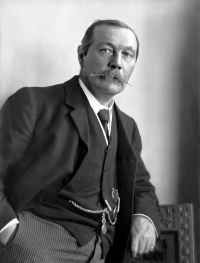 Arthur Conan Doyle,
The Memoirs of Sherlock Holmes
Arthur Conan Doyle,
The Memoirs of Sherlock Holmes
“ In three days—that is to say, on Monday next—matters will be ripe, and the Professor, with all the principal members of his gang, will be in the hands of the police. Then will come the greatest criminal trial of the century, the clearing up of over forty mysteries, and the rope for all of them; but if we move at all prematurely, you understand, they may slip out of our hands even at the last moment. “Now, if I could have done this without the knowledge of Professor Moriarty, all would have been well. ”
Obituary: Mr. G. P. Moriarty (1924)
“ Gerald Patrick Moriarty died on Saturday at his residence, 1, Mill-lane, Cambridge, after a brief illness. For the past 27 years Mr. Moriarty has been a member of Pembroke College, but he was educated at Balliol College, Oxford, and was Arnold Essayist in 1886. His chief work at Cambridge was as Director of Indian Civil Services to the Associated Colleges, and he was held in great esteem by the many I.C.S. students who have been associated with him during the past quarter of a century. ”
Arthur Conan Doyle,
The Memoirs of Sherlock Holmes
“ But I could not rest, Watson, I could not sit quiet in my chair, if I thought that such a man as Professor Moriarty were walking the streets of London unchallenged.” ”
William James, The Letters of William James, Vol…
“ The Faculty of the School then included Dr. O. W. Holmes and Professor Jeffries Wyman. Charles Ed. Brown-Séquard was lecturing on the pathology of the nervous system. During the years of James's interrupted course a number of men attended the school who were to be his friends and colleagues for many years thereafter—among them William G. Farlow, subsequently Professor of Cryptogamic Botany and a Cambridge neighbor for forty years, and Charles P. Putnam and James J. Putnam—two brothers in whose company he was later to spend many Adirondack vacations and to whom he became warmly attached. ”
 Rudyard Kipling,
The Works of Rudyard Kipling: One Volume Edition
Rudyard Kipling,
The Works of Rudyard Kipling: One Volume Edition
“ You know the saying that a man who has been alone in the jungle for more than a year is never quite sane all his life after. People credited Moriarty's queerness of manner and moody ways to the solitude, and said it showed how Government spoilt the futures of its best men. Moriarty had built himself the plinth of a very god reputation in the bridge-dam-girder line. ”
Arthur Conan Doyle,
The Valley of Fear
(1915)
“ You have heard me speak of Professor Moriarty?” “The famous scientific criminal, as famous among crooks as—” “My blushes, Watson!” Holmes murmured in a deprecating voice. “I was about to say, as he is unknown to the public.” “A touch! A distinct touch!” cried Holmes. “You are developing a certain unexpected vein of pawky humour, Watson, against which I must learn to guard myself. ”
 George A. Birmingham,
The Search Party — Chapter 23
(1912)
George A. Birmingham,
The Search Party — Chapter 23
(1912)
“ Wouldn't it be better now if you was——' 'If I was to what?' says he, catching me up like. 'If you was to send Moriarty for a bit of a stroll along the road,' I says, 'to see could he hear any news of the sergeant.' 'I'll not do it,' says he, looking terrible determined. 'I'll not do the like. What's Constable Moriarty but a boy, Jimmy? A boy with maybe a mother breaking her heart after him somewhere. If there's murder going,' says he, 'it's not Constable Moriarty it'll light on, but myself.' 'Do you mean that?' says I. 'I do,' he says ”
“ To think of it!""It didn't matter to Jim," put in Koko; "he was rather amused by the posters.""And who was the man who prevailed upon James to part with his walls in this philanthropic manner?" inquired the Doctor."A provision dealer called Harris."At that moment Koko felt a touch on his arm, and wheeled round to find old Harris himself at his elbow."Mr Somers, sir, seeing you standin' 'ere, I've come to ask after the doctor. All Mount Street wants to know 'ow 'e is. Is he like to die?""There is hope, but not much. You know yourself how badly he was knocked about." ”
Rudyard Kipling,
Plain Tales from the Hills
“ When the man—startled at anything good being laid to Mrs. Reiver's door—laughed, it cost him Moriarty's friendship. Moriarty, who is married now to a woman ten thousand times better than Mrs. Reiver—a woman who believes that there is no man on earth as good and clever as her husband—will go down to his grave vowing and protesting that Mrs. Reiver saved him from ruin in both worlds. ”
 Algernon Blackwood,
The Man Whom the Trees Loved
Algernon Blackwood,
The Man Whom the Trees Loved
“ Mortimer, the vicar, called, and brought with him a more or less distinguished doctor—as to tell the professional man privately some symptoms of her husband's queerness. And his answer that there was "nothing he could prescribe for" added not a little to her sense of unholy bewilderment. No doubt Sir James had never been "consulted" under such unorthodox conditions before. His sense of what was becoming naturally overrode his acquired instincts as a skilled instrument that might help the race. ”
George A. Birmingham,
The Search Party
“ Constable Cole returned to the kitchen grinning broadly.“It’s yourself that’s in luck this day, Moriarty,” he said. “It’s not every man that gets the chance of driving round the country on a car with the like of that one. Be careful now what you’re saying to her, or you’ll have the doctor out after you with a stick if he has to come all the way back from America for the purpose.” ”
 Samuel Lover,
Handy Andy: A Tale of Irish Life…
Samuel Lover,
Handy Andy: A Tale of Irish Life…
“ Fire, of which they know the value so well, they won't take from anybody.” “And what was the consequence?” said Moriarty. “Sir, it was the most harmless broadside ever delivered from the ports of a British frigate; not a single house or human being was injured—the day was so hot that every sentinel had sunk on the ground in utter exhaustion—the whole population were asleep; the only loss of life which occurred was that of a blue macaw, which belonged to the commandant's daughter.” ”
“ A poster, cunningly attached to Jim's wall, just where his red lamp would shine upon it after dusk, depicted the steam-roller descending a narrow hill at top speed, while directly in its track lay a young woman in evening dress, and apparently unconscious. The poster had attracted half the adult population of Mount Street to the theatre."Now I come to think of it," said the Doctor, "I remember something of this kind was visible in the photograph of the place which James sent me at Christmas. It represented a man throwing another man--or a woman, possibly a woman--out of a balloon. ”
Henry James, The Better Sort (1903)
“ They had been always of course, the Papers, very largely about him, but it was not too much to say that at this crisis they were about nothing else worth speaking of; so that our young woman could but groan in spirit at the direful example set to the emulous. She spared an occasional moment to the vision of Mortimer Marshal, saw him drunk, as she might have said, with the mere fragrance of the wine of glory, and asked herself what art Bight would now use to furnish him forth as he had promised. ”
Civilization in the United States… (1922)
“ We live after all in an open universe, the lid is off and time relentlessly operates for the production of novelties. No empiricist can give a decision until the evidence is all in, and in the nature of the case this can never happen.Such openness of interest forefends the possibility of James’ founding a school of philosophy. It also renders all his younger contemporaries in some measure his disciples. Popularly he is the refuge of the mystics and heterodox, the spiritualists and the cranks who seek the sanction of academic scholarship and certified dignity. ”
Henry James, Partial Portraits
“ We have said already, and repeated, that Du Maurier has a great deal of irony—the irony of the thorough-going artist and of the observer who has a strain of foreign blood in his veins. There are certain pretensions that such a mind can never take seriously; in the artist there is of necessity, as it appears to us, a touch of the democrat—though, perhaps, he is as unlikely to have more than a certain dose of this disposition as he is to be wholly without it. Some of his drawings seem to us to have for the public he addresses a stinging democratic meaning ”
Arthur Conan Doyle,
The Memoirs of Sherlock Holmes
“ Any attempt at recovering the bodies was absolutely hopeless, and there, deep down in that dreadful caldron of swirling water and seething foam, will lie for all time the most dangerous criminal and the foremost champion of the law of their generation. The Swiss youth was never found again, and there can be no doubt that he was one of the numerous agents whom Moriarty kept in his employ. As to the gang, it will be within the memory of the public how completely the evidence which Holmes had accumulated exposed their organization, and how heavily the hand of the dead man weighed upon them. ”
William Hazlitt, The Spirit of the Age; Or, Contemporary Portraits
“ He is a man of the world and a scholar; but the scholar gives the tone to all his other acquirements and pursuits. Sir James is by education and habit, and we were going to add, by the original turn of his mind, a college-man; and perhaps he would have passed his time most happily and respectably, had he devoted himself entirely to that kind of life. The strength of his faculties would have been best developed, his ambition would have met its proudest reward, in the accumulation and elaborate display of grave and useful knowledge. ”
George Niblo, What's your hurry? A deck full of jokers
“ Moriarty was once a pilot."Faith," says he to me, "time was when I piloted [Pg 93] all kinds of ships into harbor, but I've redooced it all down to a system, and the only sort I take over the bar now is schooners sor."But I musn't forget to tell you about my friend, old Dr. Raggles.I always refer to him as "that old war horse." You'd know why, if you cast your eye over that last bill he sent me. As a charger he'd be hard to beat.The doctor took a day off recently and ran up to a country town to see a family horse that was for sale. ”
William Hazlitt, The Spirit of the Age; Or, Contemporary Portraits
“ It is no wonder that this sort of friendly intellectual gladiatorship is Sir James's greatest pleasure, for it is his peculiar forte. He has not many equals, and scarcely any superior in it. He is too indolent for an author; too unimpassioned for an orator: but in society he is just vain enough to be pleased with immediate attention, good-humoured enough to listen with patience to others, with great coolness and self-possession, fluent, communicative, and with a manner equally free from violence and insipidity. ”
“ The father had not profited sufficiently by his studies either in law or philosophy to recognise the folly of a man in disgrace [Pg 96] venturing to measure swords with one of fortune's favourites. And Sir James at the time of his quarrel with Claverhouse was in disgrace. At the close of 1681 he had been dismissed from the office of President of the Court of Session for refusing the Test Act; and for some while previously he had been coldly regarded for his advocacy of gentler measures than suited Lauderdale and his creatures. The Dalrymples were strict Presbyterians ”
George A. Birmingham,
The Search Party
“ Goddard. “That’s part of the stratagem.”“Constable Moriarty,” said Cole, “would be talking to her pleasant and agreeable the way he’d distract her mind and him mending the tyre. It’s himself knows how to talk to a young lady.”“I do not,” said Moriarty. “She’d be laughing at me.”“She’ll not laugh,” said Mr. Goddard. “That’s one thing you may feel quite sure about. Whatever else she does, she’ll not laugh.”“I’m not fit to talk to her,” said Moriarty.“You’re not fit to mend a tyre either,” said Cole; “mind that now. ”
“ Sir Savile Smart, the renowned specialist in abdominal matters, had written to Dr Mortimer--who was an old friend of his--in high praise of Jim. But there, as ever, was the qualifying clause: "Your lad can do wonders when he likes, which isn't always." And then again Jim was given to bursts of rowdyism, accounts of which had trickled down to Threeways, where Jim was regarded as a lovable, harum-scarum youth, who would come into all the Doctor's money, "and so it would be all right." ”
“ Mr Harris shook his head."It vos Isaac drove me to it. I felt I couldn't stand that velp no longer--'e drove me to it."Mr Harris looked very bleared. He had swallowed half a pint of neat spirit, and the room seemed to be going round him."Well," said Jim, "you may thank your stars that wasn't prussic acid. When you feel better, get along home and turn into bed.""I vill, doctor, I vill," whined the old Jew; "and I'll pull up--so 'elp me, I vill.""That's right," said Jim; "now take another nap--it'll do you good." ”
 Edmund Gosse,
Aspects and Impressions
Edmund Gosse,
Aspects and Impressions
“ Morley, whom we both frequently saw at that epoch, I am pretty sure that the event took place early in 1880. The acquaintance, however, did not "ripen," as people say, until the summer of 1882, when in connexion with an article on the drawings of George Du Maurier, which I was anxious Henry James should write—having heard him express himself with high enthusiasm regarding these works of art—he invited me to go to see him and to talk over the project. ”
 Paul Leicester Ford,
The Honorable Peter Stirling and What People Thought of Him
Paul Leicester Ford,
The Honorable Peter Stirling and What People Thought of Him
“ Moriarty, and can understand why others do. He is so ugly, and so honest, and so jolly. He’s lovely.” “Then we get another grade. Usually men of a good deal of brain force, though not of necessity well educated. They influence all below them by being better informed, and by being more far-seeing. Such men as Gallagher and Dummer. They, too, are usually in politics for a living, and so can take the trouble to work for ends for which the men with other work have no time. They don’t need the great personal popularity of those I have just mentioned, but they need far more skill and brain. ”