“ And when they sawe the darksome night, They sat them downe and cryed. Thus wandered these two prettye babes, Till death did end their grief; In one another’s armes they dyed, As babes wanting relief. No burial these prettye babes Of any man receives, Till Robin-redbreast painfully Did cover them with leaves. Randolph Caldecott’s Picture Books“The humour of Randolph Caldecott’s drawings is simply irresistible, no healthy-minded man, woman, or child could look at them without laughing.”In square crown 4to, picture covers, with numerous coloured plates. ”
Quotes about “Randolph Caldecott”
Henry Blackburn, Randolph Caldecott: A Personal Memoir of His Early Art Career
“ In the old tenth-century city of Goslar, Caldecott's pencil was never at rest. Taking a guide to save time (whose portrait he gives us, with a note of a [Pg 42] curious sixteenth-century street door) he explores from morning to night, choosing as subjects always "the life of the place." Procession of the Sick. "Drinking the waters at Goslar" in 1872 was a crude effort artistically, which may be contrasted with his sketches of the same scenes at Buxton in 1876, but the humour is irresistible. An extract from our diaries is necessary here to explain the illustration. ”
Henry Blackburn, Randolph Caldecott: A Personal Memoir of His Early Art Career
“ It is clear from the above letter that Caldecott was conscious of the great change that was coming in his work in 1874. The suggestions of his friends that he should draw continually from familiar objects, and the hints he received from time to time that he "could not draw a lady," are ludicrously illustrated in two sketches to a Manchester friend who watched the progress of the artist with lively interest. ”
Henry Blackburn, Randolph Caldecott: A Personal Memoir of His Early Art Career
“ To be "on the road" was always a pleasure to Caldecott, from the "old Whitchurch days," which [Pg 171] he often described to his friends—driving home in the dark at reckless speed after a late supper, in a dog-cart full of rather uproarious company—down to 1885 at Frensham, when as host, he would drive his friends in the lanes of Surrey.At least 200 sketches must have been made in these journeys; besides jottings of heads, figures and the like, and several drawings in water colours. ”
Henry Blackburn, Randolph Caldecott: A Personal Memoir of His Early Art Career
“ Wholesome as the England he loved so well. Manly, tolerant, and patient under suffering. None of the [Pg 207] friends he made did he let go. No envy, malice, or uncharitableness spoiled him; no social flattery or fashionable success, made him forget those he had known in the early years."Speaking generally of his friend Caldecott, whom he had known intimately in later years, Mr. Locker-Lampson (to whom we are indebted for the letters and sketches on pages 191, 192, and 199) , writes:—"It seems to me that Caldecott's art was of a quality that appears about once in a century. ”
Henry Blackburn, Randolph Caldecott: A Personal Memoir of His Early Art Career
“ The next day, which Caldecott called "a rest," was devoted to visiting two farms in the neighbourhood, seeing as much as possible of the interiors of the old houses near Carhaix, with their carved bedsteads, cabinets and clocks, old brasswork and embroideries. It was a rather anxious time for his travelling companion, for there was no restraining Caldecott with such material before him, and he was overworked.It was in this district that he made one of his most successful sketches; a typical Breton (p. 177) , in ancient costume with long hair and [Pg 179] knee breeches ”
Henry Blackburn, Randolph Caldecott: A Personal Memoir of His Early Art Career
“ Many works, such as the frieze of a horse fair (p. 137) , models in terra cotta and paintings, were the outcome of the Brittany journeys in 1874 and 1878; but Caldecott did not give himself a chance to do what he wished in France; other work crowded upon him in 1878, and before he had time to finish the sketches for Breton Folk, he had to return to London to complete drawings for his Picture Books, and other work in hand for the Graphic newspaper. ”
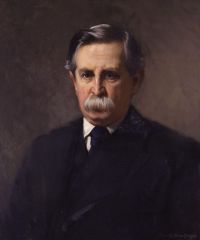 Henry Austin Dobson,
Dictionary of National Biography…
(1886)
Henry Austin Dobson,
Dictionary of National Biography…
(1886)
“ CALDECOTT, RANDOLPH (1846–1886) , artist, was born at Chester on 22 March 1846, his father being an accountant of good standing, and one of the founders of the Institute of Accountants in England. He was educated at King Henry VIII's School in his native town, where he and his two brothers were successively head-boys. Among his earliest amusements as a child had been the cutting out of animals in wood, and as a schoolboy he won a prize for drawing. ”
Henry Blackburn, Randolph Caldecott: A Personal Memoir of His Early Art Career
“ And so, in May, 1870, Caldecott, as his diary records, went to London for a few days with a letter of introduction to Mr. Thomas Armstrong from Mr. W. Slagg; and in the same year, 1870, some of his drawings were shown to Shirley Brooks, and to Mark Lemon, then editor of Punch. Mr. Clough thus records the event:—"Bearing an introductory letter he went up to London on a flying visit, carrying with him a sketch on wood and a small book of drawings of the 'Fancies of a Wedding.' He was well received. ”
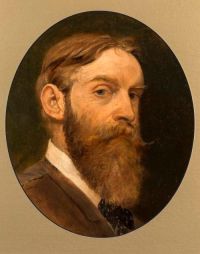 Randolph Caldecott,
The Milkmaid
Randolph Caldecott,
The Milkmaid
“ RANDOLPH CALDECOTT’S Collection of Pictures and Songs No. 1 containing the first 8 books listed above with their Colour Pictures and numerous Outline Sketches. RANDOLPH CALDECOTT’S Collection of Pictures and Songs No. 2 containing the second 8 books listed above with their Colour Pictures and numerous Outline Sketches. The Published Prices of the above Picture Books can be obtained of all Booksellers or from the Illustrated Catalogue of the Publishers. ”
Henry Blackburn, Randolph Caldecott: A Personal Memoir of His Early Art Career
“ Never, perhaps, in any book since Washington Irving's Old Christmas and Bracebridge Hall was the illustrator more in touch with the author than in North Italian Folk; but for some reason—probably because Caldecott's work and style had become identified with English people and their ways, both abroad and at home—the illustrations made little impression. The completeness of the pictures, and the local colour infused into them by the author, left little to be done ”
Henry Blackburn, Randolph Caldecott: A Personal Memoir of His Early Art Career
“ Thus, his love of sport and fondness for rural pursuits, which never forsook him, were evidenced at an early age. His artistic instincts were also early developed, and many treasured [Pg 2] sketches, models of animals, &c., cut out of wood, were produced in Chester by the boy Caldecott.Perhaps the best and most characteristic record of his early life is, that he and his brother were "two of the best boys in the school;" the genius that consists in "an infinite faculty for taking pains" having much to do with his after career of success. ”
Randolph Caldecott,
A Frog He Would A-Wooing Go
“ And gave a loud knock, and gave a loud call. With a rowley-powley, gammon and spinach, Heigho, says Anthony Rowley! "Pray, Miss MOUSEY, are you within?" Heigho, says Rowley! "Oh, yes, kind Sirs, I'm sitting to spin." ”
Henry Blackburn, Randolph Caldecott: A Personal Memoir of His Early Art Career
“ This was an opportunity for the artist. Caldecott's original sketch of this subject, if it is in existence, should be treasured; some idea of the humour of it may be gathered from the drawing overleaf which was crowded into the corner of the newspaper. He also made a highly grotesque and artistic model in terra-cotta of the Tichborne Trial, now in the possession of Mr. Stanley Baldwin of Manchester. "The New Prime Minister." ”
Henry Blackburn, Randolph Caldecott: A Personal Memoir of His Early Art Career
“ NORTH ITALIAN FOLK.It was in the same winter, during his journey in North Italy, that Caldecott made twenty-eight illustrations for a book on North Italian Folk. [9] Here Caldecott's studies, and his habit of sketching the peasantry wherever he went, served him well. Take the picture of the priest and his faithful servant Caterina; the latter, reproaching her master for bringing home a neighbour, Maddalena, "to eat two lasagne with us!" Caterina is "a gaunt threadbare-looking woman of some five-and-thirty [Pg 155] years, and the prevosto is gaunt too, and sallow; the two match well together. ”
Randolph Caldecott,
The Panjandrum Picture Book
“ Trip it, trip it to the men. Then after an hour, they went to a bower, And played for ale and cakes, And kisses too—until they were due the lasses held the stakes. The girls did then begin to quarrel with the men, And bid them take their kisses back, and give them their own again, And bid them take their kisses back and give them their own again. ”
Randolph Caldecott,
The Panjandrum Picture Book
“ And bound themselves, by kisses twelve, To meet the next Holiday. And bound themselves, by kisses twelve, To meet the next Holiday. RIDE A COCK-HORSE TO BANBURY CROSS Ride a Cock-Horse to Banbury Cross, To see a fine Lady Get on a white Horse, With rings on her fingers, and bells on her toes, She shall have music wherever she goes. ”
Randolph Caldecott,
The Panjandrum Picture Book
“ For this is a Holiday! Then every man did put his hat off to his lass, And every girl did curchy, curchy, curchy on the grass. "Begin," says Hall; "Ay, ay," says Mall, "We'll lead up Packington's pound;" ”
Randolph Caldecott,
R. Caldecott's Picture Book (No…
“ Was a gruntin', grindin' grindlestone, an' that they left behind. Look ye there! One said it was a grindlestone, another he said "Nay; It's nought but an' owd fossil cheese, that somebody's roll't away." ”
Randolph Caldecott,
The Queen of Hearts, and Sing a Song for Sixpence
“ Was not that a dainty Dish To set before the King? The King was in his counting-house, Counting out his Money. The Queen was in the Parlour, Eating Bread and Honey. The Maid was in the Garden, Hanging out the Clothes ”
William Alexander Caruthers, The Kentuckian in New-York; or…
“ How beautiful a little act sometimes appears, Randolph, when it sits upon the countenance of one so artless by nature that you can see all the machinery which she imagines is so completely hidden, as a child often hides its eyes and vainly supposes itself unseen. ”
 Andrew Lang,
The Library
(1892 (second edition))
Andrew Lang,
The Library
(1892 (second edition))
“ Nothing more genuine, more heartily laughable, than this set of designs has appeared in our day. And Mr. Caldecott has few limitations. Not only does he draw human nature admirably, but he draws animals and landscapes equally well, so one may praise him without reserve. Though not children's books, mention should here be made of his "Bracebridge Hall," and "Old Christmas," the illustrations to which are the nearest approach to that beau-ideal, perfect sympathy between the artist and the author, with which the writer is acquainted. ”
Sidney Lee, Dictionary of National Biography… (1886)
“ Caldecott died at the age of ninety, at Dartford, at the end of May 1833. He best deserves to be remembered as a book collector and Shakespearean student. He laid the foundations of his library at an early age, and at his death it was singularly rich in sixteenth-century literature. He was a regular attendant at the great book sales, and many of Farmer's, Steevens's, West's, and Pearson's books passed to him. ”
William Alexander Caruthers, The Kentuckian in New-York; or…
“ Lamar, you have seen; the other is Mr. Beverley Randolph, of Virginia—we were both class and room-mates. Randolph has gone on a journey through the Southern States, as he pretends; but, I believe, in truth, to take a sly peep at his affianced bride. If he likes her looks, it is a bargain; and if not, he will pass it all off for a college joke." Here he was interrupted by the lady gasping; and on looking in her face, he found she was as pale as marble, and terribly agitated. She asked her father for water, which he handed to her instantly, while Chevillere rang violently at the bell. ”
Henry Austin Dobson,
Dictionary of National Biography…
(1886)
“ Caldecott's genius was thoroughly English, and he delighted in portraying English country and out-of-door life. He had a keen love, dating from his Chester and Whitchurch days, for the quaint and old-fashioned in furniture and costume, and the scenes and accessories of the latter half of the eighteenth century especially attracted him. In grace and refinement he was fully the rival of Stothard, but while possessing an equal appreciation of feminine and childish beauty, he far excelled that artist in vivacious humour and sportive fancy. ”
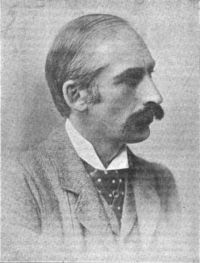 George Somes Layard,
Kate Greenaway
George Somes Layard,
Kate Greenaway
“ Kate Greenaway to Frederick Locker 24 May, 1882.I’ve been to call on the Caldecotts to-day with Mrs. Evans. My brother showed me some of his (Mr. Caldecott’s) new drawings yesterday at Racquet Court. They are so uncommonly clever. The Dish running away with the Spoon—you can’t think how much he has made of it. I wish I had such a mind. I’m feeling very low about [90] my own powers just now, for I have been looking at the originals for the new Crane book. Some of them are literally dreams of beauty. I do wish you could see them. There is one—a long low design of a Harvest Home. ”
George A. Lawrence, Barren Honour: A Novel
“ But you shall not be left to Clydesdale's tender mercies defenceless. I'll speak to Randolph to-day. He starts for England immediately, and he shall not lose sight of you till you reach it. He knows enough of your husband not to be surprised at being asked to watch over you. You may trust him as thoroughly as you could trust me. His heart is as soft as a woman's, and his nerves are steel: I have seen them tried often and hardly. Write to Dene, and go there straight from Dover. Clydesdale will have come to his senses before that, and will scarcely object. ”
 Susan Warner,
Melbourne House, Volume 2
Susan Warner,
Melbourne House, Volume 2
“ Sandford. "I do not know how the ladies can get along without some sport—ha, ha! There is a boat on the lake—isn't there?""They say so," Mr. Randolph returned. "I have not been there for a long time.""Then I shall take the charge of your entertainment, Mrs. Randolph," Mr. Sandford went on. "I shall persuade you to put yourself under my guidance, and let me initiate you into the mysteries of pickerel catching.""I do not think you can persuade me out of the shade—if once I get in it again—" said the lady."Why mamma," said Ransom, "pickerel fishing is splendid!"Mr. Randolph looked at Daisy. ”
 Harry Castlemon,
Rodney, the Overseer
Harry Castlemon,
Rodney, the Overseer
“ Uttering wild yells of approval, with which were mingled loud calls for ropes and dire threats against the peace of mind and bodily comfort of Captain Tom Randolph, the crowd made a rush for the door, and it was several minutes before Mr. Gray and the cool-headed men who sided with him could make themselves heard above the tumult."Be reasonable, gentlemen," urged the former. "Don't let your excitement lead you to do something you will be heartily ashamed of and sorry for to-morrow. You cannot touch those men in the way you suggest, especially Tom Randolph, who is a State officer. ”
 Henry Adams,
History of the United States of America…
(1889)
Henry Adams,
History of the United States of America…
(1889)
“ Although his early career had ended in the most conspicuous failure yet known in American politics, he returned to the House, with intelligence morbidly sharpened, to begin a second epoch of his life with powers and materials that gave him [110] the position of equal among men like Calhoun, Pinkney, and Webster. Randolph held a decisive advantage in wishing only to obstruct. He had no legislation to propose, and his political philosophy suited that extreme “to which,” according to Calhoun, “the people of this country are peculiarly liable.” ”
Chautauqua Institution, The Chautauquan, Vol. 04, January 1884
“ At a quarter before twelve o’clock, on the twenty-fourth day of June, 1833, aged sixty years, he breathed his last, in a chamber of the City Hotel, Philadelphia.From the very necessities of the nature of an Eccentric, John Randolph could not be in harmony with the time in which he lived. But this difference was intensified into enmity by the irritable nature of his mind and the diseased condition of his body; nay, by his very virtues and genius. To increase the enmity and his own misfortune, he threw himself with ardor upon the losing side of an irrepressible conflict in government. ”
Harry Castlemon,
Rodney, the Overseer
“ There was a good deal of pressure brought to bear upon every young man and boy in the South about that time, and those who would not put on a gray jacket or do something else to show their zeal for the cause were coldly treated and sometimes snubbed; but Tom Randolph escaped all this, and even raised himself higher in the estimation of some of the Mooreville people by procuring, through his father's influence, a captain's commission in the State militia, with authority to recruit a company of mounted men who were to act as Home Guards. ”
 Bret Harte,
Trent's Trust, and Other Stories
Bret Harte,
Trent's Trust, and Other Stories
“ The president absorbed and possessed Randolph with eyes that never seemed to leave him. Then leaning back against the counter, which he lightly grasped with both hands, he said: “We've sent to the Niantic Hotel to inquire about your man. He ordered his room by letter, giving no name. He arrived there on time last night, slept there, and has occupied the room No. 74 ever since. WE don't know him from Adam, but”—his eyes never left Randolph's—“from the description the landlord gave our clerk, you're the man himself.” For an instant Randolph flushed crimson. ”
