“ I had not expected to find an enemy in you, Zacchary. One might think you were unwilling to hold out to Master Roger a slender chance of life.'''Tis the little maid I be thinking of now,' said Zacchary abruptly. 'If so be her's taken too, what be I to say to the Admur'l? Her was left in my care in Lunnon. 'Tis a hundred to one Master Roger will go just the same, and liker than not her'll be in gaol at the end on 't.''Give her the hundredth chance. And remember, she is a quick-witted, brave woman, playing a woman's game. You are always thinking of her as a little child. ”
Quotes about “Roger Scatcherd”
 Elizabeth Cleghorn Gaskell,
Wives and Daughters
“ Poor, poor Roger! How little he thinks of all this! When I want to write words of love to him I pull myself up, for I have written words as affectionate to that other man. And if Mr. Preston ever guessed that Roger and I were engaged, he would manage to be revenged on both him and me, by giving us as much pain as he could with those unlucky letters—written when I was not sixteen, Molly,—only seven of them! They are like a mine under my feet, which may blow up any day; and down will come father and mother and all. ”
Elizabeth Cleghorn Gaskell,
Wives and Daughters
“ I expect him every day," said Roger, uneasily."Do you think your father will be very angry with him?" asked Molly, with as much timidity as if the squire's displeasure might be directed against her."I don't know," said Roger. "My mother's illness may alter him; but he didn't easily forgive us formerly. I remember once—but that is nothing to the purpose. I can't help fancying that he has put himself under some strong restraint for my mother's sake, and that he won't express much. But it doesn't follow that he will forget it. ”
 Elizabeth Gaskell,
Wives and Daughters — Chapter XXX: Old Ways And New Ways
(1865)
“ Roger let go; they were not on firm ground, and he did not wish any watchers to think that he was exercising any constraint over his father; and this quiet obedience to his impatient commands did more to soothe the squire than anything else could have effected just then. ”
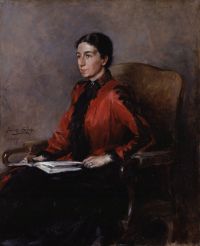 Mrs. Humphry Ward,
Marriage à la mode
“ She looked at her father again, and then, evidently perceiving that he was not to be moved by force, she changed her tactics. Her delicate, elfish face melted into the sweetest smile; she stood on tiptoe, holding out to him her tiny arms. With a laugh of irrepressible pride and pleasure, Roger stooped to her and lifted her up. She nestled on his shoulder—a small Odalisque, dark, lithe, and tawny, beside her handsome, fair-skinned father. And Roger's manner of holding and caressing her showed the passionate affection with which he regarded her. ”
Mrs. Humphry Ward,
Marriage à la mode
“ As she clung to the wall, which alone separated her from the echoing gulf beyond, she could not prevent herself from thinking of Roger, Roger as he was when Alfred Boyson introduced him to her, when they first married, and she had been blissfully happy; happy in the possession of such a god-like creature, in the envy of other women, in the belief that he was growing more and more truly attached to her. ”
Elizabeth Gaskell,
Wives and Daughters — Chapter XXVII: Father And Sons
(1865)
“ Of course the squire heard this little aside with the unlucky uncertainty of hearing which is a characteristic of the beginning of deafness; and its effect on him was perceptible in the increased acrimony of his next speech.'You young men think you know everything. I tell you it's a palpable Whig trick. And what business has Roger—if it is Roger the man wants— to go currying favour with the French? In my day we were content to hate 'em and to lick 'em. But it's just like your conceit, Osborne, setting yourself up to say it's your younger brother they're asking, and not you ”
Roger Baxter, Meditations for every day in the year … (1823)
“ As there is no hour or moment, O Lord, in which I do not enjoy your benefits, so ought there to be no moment in which you are not present before my eyes by remembrance, and in which I do not love you with all my strength. ”
Henry James, Watch and ward (1878)
“ Nora, for an instant was lost in meditation. "As regards marriage," she said at last, quietly, "I will do what Roger wishes." Fenton lost patience. "Roger be hanged!" he cried. "You are not his slave. You must choose for yourself and act for yourself. You must obey your own heart. You don't know what you are talking about. One of these days your heart will say its say. Then we shall see what becomes of Roger's wishes! If he wants to make what he pleases of you, he should have taken you younger,—or older! ”
Elizabeth Cleghorn Gaskell,
Wives and Daughters
“ With such an engrossing subject, it was, perhaps, no wonder that he unconsciously neglected his father; but it was none the less sad at the time, and to be regretted in its consequences."I may come in and have a pipe with you, sir, mayn't I?" said Roger, that first evening, pushing gently against the study-door, which his father held only half open."You'll not like it," said the squire, still holding the door against him, but speaking in a relenting tone. "The tobacco I use isn't what young men like. Better go and have a cigar with Osborne." ”
 Michael Arlen,
The Romantic Lady
“ For to him, Roger, what humiliation! To have realised within himself that he, of all the men in the world, was that strangely contemptible thing, I don't quite know why, a bad loser! To confess that realisation to me could add nothing to the humiliation, for Roger was never but first audience to his own acting, never but the main person in any gallery to which he might play! He stood or fell by himself, and if he fell, no other's judgment could count beside his own. ”
Elizabeth Gaskell,
Wives and Daughters — Chapter XXIII: Osborne Hamley Reviews His Position
(1865)
“ He's a handsome fellow now, but the sunshine has gone out of his face.''He's a good deal troubled about this money, and the anxiety he has given you,' said Roger, rather taking his brother's feelings for granted.'Not he,' said the squire, taking the pipe out of his mouth, and hitting the bowl so sharply against the hob that it broke in pieces. 'There! But never mind! I say, not he, Roger! He's none troubled about the money. It's easy getting money from Jews if you're the eldest son, and the heir. They just ask, "How old is your father, and has he had a stroke, or a fit?" ”
Henry James, Watch and ward (1878)
“ They had between them a kind of boyish levity which kept them from lingering long on delicate ground; but they felt at times that they belonged, by temperament, to irreconcilable camps, and that the more each of them came to lead his own life, the more their lives would diverge. Roger was of a loving turn of mind, and it cost him many a sigh that a certain glassy hardness of soul on his cousin's part was forever blunting the edge of his affection. He nevertheless had a deep regard for Hubert; he admired his talents, he enjoyed his society, he wrapped him about with his good-will. ”
Henry James, Watch and ward (1878)
“ Roger felt as if he were now establishing himself in society in behalf of that larger personality into which his narrow singleness was destined to expand. He was paving the way for Nora. It seemed to him that she might find it an easy way to tread. He compared her attentively with every young girl he met; many were prettier, some possessed in larger degree the air of "brightness"; but none revealed that deep-shrined natural force, lurking in the shadow of modesty like a statue in a recess, which you hardly know whether to denominate humility or pride. ”
Henry James, Watch and ward (1878)
“ In her appearance, in spite of her childish innocence and grief, there was something undeniably vulgar. "She looks as if she belonged to a circus troupe," Roger said to himself. Her face, however, though without beauty, was not without interest. Her forehead was symmetrical and her mouth expressive. Her eyes were light in color, yet by no means colorless. A sort of arrested, concentrated brightness, a soft introversion of their rays, gave them a remarkable depth. "Poor little betrayed, unfriended mortal!" thought the young man. "What is your name?" he asked. "Nora Lambert," said the child. ”
William Pitt Scargill, Tales of My Time, Vol. 1 (of 3…
“ But as time revolved, reverses occurred; two or three infant children dropped off—Colbrook was left without an heir—and a chronic rheumatism succeeded, which called for more temper, resignation, and resource of mind than poor Sir Roger possessed to meet the demand. His decline of life, therefore, exhibited the sorry picture of a nervous, growling old man, who revenged every cloud in the sky which produced a sharper twinge, on every body who came in his way. His temper was graduated like the barometer, and rose or fell with the elasticity of the atmosphere. ”
Henry James, Watch and ward (1878)
“ Lucinda therefore was gracious. For Roger it seemed as if life had begun afresh and the world had put on a new face. High above the level horizon now, clearly defined against the empty sky, rose this small commanding figure, with the added magnitude that objects acquire in this position. She gave him a great deal to think about. The child a man begets and rears weaves its existence insensibly into the tissue of his life, so that he becomes trained by fine degrees to the paternal office. But Roger had to skip experience, and spring with a bound into the paternal consciousness. ”
Roger L'Estrange, Fables of Æsop and Other Eminent Mythologists… (1692)
“ And why should not All the Works of the Creation Expostulate at the same Rate, and upon the same Grounds? Why has not Man the Wings of an Eagle to carry him from Danger, or to satissie his Curiosity what the World's a doing? ”
Elizabeth Gaskell,
Wives and Daughters — Chapter XXVII: Father And Sons
(1865)
“ There was little enough relief in the daily life at the Hall to help them all to shake off the gloom; and it even told on the health of both the squire and Osborne. The squire became thinner, his skin as well as his clothes began to hang loose about him, and the freshness of his colour turned to red streaks, till his cheeks looked like Eardiston pippins, instead of resembling 'a Katherine pear on the side that's next the sun.' Roger thought that his father sate indoors and smoked in his study more than was good for him, but it had become difficult to get him far afield ”
Henry James, Watch and ward (1878)
“ Roger was a practical man; as he went he gathered facts and noted manners and customs; but the muse of observation for him was the little girl at home, the ripening companion of his own ripe years. It was for her sake that he collected impressions and laid up treasure. He had determined that she should be a lovely woman and a perfect wife; but to be worthy of such a woman as his fancy foreshadowed, he himself had much to learn. To be a good husband, one must first be a wise man; to educate her, he should first educate himself. ”
Henry James, Watch and ward (1878)
“ Some people think me a clergyman, Nora," he said, lowering his voice with a hint of mock humility. "But do you know you are formidable, with your fierce friendships and your jealous suspicions? If you doubt of me, well and good. Let me walk like an Homeric god in a cloud; without my cloud, I should be sadly ungodlike. Indeed, for that matter, I doubt of myself. But I don't really undervalue Roger. I love him, I admire him, I envy him. I would give the world to be able to exchange my restless imagination for his silent, sturdy usefulness. ”
Henry James, Watch and ward (1878)
“ Roger had never seen anything so tragic as the two long harsh lines which descended from his nose, beside his mouth, in seeming mockery of his foppish, relaxed mustache. Lawrence felt that his companion was going to address him; he began to draw off his gloves. The stranger suddenly came towards him, stopped a moment, eyed him again with insolent intensity, and then seated himself on the sofa beside him. His first movement was to seize the young man's arm. "He is simply crazy!" thought Lawrence. Roger was now able to appreciate the pathetic disrepair of his appearance. ”
Roger L'Estrange, Fables of Æsop and Other Eminent Mythologists… (1692)
“ Our Own Lot is Best, and by Aiming at what we have Not, and what is Impossible to be had, we lose what we have already. No Man goes out of Himself but to his Loss. Imitation is Servile, let it be Where, How, and What it will. Nature Points out to us which way Every Man’s Talent and Genius lies ”
Elizabeth Gaskell,
Wives and Daughters — Chapter XXXIII: Brightening Prospects
(1865)
“ Mason told me the tutor said that only half of Roger's success was owing to his mental powers; the other half was owing to his perfect health, which enabled him to work harder and more continuously than most men without suffering. He said that in all his experience he had never known any one with an equal capacity for mental labour; and that he could come again with a fresh appetite to his studies after shorter intervals of rest than most. ”
“ Then, uncomfortable fact, Roger had grown up. Each time he had come back from Blundell's he had been different: rougher, noisier, not knowing what to do with his strength that was coming on him, given to saying and doing awkward things; with a loudly voiced scorn for girls (in Elise's presence) that disappeared when the two were together; for Marion was Marion, and, like his mother (and no other) set apart in his boyish thoughts.And all through his growing youth, toughening every year just as an ivy stem toughens and becomes a tree trunk, ran that one desire to be a sailor. ”
 Mary Jane Holmes,
Millbank;
(1872)
“ Walter Scott was uncertain what to do. She had never dreamed that Roger might fancy Magdalen, he was so much older and seemed to care so little for women; but she was sure now that he did, and the hundred thousand dollars she had looked upon as eventually sure seemed to be fading from her grasp. There were wrinkles in her forehead when she left the breakfast table, and her face wore a kind of abstracted look, as if she were intently studying some new device or plan. ”
Roger L'Estrange, Fables of Æsop and Other Eminent Mythologists… (1692)
“ An Ape, with a tayl, would be as scandalous, as a Fox without One. Why should not Any One Creature Envy the Whole, as well as any One Part of Another? And why should not an Ape be as much Troubled that he has no Wings, as that he has no Tayle? ”
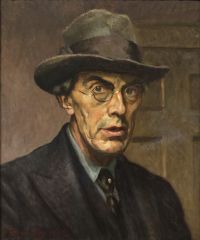
“ He regards the artist as a strange species, half idiot, half divine, but above all irresponsibly and irredeemably himself. He seems equally strange in his outrageous egoism and his superb devotion to an idea. ”
Roger L'Estrange, Fables of Æsop and Other Eminent Mythologists… (1692)
“ I speak of a Disparity of Years, which, in the Moral, takes in all Other Disproportions. The One’s too Young, T’other too Old; to shew us that Marriage is out of Season if it does not Hit the very Critical Point betwixt them. ”
Roger Baxter, Meditations for every day in the year … (1823)
“ How pleased was the heavenly Father at this new sight; "When He introduceth the first-begotten into the world, He saith: And let all the angels of God adore Him." (Heb. i. 6.) Imagine you see the angels of heaven falling prostrate in adoration, saying, "Holy, holy, holy. Lord God of sabaoth, the heavens and the earth are full of the majesty of Thy glory." Rejoice, and adore your new-born Saviour. ”
Roger L'Estrange, Fables of Æsop and Other Eminent Mythologists… (1692)
“ Am not I the Creature of an Almighty Power; and is it not the Same Power and Wisdom that Made and Order'd The World, that has Assign’d me this Place, Rank or Station in’t? This Body, This Soul, This every Thing? What I am, I must be, and there’s no Contending with Invincible Necessity ”
Charles Roger, The Rise of Canada, from Barbarism to Wealth and Civilisation…
“ Indeed the Americans did very quietly send one or two cruisers and privateers to dodge about that marine paradise, the Thousand Islands, forming the delta of Lake Ontario, and covered to this day with timber to the water's edge, islands of all sizes and of all forms, gently rising out of the limpid rippling stream, or boldly standing forth from the deep blue water, presenting a rugged, rocky moss-clad front to the wonderstruck beholder. ”
Roger Baxter, Meditations for every day in the year … (1823)
“ The haste with which the Jews were commanded to eat the paschal lamb prefigured the hasty fury of His persecutors. The bitter wild lettuce represented the gall to His mind, and the bitter chalice of His passion, which He had to drink to the very dregs. Great must have been His love for mankind, when, with all these presentiments and feelings, He could still persevere in hastening to commence His passion! ”

