Seville orange

Definition and stakes

Aubrey F. G. Bell,  The Magic of Spain

“ Seville is lovely in winter, when the sky is a cold, serene blue, and night by night{133} the stars glint and glitter; lovely in spring, when everywhere, in roof and patio and garden, is a triumph of green, when the oranges still hang on the orange-trees in flower—like yellow crocuses peering from the snow—and the corn is already high in the olives beyond the river ”
Source: Gutenberg

Friedrich A. Flückiger,  Pharmacographia (1879)

“ Description—The Bitter Orange known in London as the Seville Orange is a globular fruit, resembling in size, form, and structure the common Sweet Orange, but having the peel much rougher, and when mature of a somewhat deeper hue. The pulp of the fruit is filled with an acid bitter juice. The ripe fruit is imported into London; the peel is removed from it with a sharp knife in one long spiral strip, and quickly dried, or it is sold in the fresh state. It is the more esteemed when cut thin, so as to include as little as possible of the white inner layer. ”
Source: Gutenberg

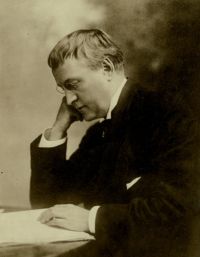
Portrait of Albert Frederick Calvert Albert Frederick Calvert,  Seville: an historical and descriptive account of "the pearl of Andalusia"

“ SEVILLE Seville is the most Spanish of the cities of Spain. On her white walls the sunlight plays perpetually, the air is laden with the scent of the orange, the sound of the guitar and castanets is heard continually in the narrow streets. This is the South of romance, the South of which northerners dream and towards which so many of them are drawn by an irresistible fascination. The cities of Leon and Castile are grim and Gothic. Cordova is Moorish ”
Source: Gutenberg

Get perspective with Kwize: daily news enlightened by great literature