Sraddha

Definition and stakes

The Mahabharata of Krishna-Dwaipayana Vyasa…

“ By performing the Sraddha on the twelfth day one always beholds, if one desires, diverse kinds of beautiful articles made of silver and gold. By performing the Sraddha on the thirteenth day one attains to eminence over one's kinsmen. Without doubt, all the young men in the family of him who performs the Sraddha on the fourteenth day meet with death. Such a man becomes entangled in war. By performing the Sraddha on the day of the new moon, one obtains the fruition of every wish. ”
Source: Gutenberg

William Crooke,  The Popular Religion and Folk-Lore of Northern India…

“ We have seen that the Drâvidians also regard the rite as merely domestic and to be performed by the house-master.
The orthodox Hindu, besides the usual Srâddha, in connection with his daily worship, offers the Tarpana or water oblation to the sainted dead. The object of the annual Srâddha is, as is well known, to accelerate the [181] progress (gati) of the soul through the various stages of bliss, known as Sâlokya, Sâmîpya and Sârûpya, and by its performance at Gaya the wearied soul passes into Vaikuntha, or the paradise of Vishnu.
”
Source: Gutenberg

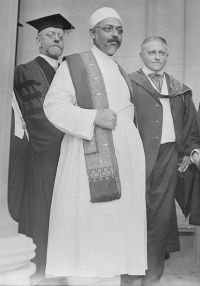
Portrait of F. Max Müller F. Max Müller,  India: What can it teach us?

“ It seems therefore a word of a more modern origin. There is a passage in Âpastamba's Dharma-sûtras which betrays, on the part of the author, a consciousness of the more modern origin of the Srâddhas: [306]
"Formerly men and gods lived together in this world. Then the gods in reward of their sacrifices went to heaven, but men were left behind. Those men who perform sacrifices in the same manner as the gods did, dwelt (after death) with the gods and Brahman in heaven. Now (seeing men left behind) Manu revealed [255] this ceremony which is designated by the word Srâddha."
”
Source: Gutenberg

Get perspective with Kwize: daily news enlightened by great literature