“ If a man cannot move freely, he cannot fight. If a horse cannot move, what use is his rider? If the artillery-man cannot serve [80] the gun freely and the gun is immovable, field artillery is useless. Therefore, if gas becomes a standard weapon, we are left with the tank and the aeroplane as the sole effective arms for offensive action. Only as the static defenders of the fortified bases—the land-ports—of tanks and aircraft will there be a future for infantry and artillery, the former armed with super-heavy armour-piercing machine-guns, and the latter with anti-tank and anti-aircraft guns. ”
Anti-aircraft artillery
Definition and stakes
Quotes about “anti-aircraft artillery”
Frederick Arthur Ambrose Talbot, Aeroplanes and Dirigibles of War
“ In addition to the natural accidents to which the strategical aerial observer is exposed, the dangers arising from hostile gun-fire must not be overlooked. He is manoeuvring the whole time over the enemy's firing zone, where anti-aircraft weapons are disposed strategically, and where every effort is made by artillery to bring him down, or compel him to repair to such a height as to render observation with any degree of accuracy well-nigh impossible. ”
Elmer Haslett, Luck on the Wing: Thirteen Stories of a Sky Spy
“ Imparting this information to Davis, he turned the machine and we started back toward the line to call our batteries and start the fatal ball rolling.A favorite trick of the Hun’s anti-aircraft artillery, and our own, as far as that is concerned, is to allow the entrance of observation planes to a considerable depth within the lines without molesting them, closely following it all the time with finely adjusted sights, and just as the plane turns to go back toward the lines the artillery opens up with everything available. ”
René-Louis-Jules Radiguet, The Making of a Modern Army and its Operations in the Field
“ Field artillery has a capital part to play in the repulse of these attacks, which are usually broken up by the rapidity and power of the barrages. The guns of 75 mm. are assisted by the groups of 105 and by the destruction groups of 155, and also by counter-battery or neutralization fire from the heavy artillery, according to the necessities of the moment.4. Anti-aircraft artillery. Airplanes are the most reliable and effective weapons against airplanes and Zeppelins, but it is impossible to command at all times a sufficient number of machines to prevent the enemy’s incursions. ”
Frederick Arthur Ambrose Talbot, Aeroplanes and Dirigibles of War
“ In this trying field of artillery research the prominent German armament manufacturers, Krupp of Essen and Ehrhardt of Dusseldorf, played a leading part, the result being that before the airship or the aeroplane was received within the military fold, the anti-aircraft gun had been brought into the field of applied science. ”
Frederick Arthur Ambrose Talbot, Aeroplanes and Dirigibles of War
“ Picking up the range is still as difficult as ever. The practice followed by the Germans serves to indicate the Teuton thoroughness of method in attacking such problems even if success does not ensue. The favourite German principle of disposing anti-aircraft artillery is to divide the territory to be protected into equilateral triangles, the sides of which have a length of about six miles or less, according to the maximum effective range of the pieces at an elevation of 23 1/2 degrees. ”
Frederick Arthur Ambrose Talbot, Aeroplanes and Dirigibles of War
“ In the early days of the war the German anti-aircraft artillerymen proved sadly deficient in this work, but practice improved their fire to a marvellous degree, with the result that at the moment it is dangerous for an aviator to essay his task within an altitude of 6,000 feet, which is the range of the average anti-aircraft gun. ”
“ None of the offices of the aeroplane proved more valuable than that of giving the range of enemy positions to one's own artillery, and then registering the shots, marking where they fell too short, or overpassed the mark. This is one of the most dangerous as well as the most useful of the services rendered by the man-bird. It requires great nerve, judgment, and coolness on the part of the aviator, for he must hang over the enemy trenches and expose himself to the fire of their anti-aircraft guns, the efficacity of which made rapid strides as the war progressed. ”
Willis J. Abbot,
Aircraft and Submarines
“ They have a driver, who is a pilot, like ourselves; then they have an artillery officer on board, whose sole duty it is to send back word, mostly by Marconi, to his battery where the shots are landing. He will say: "Too far," "Too short," "Right," or "Left," and he stays there over this battery until the work done by the French guns has been absolutely controlled, and above him he has some of these battle planes keeping him from being attacked from above by German airmen. Of course, they may be shot at by anti-aircraft guns, which you can not help. That is artillery regulating. ”
Richard M. Russell, The 151st Field Artillery Brigade (1919)
“ It grows louder. It is the engines of the enemy’s planes. Suddenly Hell is torn loose. The anti-aircraft guns or Archies, as the British call them, have opened fire from the ground. The planes return the compliment with bombs and machine guns. A boiler factory in your head would not be nearly so bad for your ears as the cracking and shrieking that takes place. As suddenly as it [30] started it ceases. All is quiet. We go about our duties or sleep, as the case may be, until the next raid occurs. ”
Ian Hamilton, Gallipoli Diary, Volume 2
“ Up to 24th August no anti-aircraft guns had been provided, but specially constructed emplacements had been made for 18-prs. to be used against aircraft, and though never successful in bringing down an enemy 'plane they certainly made good enough shooting to cause enemy aviators to treat them with respect. ”
Philip Dana Orcutt, The White Road of Mystery: The Note-Book of an American Ambulancier
“ The practical value of the anti-aircraft guns is to keep the machines so high in the air that they can accomplish little, as the guns rarely score. At M——, where every day they have been shooting two or three hundred rounds at the machines which fly over the city, they are quite proud of their record, for once in one day they shot down three machines—two of their own and one German. They have been resting on their laurels ever since. It was a few examples like this which taught the French airmen to keep out of the sky while the contre-avions were busy. ”
Willis J. Abbot,
Aircraft and Submarines
“ The aviator makes quick turns—zigzags—employs every artifice to defeat the aim of his enemy below. Small wonder that in the majority of cases they have been successful. The attitude of the airmen toward the "Archies" is one of calm contempt.The German mind being distinctly scientific invented early in the war a method of fixing the range and position (p. 146) of an enemy airplane which would be most effective if the target were not continually in erratic motion. The method was to arrange anti-aircraft guns in a triangle, all in telephonic connection with a central observer. ”
Frederick Arthur Ambrose Talbot, Aeroplanes and Dirigibles of War
“ While the anti-aircraft gun represents the only force which has been brought to the practical stage for repelling aerial attack, and incidentally is the sole offensive weapon which has established its effectiveness, many other schemes have been devised and suggested to consummate these ends. ”
Willis J. Abbot,
Aircraft and Submarines
“ Sometimes science wins, often enough for the Germans to cling to the system. But more often the shrewd aviator defeats science by his swift and eccentric changes of his line of flight.At the beginning of the war Germany was very much better equipped with anti-aircraft guns than any of her enemies. This was due to the remarkable foresight of the great munition makers, Krupp and Ehrhardt, who began experimenting with anti-aircraft guns before the aircraft themselves were much more than experiments. The problem was no easy one. ”
Willis J. Abbot,
Aircraft and Submarines
“ It is impossible, because of the long range, for modern guns to fire without the help of airplanes. The accuracy of artillery fire depends entirely on its being directed by an airplane."This was clearly illustrated during the battle of the Somme in 1916. The French at that time had concentrated such a large number of fighting machines that no German machine was allowed to fly over the lines. On the other hand, the Allies' reconnaissance machines were so numerous that each French battery could have its fire directed by an airplane. ”
W. Lockwood Marsh, A History of Aeronautics
“ The air currents set up by the leading machines were thus avoided by those in the rear, while each pilot had a good view of the leader's bombs, and were able to correct their own aim by the bursts, while the different heights at which they flew rendered anti-aircraft gun practice less effective. Further, machines were able to afford mutual protection to each other and any attacker would be met by machine-gun fire from three or four machines firing on him from different angles and heights. ”
Eric Fisher Wood,
The Note-Book of an Attaché: Seven Months in the War Zone
“ Moreover, there are usually two officers in an aëroplane and the systems of double control enable the aëroplane to return to its base even if one of them is killed outright.Anti-aircraft guns are not greatly feared by aviators, and they consider it merely an extraordinary piece of bad luck to be hit by one. The aviators fear most of all the fire of large bodies of infantry, and in flying over a regiment at an altitude of 1000 yards they realize that they run serious risk of being brought down. ”
Field artillery materiel (1920)
“ The field artillery employs machine guns and automatic rifles only defensively, either against hostile aircraft, or against enemy infantry in case of a break-through. For this reason the tactical use of these weapons by the artillery is considerably different from that by the infantry, and the dispositions that must be made are adapted to particular needs. ”
Reginald Grant, S.O.S. Stand to!
“ When the descent had commenced two of the crew had taken to their parachutes and got away safely.Anti-aircraft guns now opened up on it from our lines in an endeavor to destroy it and prevent it getting into the hands of the enemy, and German airplanes and anti-aircraft guns were also firing at it, so that it was a target for all concerned. This, perhaps, is about the only incident in the entire war to date where both the British and the Germans were equally bent upon the destruction of a common object. ”
Kenneth Ward, The Boy Volunteers with the British Artillery
“ The guns were constantly booming, and sometimes there would be a rattle, as though salvos of machine guns were brought into action. Anti-airship guns were always flashing, and high in the air white and gray puff balls would announce the explosion of shells, trying to feel out the positions of the airships. ”
Thomas W. Corbin, The Romance of War Inventions
“ Now we see men flying every day and there is scarcely anyone who has not had a friend or relative in the Flying Corps.Recent experience, too, has shown that this one invention has revolutionized warfare in several important departments, particularly in the use of very heavy long-range artillery. Huge guns, hidden in a hollow or behind a hill, have been set to throw shells on to an unseen target, while a man in an aeroplane above watches the result and signals back by wireless. Thus by the aid of aircraft the power of artillery has been immensely increased. ”
H. D. Trounce, Fighting the Boche Underground
“ When flying too low they would sometimes be hit by the "archies," or anti-aircraft guns. Sometimes their gasolene-tanks would be hit, and they would then burst into flames, turn over, and fall apparently helplessly for some distance, but in the majority of cases would even then make a safe landing. Other times the enemy planes would come low enough to let us get a shot at them with our rifles and Lewis guns, and we would blaze away, but seldom recorded a hit. All aviators, however, agree that they are not much disturbed by the archies, but strongly dislike machine-gun fire. ”
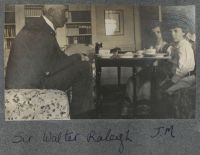
Sir Walter Alexander Raleigh,
The War in the Air; Vol. 1
“ Nothing prevents them from obtaining the required information, and they frequently return with rifle or shrapnel bullets through their aeroplane or even their clothing, without considering such, to them, ordinary incidents as worth mentioning. To-day I watched for a long time an aeroplane observing for the six-inch howitzers for the Third Division. It was, at times, smothered with hostile anti-aircraft guns, but, nothing daunted, it continued for hours through a wireless installation to observe the fire and indeed to control the Battery with most satisfactory results. ”
Willis J. Abbot,
Aircraft and Submarines
“ While as scouts, range finders, guides for the artillery, they exerted some influence on the course of the war, as a fighting arm in its earlier years, they were without efficiency. The bombing forays were harassing but little more, because the craft engaged were of too small capacity to carry enough bombs to work really serious damage, while the ever increasing range of the "Archies" compels the airmen to deliver their fire from so great a height as to make accurate aim impossible. ”
James Alexander Kilpatrick, Tommy Atkins at War: As Told in His Own Letters
“ Evidently the anti-aircraft guns, though rather terrifying, do very little damage. Airmen have had shells burst all round them for a long time without being hurt. Of course they are careful to fly at a high altitude. When struck by shrapnel, however, an aeroplane (one witness says) "just crumples up like a broken egg." On the other hand, bombs dropped from aeroplanes do great damage, if properly directed. A petrol bomb was dropped by an English airman at night into a German bivouac with alarming results, and another thrown at a cavalry column struck an ammunition wagon and killed fifteen men. ”
Laurence Yard Smith, The Romance of Aircraft
“ Of course the observation balloon at the front has to be carefully protected, for it furnishes a good target for the bombs from enemy aircraft. Every kite balloon has its detachment of defending airplanes, which circle round it in wide circles, on the lookout for approaching bombing planes of the enemy. Anti-aircraft guns also stand guard against the danger. Nevertheless the observer's life is a perilous one, the more so because he is a fixed target, unable to shift his position. ”
Various, The Atlantic Monthly, Volume 09…
“ In a close conflict so unwieldy a weapon as the telescope-rifle is of course useless, and its owner must depend upon his side-arms for defence. The same is true of artillery, and, as we said before, these riflemen are to be considered and used in service as light artillery,—requiring a sufficient support to enable them to withdraw from close action, but operating with deadly effect upon individual enemies at a distance at which cannon are serviceable only against masses, and, for the most part, require a series of trials to get the range, which may be constantly shifting. ”
Eric Stuart Bruce, Aircraft in war (1914)
“ As an illustration, there is nothing to-day to prevent a long-range battery, well served by its aëroplanes, from effectively shelling an enemy without knowing in the least the character of its objective—i.e., whether an infantry force or position, a body of cavalry, or the enemy’s guns. In the present war the aëroplane appears to have been utilised by the German army, as a matter of regular routine, as an auxiliary to the artillery in the manner indicated. ”
Earl of Ypres John Denton Pinkstone French, 1914
“ The modern rifle and machine gun add tenfold to the relative power of the defence as against the attack. This precludes the use of the old methods of attack, and has driven the attack to seek covered entrenchments after every forward rush of at most a few hundred yards.It has thus become a practical operation to place the heaviest artillery in position close behind the infantry fighting line, not only owing to the mobility afforded by motor traction but also because the old dread of losing the guns before they could be got away no longer exists. ”
Various, Encyclopaedia Britannica, 11th Edition…
“ Massed guns with modern shrapnel would, if allowed to play freely upon the attack, infallibly stop, and probably annihilate, the troops making it. The task of the guns, then, is to destroy the opposing guns and artillerymen, a task which will engage almost all the resources of the assailant’s artillery in the struggle for artillery superiority. ”