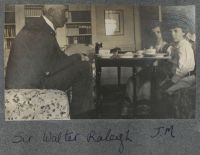
Sir Walter Alexander Raleigh

Sir Walter Alexander Raleigh

Summary

Portrait of Sir Walter Alexander Raleigh Sir Walter Alexander Raleigh The War in the Air; Vol. 1

If they desire intensity and gravity, let them follow the pilot out on to the aerodrome, and watch his face in its hood, when the chocks are pulled away, and he opens the throttle of the engine. No Greek sculpture is finer in its rendering of life and purpose. To see him at his best they would have to accompany him, through the storm of the anti-aircraft guns, into those fields of air where every moment brings some new trial of the quickness of his brain and the steadiness of his nerve.
Source: Gutenberg

Portrait of Sir Walter Alexander Raleigh Sir Walter Alexander Raleigh The War in the Air; Vol. 1

Off the coast of Cornwall or over the rivers of West Africa, in raids on German cities or in expeditions to assist beleaguered Allies, the Naval Air Service were incessantly active on the fringe of things. They were sailors and adventurers by tradition; they adapted themselves to circumstance, and made the best of what they found. Their courage put new heart into desperate men, and their humanity (the greatest tradition of the British navy) added lustre to their courage.
Source: Gutenberg

Portrait of Sir Walter Alexander Raleigh Sir Walter Alexander Raleigh The War in the Air; Vol. 1

One service cannot be judged by the standards of another service. A soldier who knows nothing of the sea might easily mistake naval discipline for lack of discipline. A like mistake has often been made by those who are brought into casual relations with the air force. But the temper of the air force is a new and wonderful thing, born of the duties and dangers which war in the air has brought with it. To preserve that temper as a national inheritance is the dearest wish of those who covet for the air force a place beside the navy and the army.
Source: Gutenberg

Get perspective with Kwize: daily news enlightened by great literature