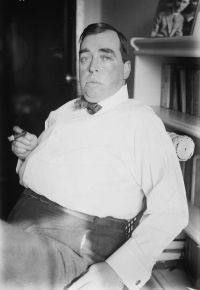
“ Knowing from your own lips that you want a shave and that's positively all, he nevertheless is instantly filled with a burning desire to equip you with a large number of other things. In this regard the barbering profession has much in common with the haberdashering or gents'-furnishing profession as practiced in our larger cities. ”
Quotes about “barbering”
Our Changing Morality: A Symposium (1924)
“ They curled their hair, even their beards, wore gold ornaments, diligently brushed their teeth and polished their finger-nails. “They arrange their hair so tenderly,” he writes, “that when walking they never touch one another, in order not to disturb it.” It is usual in states where women are dominant for the men to wear long hair and pay particular attention to their barbering. ”
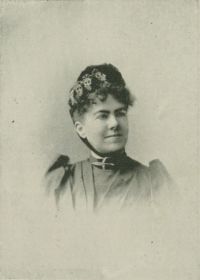 E. E. Brown,
Wonder Stories of Travel
E. E. Brown,
Wonder Stories of Travel
“ Of course there are a great many barbers, and, with all the millions of people in China, they have a large business. [135] Besides the shops, many barbers have little movable stands containing all their tools, and they may often be seen plying their art by the wayside, or at the houses of their customers. The barber has a basin of hot water, a towel, and an awkward kind of razor; and when he has shaven and washed the head, and braided the hair of a man, he ends up all by patting him, with both hands, upon the back and shoulders, in a way which, to him, is truly delightful. ”
William Andrews, At the Sign of the Barber's Pole…
“ At this period, indeed, the barber-surgeon was a man of considerable importance. His shop was the gathering-place of idle gallants, who came to have their sword-wounds dressed after street frays. The gittern, or guitar, lay on the counter, and this was played by a customer to pass away the time until his turn came to have his hair trimmed, his beard starched, his mustachios curled, and his love-locks tied up. We give a picture of a barber's shop at this period; the place appears more like a museum than an establishment for conducting business. ”
George Bryan, Chelsea, in the Olden & Present Times
“ The particularity of this man put me into a deep thought, whence it should proceed that, of all the lower order, barbers should go further in hitting the ridiculous than any other set of men: watermen brawl, cobblers sing; but why must a barber be for ever a politician, a musician, an anatomist, a poet, and a physician. The learned Vossius says, his barber used to comb his hair in iambics; and indeed in all ages, one of this useful profession, this order of cosmetic philosophers, has been celebrated by the most eminent hands. ”
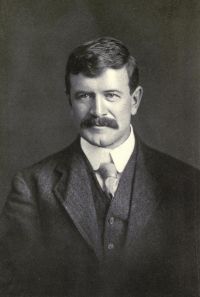 Stephen Leacock,
Literary Lapses — Men Who Have Shaved Me
(1910)
Stephen Leacock,
Literary Lapses — Men Who Have Shaved Me
(1910)
“ A barber is by nature and inclination a sport. He can tell you at what exact hour the ball game of the day is to begin, can foretell its issue without losing a stroke of the razor, and can explain the points of inferiority of all the players, as compared with better men that he has personally seen elsewhere, with the nicety of a professional. He can do all this, and then stuff the customer's mouth with a soap-brush, and leave him while he goes to the other end of the shop to make a side bet with one of the other barbers on the outcome of the Autumn Handicap. ”
H. F. Waring, Once a Week (1860)
“ Now, an apron had invariably been associated with my idea of a barber. A most faultless moustache, exquisite whiskers, and beard of the first fashion, adorned this Adonis, and the rings which sparkled on his fingers suggested the possible bells which may have tinkled on his toes. Look whichever way I might, the repetition of his figure in the many mirrors by which I was surrounded gave the impression that I sat amidst a host of fashionable barbers, or elegant Adonises, each of them flourishing and sharpening the brightest of all conceivably bright razors. ”
Francis Bradley Bradley-Birt, Bengal Fairy Tales (1920)
“ A human life was going to be terminated by a swift stroke inflicted by the razor, and so it was necessary to sharpen it with peculiar attention. The barber, on standing in front of the king, put a few drops of water to his razor and began rubbing it against the hone, as barbers invariably do before shaving. The act reminded the king of the Brahmin's sloka, and he said, "You see, barber, that what the Brahmin said the other day may be fitly said by me also on the present occasion. ”
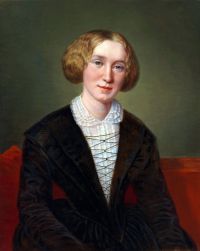
“ But now all is ready for your initiation into the mysteries of the razor.” “Mysteries they may well be called,” continued the barber, with rising spirits at the prospect of a long monologue, as he imprisoned the young Greek in the shroud-like shaving-cloth; “mysteries of Minerva and the Graces. I get the flower of men’s thoughts, because I seize them in the first moment after shaving. (Ah! you wince a little at the lather: it tickles the outlying limits of the nose, I admit.) And that is what makes the peculiar fitness of a barber’s shop to become a resort of wit and learning. ”
Anonymous, Trichocosmos: Notes historical… (1890)
“ One is as much astonished at the size of the combs, scissors, and razors of the ancient barbers as at the giant arms and armour worn by the knights of old. What ponderous blades these artists wielded it is fearful to contemplate. There is an old joke that some barber advertised shaving by the acre, and cutting blocks with a razor one would think not impossible with such weapons. Actius’ razor, which was of the keenest, must have been after this fashion. ”
 Jonathan Swift,
Gulliver's Travels
(1726)
Jonathan Swift,
Gulliver's Travels
(1726)
“ I used to attend the king’s levee once or twice a week, and had often seen him under the barber’s hand, which indeed was at first very terrible to behold; for the razor was almost twice as long as an ordinary scythe. His majesty, according to the custom of the country, was only shaved twice a-week. I once prevailed on the barber to give me some of the suds or lather, out of which I picked forty or fifty of the strongest stumps of hair. ”
 Susanna Moodie,
The Monctons: A Novel. Volume 2…
Susanna Moodie,
The Monctons: A Novel. Volume 2…
“ Come, barber, repeat your verses, and hear what the gemman says of them." "With all my heart;" and flinging his shoulders back and stretching forth his right arm, the barber repeated, in a loud theatrical tone— "I, William, Sheldrake, shave for a penny,Ladies and gentlemen—there can't come too many—With heads and beards—I meant to sayThose who've got none may keep away." A hearty burst of laughter from us all greatly disconcerted the barber, who looked as ruefully at us as a stuck pig. "You hairy monster!" quoth Mrs. Archer, "what do you mean by shaving the ladies? ”
John Anderton Naylor, From John O'Groats to Land's End
“ We have heard it said that every man's hair has a stronger growth on one side of his head than the other, but whether this barber left more hair on the strong side or not we did not know. In any case, the difference between the two sides, both of hair and beard, after the barber's operation was very noticeable. The only sublime thing about the shop was the barber himself, and possibly he thought of himself when speaking of its sublimity. He was a well-known character in Wick, and if his lot had been cast in a more expansive neighbourhood he might have filled a much higher position. ”
 Andrew Lang,
The Red Fairy Book
(1890)
Andrew Lang,
The Red Fairy Book
(1890)
“ The barber, determined not to lose his razor, pursued the man, and they both continued running at full speed till they had got well out of the town, when all of a sudden the man fell head foremost down a precipice, and never was seen again. So he too, like the others, had been forced against his will to follow the voice that called him. The barber, who went home whistling and congratulating himself on the escape he had made, described what had happened, and it was noised abroad in the country that the people who had gone away, and had never returned, had all fallen into that pit ”
H. F. Waring, Once a Week (1860)
“ What is the use of your persisting in shaving yourself, ill and nervous as you are? While there are hundreds of barbers in this great town; fifty I dare say in the next street! Now do, there’s a sensible man, dress quickly—never mind your beard—go and get shaved at the nearest barber’s, and depend on it you’ll find it quite a treat to be shaved;” adding, sotto voce, as I left the room, “since you will not grow a beard and moustache like everybody else.” ”
“ Jacob, who had known the barber well in days gone by, crossed the road and entered his shop.“Good-morning, Urban,” he said, “I have come to ask a favour of you. Will you be so good as to allow me a glance into your looking-glass?”“With pleasure, there it stands,” he said laughing heartily, and the customer who was being shaved laughed also. “You are a handsome little fellow,” the barber went on, “tall and slim, a neck like a swan, hands as dainty as a queen’s, and as pretty a little nose as one could see anywhere. It is no wonder that you are conceited, and wish to take a glance at yourself. ”
“ These barbers got nothing on me! I’ll doggone well get my hair cut where I doggone well want to! Don’t want to hear anything more about it! I’m through standing by people—unless I want to. It doesn’t get you anywhere. I’m through!”The Pompeian Barber Shop was in the basement of the Hotel Thornleigh, largest and most dynamically modern hotel in Zenith. Curving marble steps with a rail of polished brass led from the hotel-lobby down to the barber shop. ”
Rounsevelle Wildman, Tales of the Malayan Coast
“ By its side sits a naked little bit of bronze, with a basket of sugar-cane—each stick, two feet long, cleaned and scraped, ready for the hungry and thirsty rickshaw coolies, who have a few quarter cents with which to gratify their appetites. On every veranda and in every shady corner are the Kling and [304] Chinese barbers. They carry their barber-shops in a kit or in their pockets, and the recipient of their skill finds a seat as best he may. The barber is prepared to shave your head, your face, trim your hair, braid your queue, and pull the hairs out of your nose and ears. ”
Joseph Grego, Rowlandson the Caricaturist; a Selection from His Works…
“ A Penny Barber. Companion to Sufferer for Decency (June 1789) . Published by W. Holland, 50 Oxford Street.—A stout old gentleman, enveloped [258] in a barber's cloth, has taken his seat in the shaving-chair; his wig is removed and his chin plenteously lathered; the aproned barber is still employed with his soap and basin. One customer is performing an ablution; and the assistant, whose hair is dressed in the wildest French style, is smoothing down a compact full-bottomed old-fashioned wig. ”
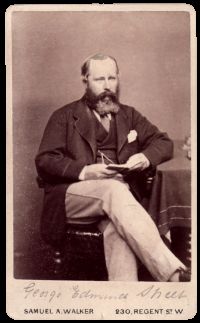 George Edmund Street,
Brick and Marble in the Middle Ages…
George Edmund Street,
Brick and Marble in the Middle Ages…
“ Nor is the coppersmiths’ the only trade that loves publicity, for here as elsewhere the barbers’ shops are very amusing, quite open in front, with perhaps a yellow curtain hanging down half way, affecting only to conceal the inviting interior, which however is always sufficiently visible, occupied in the centre by a chair, on which sits the customer gravely holding a soapdish to his chin whilst the barber operates; and this going on all day makes one think that shaving is, after all, one of the great works of an Italian’s time! ”
T. J. McConnaughay, Barbers' Manual (Part 1); Text Book on Taxidermy…
“ Treat every customer as though your success depended upon him and him alone, and always exert your utmost to do good work. Much depends upon the barber's ability to shave well. To 37accomplish the great desideratum of being able to shave well each one of the various customers with their varying qualities of beard, you must diligently study the temper of your razors with reference to the peculiar beard of each customer. Again much depends upon the lather, the brush, the hone, the strop, etc. ”
Thomas K. Bullock, The Wigmaker in Eighteenth-Century Williamsburg
“ In the latter century the first guilds of barbers were formed in both France and England, and by the seventeenth 5 century the golden age of the barber had begun.For most of the seventeenth and eighteenth centuries in Europe an inordinate emphasis on appearance led to excesses of fashion in both costume and hairdress. Men followed the vagaries of high fashion as faithfully as women, and vied with each other in wearing long curls of their own or somebody else’s hair. ”
Arthur Frederick Wallis, Idonia: A Romance of Old London
“ I could have crossed staves with the barber that had his dwelling over against mine, or almost stolen his pewter shaving dish from the sill where it lay. Of these conceits of mine, however, the barber was necessarily ignorant, being then busily engaged upon the exercise of his craft, which he carried on perforce above stairs, the shop below and the other rooms being used by a haberdasher and alderman, that had his goods stored there. I noted the barber particularly as well for his extraordinary grace and courtesy, as for the activity he manifested in his occupation. ”
Thomas Stevens, Around the World on a Bicycle - Volume II
“ Some few prefer being bled in the roof the mouth, and they all squat on their hams in rows, some bleeding from the arm, others from the mouth, while the inevitable crowd of onlookers stand around, gazing and giving advice. While the barber is engaged in binding on the wad of cotton, or during any interval between patients, he inserts the handle of the razor between his close-fitting skull-cap and his forehead, letting the blade hang down over his face, edge outward ”
 David Ross Locke,
Nasby in Exile
David Ross Locke,
Nasby in Exile
“ There is no barber like the American barber, and no such comfort anywhere in barbers as we enjoy at home. Tourists have complained of the straight chairs, the dull razors, and all that sort of thing, and with some reason, though it is not as bad as represented. I have never known of any one being absolutely killed by an European barber, either at sight or sixty days.It is true that you do not have the luxurious reclining chair, nor the soothing manipulations of a deft artist, nor the delightful hair dressing, and all that. ”
William Andrews, At the Sign of the Barber's Pole…
“ The hair of the nostrils cut away, and everything done in order, comely to behold. The last action in the tragedy is the payment of money; and lest these cunning barbers might seem unconscionable in asking much for their pains, they are of such a shameful modesty as they will ask nothing at all, but, standing to the courtesy and liberality of the giver, they will receive all that comes, how much soever it be, not giving any again, I warrant you; for take a barber with that fault, and strike off his head. ”
Edwin Creer, Board-Work; or the Art of Wig-making…
“ He is to be commended for this, as he simply follows the course adopted by those in other walks in life. Whether the old-fashioned description of razor is better or worse than the more modern “hollow-ground” I will not discuss, believing that a great deal depends upon the shaver, the nature of the beard, and the conditions under which the shaving operation is performed. Good practice in a barber’s shop is 223the best school in the world for imparting a knowledge of easy shaving; while ordinary intelligence combined with shrewd observation, will go far towards making one a master of his art. ”
Various, Punch, or the London Charivari…
“ This encouraging information was received with cheers, but I could not help fancying that the audience was not subsequently quite so eager to assist by submission to the razor in contributing to the blindfolded barber's triumph. Then the mildly-spoken gentleman announced that the contest would not come off, for some reason that was not quite clear to me. Hereupon a rather aggressive person claimed to be shaved—and shaved he was, also another person of an older growth than the first applicants. ”
Stephen Leacock,
Literary Lapses — Men Who Have Shaved Me
(1910)
“ The education of the customer is, as I have said, the chief part of the barber's vocation. But it must be remembered that the incidental function of removing his whiskers in order to mark him as a well-informed man is also of importance, and demands long practice and great natural aptitude. In the barbers' shops of modern cities shaving has been brought to a high degree of perfection. A good barber is not content to remove the whiskers of his client directly and immediately. He prefers to cook him first. ”
 Harry Leon Wilson,
Ruggles of Red Gap
(1922)
Harry Leon Wilson,
Ruggles of Red Gap
(1922)
“ Then, having once more stood by at the barber's while he was shaved and his moustaches firmly waxed anew, I saw that he was fit at last for his art studies. The barber this day suggested curling the moustaches with a heated iron, but at this my charge fell into so unseemly a rage that I deemed it wise not to insist. He, indeed, bluntly threatened a nameless violence to the barber if he were so much as touched with the iron, and revealed an altogether shocking gift for profanity, saying loudly: "I'll be—dashed—if you will!" ”
