
“ The brickmaker may no longer debase and ruin, both morally and physically, his child of the tender age of nine or ten years, by turning it—boy or girl—into the brick-yard to toil, shoeless and ragged, at carrying heavy lumps on its head. ”
Brickmaker
Definition and stakes
The theme of “brickmaker” has been addressed by authors such as George Frederick Harris, George Smith, Charles Babbage and Charles G. Harper. It is often associated with terms like clay, brick, kiln, bricklayer and brickwork.
Quotes about “brickmaker”
George Frederick Harris, The Science of Brickmaking
“ The brickmaker hardly needs to be told that if he places his bricks in the sun to dry, they, or a large percentage of them, will crack, and become practically worthless from a commercial standpoint. To dry a brick properly in the open air is a lengthy operation—too lengthy for many manufacturers, who, in consequence, have had recourse to artificial drying. Many a brickyard has had to be abandoned from the inability of the worker to produce bricks that did not crack at some period of the operation, either in the drying, or burning, or both. ”
George Frederick Harris, The Science of Brickmaking
“ But what we more particularly desire to draw the reader’s attention to at the present stage, is not the employment of lime in making fire-bricks so much as its mixture with ordinary brick-earth, as in the manufacture of malm bricks. Sometimes the mixture has been effected by Nature, as is the case with true marls; but the brickmaker does not care so much for these, as without considerable and expensive artificial assistance they do not often make readily saleable bricks. ”
George Frederick Harris, The Science of Brickmaking
“ On the other hand, take a thick marine clay, and compare its chemical composition as ascertained at the present time with that of it made, say, 20 years ago in the same brickyard, and the analyses will, in most instances, be practically identical—at any rate, so far as they may be of use to the brickmaker.24 A brickmaker using a marine clay possesses innumerable advantages over another employing brick-earths due to river action. ”
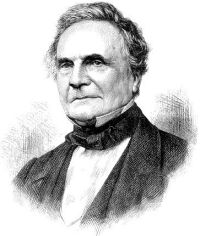 Charles Babbage,
On the Economy of Machinery and Manufactures
Charles Babbage,
On the Economy of Machinery and Manufactures
“ An oblong box of wood fitting upon a bottom fixed to the brickmaker's bench, is the mould from which every brick is formed. A portion of the plastic mixture of which the bricks consist is made ready by less skilful hands: the workman first sprinkles a little sand into the mould, and then throws the clay into it with some force ”
George Frederick Harris, The Science of Brickmaking
“ When present as hard crystalline lumps or pebbles, they have been derived from the destruction of limestones, and are then the greatest nuisance imaginable to the brickmaker and the most dangerous constituent at the same time. With proper machinery these hard lumps may be ground down to fine particles, but they are even then only to be admitted into the earth on sufferance. ”
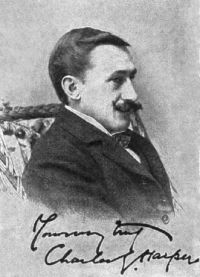 Charles G. Harper,
The Somerset Coast
Charles G. Harper,
The Somerset Coast
“ Then it is ready for the moulder, that is to say, the actual brickmaker, who, after the identical fashion followed by the moulder of ordinary bricks, takes his lumps of material, throws them into a wooden framework made to the gauge of a brick, scrapes off the surplus clay from the top and pushes the raw brick aside, as one of a rapidly growing row. ”
George Frederick Harris, The Science of Brickmaking
“ Iron, in large proportion, acts as a flux to other constituents when the brick-earth is subjected to great heat in the kiln, and on that account must be carefully watched. But, to the average brickmaker, the ferruginous constituent is far more interesting as a colouring medium. At a later stage we shall have something to say concerning the colouring of bricks, &c., but it may now be remarked that red bricks, in practically all cases, owe their colour to the effects of firing on iron. ”
George Frederick Harris, The Science of Brickmaking
“ Another95 has discovered that clay should be mixed in small quantity to produce the desired result, so he and his neighbours do that, and pity the ignorance of the “sand mixers.” A third feels quite certain that crushed brick, or brick dust, is a good thing; while a fourth will add a little lime. Now, each of these ingredients is useful in its way; everything depends upon the class of brick-earth to be dealt with. It may happen that what will, in a measure, prevent cracking, will be a bad thing in the burning, and the art of the brickmaker is to know what to do under the varied conditions. ”
George Frederick Harris, The Science of Brickmaking
“ In drying, the greatest care would have to be exercised to prevent undue shrinking, and, in any case, the earth would have to be very thoroughly incorporated to make a really serviceable brick. It is with earths of this character that the majority of brickmakers in embryo come to grief; they know not how to handle them successfully, and twisting, warping, cracking, and “bursting” follow as a natural consequence. It is a common and treacherous material, that could only be made to succeed by perseverance and wide experience. ”
George Frederick Harris, The Science of Brickmaking
“ Turning to the second table, compiled for the most part from brickmakers’ circulars, and from the original results obtained for the late Building Exhibition, at the Agricultural Hall, all the experiments, we believe, having been carried out by Mr. David Kirkaldy, it will be noted that great variation in strength is apparent, following the different kinds of bricks. The highest result, 1064.2 tons per square foot, was obtained on a blue Staffordshire brick, though that is very closely run by bricks made from slate débris (1056.2 tons) from South Wales. ”
Various, Encyclopaedia Britannica, 11th Edition…
“ BRICKWORK, in building, the term applied to constructions made of bricks. The tools and implements employed by the bricklayer are:—the trowel for spreading the mortar; the plumb-rule to keep the work perpendicular, or in the case of an inclined or battering wall, to a regular batter, for the plumb-rule may be made to suit any required inclination; the spirit-level to keep the work horizontal, often used in conjunction with a straight-edge in order to test a greater length; and the gauge-rod with the brick-courses marked on it. ”
 Herbert Spencer,
Popular Science Monthly
(1872)
Herbert Spencer,
Popular Science Monthly
(1872)
“ III.—Nature of the Social Science. OUT of bricks, well burnt, hard, and sharp-angled, lying in heaps by his side, the bricklayer builds, even without mortar, a wall of some height that has considerable stability. With bricks made of bad materials, irregularly burnt, warped, cracked, and many of them broken, he cannot build a dry wall of the same height and stability. The dock-yard laborer, piling cannon-shot, is totally unable to make these spherical masses stand at all as the bricks stand. ”
Anonymous, The Useful Arts Employed in the Construction of Dwelling Houses… (1851)
“ Ordinary bricks for building are burnt in clamps, which are large oblong masses, built up of the unburnt bricks, laid regularly in layers, with large flues or passages at intervals, in which ashes, cinders, coal, and brush-wood are laid; layers of ashes are strewed over those of the bricks. The object is, that the fire, when the fuel is ignited, may penetrate every part of the mass, and bake every brick equally; even the ashes mixed up in the clay are intended to be partly burnt by the heat. ”
George Frederick Harris, The Science of Brickmaking
“ Tests of Fire-clay and Shales.—Paving Bricks.From a series of tests recently made by Mr. Fickes,22 the following factors were educed:—1. A brick which stands the “rattling” test well, has ample crushing strength and rarely chips under less than 5,000 lbs. per square inch, or crushes under less than 10,000 lbs. The crushing strength tends to vary with the resistance to abrasion, however, but more slowly and irregularly.149 2. The transverse strength also tends to vary with the resistance to abrasion, but more slowly and irregularly.3. The toughest bricks usually absorb the least water. ”
Joseph Burton and William Burton, 1911 Encyclopædia Britannica, Volume 4… (1911)
“ Although the best bricks are still pressed from tempered or plastic clay, there has recently been a great development in the manufacture of semi-plastic or dust-made bricks, especially in those districts where shales are used for brickmaking. These semi-plastic bricks are stamped out of ground shale that has been sufficiently moistened with water to enable it to bind together. The hard-clay, or shale, is crushed under heavy rollers in an iron grinding-pan having a perforated bottom through which the crushed clay passes, when sufficiently fine, into a small compartment underneath. ”
Various, Encyclopaedia Britannica, 11th Edition…
“ The frame is sometimes in the form of a skeleton cylinder, the wires being arranged radially (or the wires may be replaced by metal disks) ; but in all cases bricks thus made are known as "wire-cuts." In order to obtain a better-shaped and more compact brick, these wire-cuts may be placed under a brick press and there squeezed into iron moulds under great pressure. These two processes are now generally performed by one machine, consisting of pug-mill and brick press combined. The pug delivers the clay, downwards, into the mould; the proper amount of clay is cut off ”
George Frederick Harris, The Science of Brickmaking
“ An infusorial earth from Tuscany is composed of silica 55, magnesia 15, water 14, alumina 12, lime 3, and iron 1 per cent. That also is made into very light bricks. The general principle underlying the method of utilising those earths of organic origin is similar to that of the Dinas bricks, though they do not always require artificial fluxing.At Saarbrücken, in the Rhenish Province of Germany, a material known as “iron brick” is manufactured. It is made by mixing equal proportions of finely-ground red clay-slate with fine clay, and adding 5 per cent. ”
A manual of face brick construction (1920)
“ Throughout the whole process there is danger of distortion or discoloration in the ware unless the fires are skilfully handled. Properly done, the brick come out of the kiln in their beautiful, natural colors, due to the constitution of the clay or the various metallic oxides contained in it. To enhance these effects, different clays are sometimes mixed in going through the machines, certain ores may be added to modify the color, the brick surfaces may be scored in various ways, or the ware may be set in the kiln so as to avoid or get the flash of the fire. ”
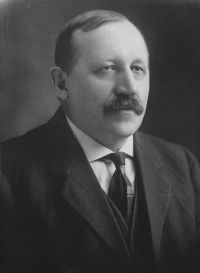 James Hudson Maurer,
The Far East
(1912)
James Hudson Maurer,
The Far East
(1912)
“ The bricklayers and stone masons on buildings get about sixty cents Mexican money or thirty cents gold per day. When employed at piecework they will make $1 a day, but to do this work from dawn to dark nearly. The bricklayer's trowel is a small butcher's cleaver in shape and with it he lifts the mortar and cuts the brick. The pointing up of joints is done with a simple tool that forces a bit of round iron into the joint, where it rubs a round grove in the mortar; for finer work they use a V-shaped tool. These tools make nicely finished work. ”
George Iles, Inventors at Work, with Chapters on Discovery
“ Stone and brick-work, in their rectilinear shapes, impose a rigidity in architectural design from which modern bricks, in their rich variety of flat and curved surfaces, have wrought emancipation. In the new residential streets of St. Louis, for example, the architecture owes much of its freedom and beauty to the new shapes in which brick is now manufactured. Even wider liberty than now falls to the lot of the brick-maker has always been enjoyed by the potter. In his hands clay lends itself to any desired imitation, to any fresh design however fanciful ”
George Frederick Harris, The Science of Brickmaking
“ Again, the whole brick may be subject to the experiment, or only the half-brick. The faces placed between the dies of the crushing machine may not be flat, and they are most frequently irregular. If the dies are applied to such bricks it is evident that corners will be broken off before the brick has really suffered much, and that to get the best result the faces must either be made perfectly true and parallel to each other, or some other method adopted to put matters right. ”
James Bartlett, 1911 Encyclopædia Britannica (1911)
“ Every brick should be well wetted before it is laid, especially in hot dry weather, in order to wash off the dust from its surface, and to obtain more complete adhesion, and prevent it from absorbing water from the mortar in which it is bedded. The bricks are wetted either by the bricklayer dipping them in water as he uses them, or by water being thrown or sprinkled on them as they lie piled on the scaffold. In bricklaying with quick-setting cements an ample use of water is of even more importance. ”
Various, Scientific American Supplement…
“ The result is that the stretchers break joint with each other, and all the joints range themselves in diagonal lines, and if in any part of the work headers of a different brick are introduced, the appearance of a cross is at once brought out; and even without this the diagonal arrangement of joints is very perceptible and pleasing.Besides wall building, the bricklayer has many other works to perform. He has to form fireplaces, flues, chimneys, and the flat trimmer arches which support the hearth, and has to set the stove, kitchen range, copper, etc., in a proper manner. ”
George Frederick Harris, The Science of Brickmaking
“ The manufacturer may test this for himself by heating a good, sound medium burnt brick to the temperature usually found in his kiln when unloading, and suddenly plunging it in snow. It is not, perhaps, that any one of these things is especially dangerous to the brick, but it is the combined effect of all of them trending in the same direction. We desire to be clearly understood on this point. The cracks produced may not seriously impair the strength of the brick; they may be merely superficial, and they mostly are. ”
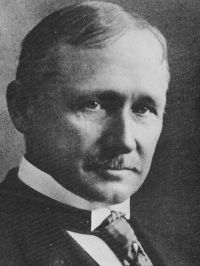 Frederick Winslow Taylor,
The Principles of Scientific Management
(1913)
Frederick Winslow Taylor,
The Principles of Scientific Management
(1913)
“ In this way the bricklayer avoids either having to turn the brick over or end for end to examine it before laying it, and he saves, also, the time taken in deciding which is the best edge and end to place on the outside of the wall. In most cases, also, he saves the time taken in disentangling the brick from a disorderly pile on the scaffold. This "pack" of bricks (as Mr. Gilbreth calls his loaded wooden frames) is placed by the helper in its proper position on the adjustable scaffold close to the mortar box. ”
Anonymous, The Useful Arts Employed in the Construction of Dwelling Houses… (1851)
“ The construction of groined arches in brick-work is the most difficult operation in the trade. Each brick that forms the arris or intersection of the cross vaults requires to be cut to a true form given by a drawing made to the full size on a board. Another perhaps still more delicate piece of workmanship for a bricklayer to execute is an oblique arch, such as are often seen in the bridges over railroads and canals, which cut established roadways obliquely. ”
George Frederick Harris, The Science of Brickmaking
“ The real reason why so little has been done to test the strength of brickwork is the difficulty in getting machines of such capacity as would crush sufficiently large masses. Small piers have been built from time to time, and bricks embedded in putty for mortar have served their purpose, but practically nothing of a really serious nature was carried out in Britain until a few months ago. ”
Anonymous, The Useful Arts Employed in the Construction of Dwelling Houses… (1851)
“ From there being so little water in the clay, and from its undergoing so much compression, the bricks produced are remarkably dense and strong, weighing half as much again as the ordinary brick, and absorbing only one-seventh as much water.Many machines have been contrived, having for their object the formation of bricks on a principle somewhat analogous. Another class of machines have effected the desired end in a different way,—viz., by forming each brick separately in a mould. ”
George Frederick Harris, The Science of Brickmaking
“ Again, a brick cracked all over, not with superficial cracks only, but with those which go far into the interior, will not yield its quality by mere immersion in water. The water, it is true, finds its way right into the brick, but, as often as not, the sides of the cracks are perfectly vitrified and almost damp proof, so that on lifting the brick out of the water the latter rolls off as though it were on “a duck’s back.” Yet such a brick, yielding but the merest fraction as a result of the immersion, may be utterly worthless when put into a building, because it would not be strong enough. ”
Samuel Birch, History of Ancient Pottery: Greek…
“ From the necessity for symmetrical buildings arose the invention of the brick, which must have superseded the rude plastering of the hut with clay, to protect it against the sun or storm. In the history of the Semitic nations the brick appears among the earliest inventions, and its use can be traced with various modifications, from the building of the Tower of Babel to the present day. It is essential that bricks should be symmetrical, and their form is generally rectangular. ”
