Brushwork

Definition and stakes

Charles H. Caffin,  A Child's Guide to Pictures

“ I need not tell you that an artist’s hands may be alive with feeling when he holds a brush, just as when he has a pencil in them. In fact, what we have said about feeling and expression in line may be applied to brushwork. In the case of a man who is not merely a filler in of spaces with paint, but is by instinct a painter, the brushwork grows into life beneath his hand. Sometimes he lays aside his brush and takes a palette-knife, with which to spread the paint on the surface or to scrape the part already painted. Sometimes he uses no tool at all, but kneads the paint with his thumb. ”
Source: Gutenberg

An Old Hand,  Hints for painters, decorators… (1882)

“ It is scarcely necessary to say that it is presumed the workman will know what brushes he will require according to the work he has in hand. His large ground paint brush, called a “pound-brush;” [Pg 9] his half-size, for smaller work; his fitch and sash tools, duster, pallet, putty and hasp knives; oval and flat varnish brushes, varnish-pot, step-ladders and long ladders, mahl-stick, pallet-board, gilding-knife, camel and sable hair-pencils, whitewash brushes, jack for window work, cushion, tip-pole, etc., etc. ”
Source: Gutenberg

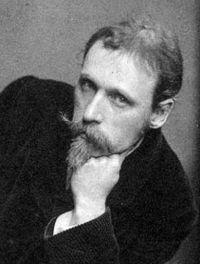
Portrait of John Ruskin John Ruskin,  Line

“ For the fact is, that while we moderns have always learned, or tried to learn, to paint by drawing, the ancients learned to draw by painting--or by engraving, more difficult still. The brush was put into their hands when they were children, and they were forced to draw with that, until, if they used the pen or crayon, they used it either with the lightness of a brush or the decision of a graver. ”
Source: Wikisource

Get perspective with Kwize: daily news enlightened by great literature