Keel (shipbuilding)

Definition and stakes

Portrait of French Ensor Chadwick French Ensor Chadwick,  Ocean Steamships

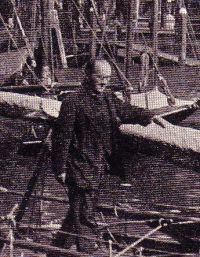
“ General View of the Frames of the City of New York—June 25, 1887.
The keel is laid down on blocks, four or five feet apart, which form a slope toward the water, so that the hull may glide down easily when the time for launching comes. It is not a keel at all, in the sense in which the word was formerly used: a modern ship has a smooth bottom, without any projecting ridge or break to the curve of her sides; it is simply the central series of plates, from which an inner keel is built up like an enormous backbone, and to this the ribs are attached.
”

Source: Gutenberg

Various,  Harper's Young People, June 15…

“ The keel of a ship has been likened to the backbone of a man, running, as it does, from stem to rudder. It consists of several timbers scarfed or pieced together, and under it is the shoe, a kind of second keel, but differing from the keel proper in that it is only loosely joined to it, whereas the keel is bolted to the ship's bottom through and through. The reason for this is that in case of grazing a rock a vessel having a shoe will, in most cases, part with the shoe, thus saving the keel, and escaping without serious injury. ”
Source: Gutenberg

William Wood,  Flag and Fleet: How the British Navy Won the Freedom of the Seas

“ The canoe navies, like other navies, did very well so long as no enemy came with something better. But when boats began to gain ground, canoes began to lose it. We do not know who made the first boat any more than we know who made the first raft or canoe. But the man who laid the first keel was a genius, and no mistake about it; for the keel is still the principal part of every rowboat, sailing ship, and steamer in the world. There is the same sort of difference between any craft that has a keel and one that has not as there is between animals which have backbones and those which have not. ”
Source: Gutenberg

Get perspective with Kwize: daily news enlightened by great literature