Pika

Definition and stakes

E. Raymond Hall,  A Synopsis of the North American Lagomorpha

“ Detection of the slightest movement of an enemy on the opposite side of the bush sends the pigmy rabbit, in one or a few jumps, into [Pg 125] the mouth of its burrow and, if need be, below ground. The pika, with the shortest ears and legs of all, lives in the rock slides and has to do little more than drop off the top of a rock into a space between the broken rocks when an enemy is detected near enough to the pika to have a chance of seizing it. ”
Source: Gutenberg

Walter Woelber Dalquest,  Mammals of Washington, Volume 2

“ Generally speaking, they are mammals of the mountains.
[Pg 378]
Common enemies of the pikas are the weasel (Mustela frenata) , marten (Martes caurina) , and hawks of several species. Pikas are active by day, especially in the early morning. Their call note is a short "eek!" which carries a long distance. This squeaking note is often heard throughout the night when rain threatens their drying hay.
Fig. 126. Distribution of the pika in Washington. A. Ochotona princeps brunnescens. B. Ochotona princeps fenisex. C. Ochotona princeps cuppes.
”
Source: Gutenberg

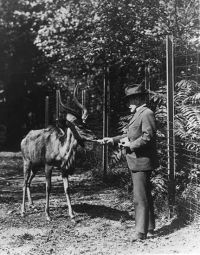
Portrait of William T. Hornaday William T. Hornaday,  The Minds and Manners of Wild Animals…

“ He burrows far down in the slide-rock that falls from the cliffs, where he is protected by a great bed of broken stone so thick that no predatory animal can dig through it and catch him. There in those awful solitudes, enlivened only by the crack and rattle of falling slide-rock, the harsh cry of Clark's nut-cracker and the whistling wind sweeping over the storm-threshed summits and through the stunted cedar, the pika chooses to make his home. Over the slide-rock that protects him, the snows of the long and dreary winter pile up from six to ten feet deep, and lie unbroken for months. ”
Source: Gutenberg

Get perspective with Kwize: daily news enlightened by great literature