“ At one time, the refiner had to consider the saleability of his refined products before he commenced to refine them, but to-day, with the perfect system which prevails for the handling of huge quantities of refined products, and the transporting of them to the most distant markets, the one desire of the refiner is, naturally, to secure from his treatment of the crude oil, as many refined products as possible, always keeping an eye on the production of the largest quantities of the higher priced products than upon those which are of low value. ”
Refiner
Definition and stakes
The theme of “refiner” has been addressed by authors such as Ida Tarbell, Andrew Ure, Various, Albert Lidgett and William Edward Garrett Fisher. It is often associated with terms like refinery, petroleum, oil, sugar and furnace.
Quotes about “refiner”
William Edward Garrett Fisher, 1911 Encyclopædia Britannica, Volume 20… (1911)
“ The refiner is essentially a finishing process as an adjunct to the beating process proper. The advantages to be derived from its use are a considerable saving in the time occupied in beating and the production of a more uniform and evenly divided pulp, particularly where a mixture of different fibres is used. By the use of the refiner the time occupied in the beater can be reduced by nearly one-half, the half-beaten pulp passing through the refiner from the beater on its way to the paper-machine. ”
 Andrew Ure,
A Dictionary of Arts, Manufactures and Mines
Andrew Ure,
A Dictionary of Arts, Manufactures and Mines
“ As to silver ingots of low standard, the perfection of the refining processes is such, that the mere copper contained in them pays all the costs; for in this case, the refiner restores to the proprietor of the ingot as much fine silver as the assay indicated to exist in the ingot, contenting himself with the copper of the alloy. ”
Andrew Ure,
A Dictionary of Arts, Manufactures and Mines
“ Instead of the blood, many refiners employ a mixture of gelatinous alumina and gypsum, called finings, prepared by adding a solution of alum to a body of lime-water, collecting, washing, and draining the precipitate upon a filter. Other refiners use both the blood and finings, with advantage. Bone black is now very frequently employed by the sugar-refiner, not in a fine meal, but in a granular state, like corned gunpowder, for the purpose of decolouring his syrups ”
 Ida Tarbell,
The History of the Standard Oil Company…
(1904)
Ida Tarbell,
The History of the Standard Oil Company…
(1904)
“ Now it was clear enough to the men approached that the great body of their association would never go into any scheme based on rebates, and they said so. The refiners saw no disadvantage in that fact. "We don't want all the producers. We only want the big ones. The small producer under our arrangement must die, as the small refiner must." ”
Arthur Hornblow, The Lion and the Mouse: A Story of American Life
“ Attracted early in life to the newly discovered oil fields of Pennsylvania, he became a dealer in the raw product and later a refiner, acquiring with capital, laboriously saved, first one refinery, then another. ”
George Morrison Rolph, Something about sugar (1917)
“ A few years ago all sugar went out in barrels or bags, while today a modern refinery turns out about twenty different styles of container, and twenty-four kinds of sugar. It is obvious, therefore, that the packing room of a refinery is an interesting place, covering as it does a large area and including a great amount of special, intricate machinery for filling, weighing and sewing or sealing packages. ”
Various, Popular Science Monthly (1887)
“ Accordingly, the successful refiner of sugars of to-day, in place of being as formerly a manufacturer exclusively, must now, as a condition of full success, be his own importer, do his own lighterage, own his own wharfs and warehouses, make his own barrels and boxes, prepare his own bone-black, and ever be ready to discard and replace his expensive machinery with every new improvement. ”
Various, Chambers's Edinburgh Journal, No…
“ An assay is then taken out by the refiner with a small ladle, and broken in the vice; and from the general appearance of the metal in and out of the furnace, the state of the fire, &c., he judges whether the toughening process may be proceeded with, and can form some opinion as to the quantity of poles and charcoal that will be required to render it malleable, or, as it is termed, to bring it to the proper pitch. ”
Ida Tarbell,
The History of the Standard Oil Company…
(1904)
“ He can suffer heavily his own mistakes, learn from them, cor-rect them. He can fight opposition, bear all—so long as the work is his. There were refiners in 1875 who loved their business in this way. Why one should love an oil refinery the outsider may not see; but to the man who had begun with one still and had seen it grow by his own energy and intelligence to ten, who now sold 500 barrels a day where he once sold five, the refinery was the dearest spot on earth save his home. ”
 John Bunyan,
Works of John Bunyan — Volume 01
John Bunyan,
Works of John Bunyan — Volume 01
“ The refiner, when he putteth his silver into his furnace, he puts lead in also among it; now this lead being ordered as he knows how, works up the dross from the silver, which dross, still as it riseth, he putteth by, or taketh away with an instrument. ”
R. Austin Freeman, The Blue Scarab — The New Jersey Sphinx (1924)
“ This paper, then, was connected either with a goldsmith or a gold refiner—who might call himself an assayist or a metallurgist. The connection was supported by the leaf of a price list of gas stoves. A metallurgist would be kept well supplied with lists of gas stoves and furnaces. The traces of lead in the dust from the hat gave us another straw blowing the same direction, for gold assayed by the dry process is fused in the cupel furnace with lead; and as the lead oxidises and the oxide is volatile, traces of lead would tend to appear in the dust deposited in the laboratory. ”
Andrew Ure,
A Dictionary of Arts, Manufactures and Mines
“ For this purpose, he takes out a sample in his small ladle, and pours it into a mould. When the copper is solidified, but still red-hot, he forges it. If it is soft under the hammer, if it does not crack on the edges, the refiner is satisfied with its ductility, and he pronounces it to be in its proper state. He orders the workmen to mould it; who then lift the copper out of the furnace in large iron ladles lined with clay, and pour it into moulds of the size suitable to the demands of commerce. ”
Various, The International Monthly, Volume 5…
“ Below, there is a refinery. It is for the establishment alone; but, just like that we have already described—only on a smaller scale. First, the rolling-mill shows us its powers by a speedy experiment;—it flattens a halfpenny, making it oblong at the first turn, and, by degrees, with the help of some annealing in the furnace, drawing it out into a long ribbon of shining copper, which is rolled up, tied with a wire, and presented to us as a curiosity. Next, we see coils of thick round wire, of a dirty white, which we can hardly believe to be gold. ”
H. B. Cornwall, Popular Science Monthly (1876)
“ It is the object of the refiner to make as much illuminating oil as possible, and to do this advantage is taken of the fact that, when the vapors of heavy oils are heated above their boiling-points, carbon is deposited, and the condensed hydrocarbons resulting have a less specific gravity. This decomposition is technically called "cracking," and it was observed long ago that in distilling the heavier oils lighter hydrocarbons were obtained during the first stages of the operation, even when not wanted. ”
 Charles Dudley Warner,
The Works of Charles Dudley Warner
Charles Dudley Warner,
The Works of Charles Dudley Warner
“ The refinery proper is the largest building in the Western country used for manufacturing purposes, and, together with its adjuncts of cooper-shops and warehouses, covers five entire blocks and employs 500 men. It has a capacity of working up 400 tons of raw sugar a day, but runs only to the extent of about 200 tons a day, making the value of its present product $7,500,000 a year. ”
Various, The Writer, Volume VI, April 1892
“ The refiners of sugar and coal oil, the makers of matches, lead-pencils, screws,—in short, almost all other interests,—have some sort of combination. The brewers stand by each other in fixing the price of beer, and if a saloon keeper fails to pay one brewer, the others will not furnish him with the product of their vats. ”
 Leslie Stephen,
Dictionary of National Biography…
(1897)
Leslie Stephen,
Dictionary of National Biography…
(1897)
“ Among his inventions was an improved method of refining gold and silver and of collecting the smaller particles of them, formerly lost in the processes of the local manufacturers. Stimulated by his successes, he established in Steelhouse Lane a large laboratory, and in connection with it a refinery of the precious metals. ”
Ida Tarbell,
The History of the Standard Oil Company…
(1904)
“ At the start the difficulty of getting the apparatus for a refinery to the creek had been so enormous that the bulk of the crude had been driven to the nearest manufacturing cities—Erie, Pittsburgh, Cleveland. Much had gone to the seaboard, too, and Boston, New York, Philadelphia and Baltimore were all doing considerable refining. There was always a strong feeling in the Oil Regions that the refining should be done at home. Before the railroads came the most heroic efforts were made again and again to get in the necessary machinery. ”
George Morrison Rolph, Something about sugar (1917)
“ The chemical laboratory is really the heart of the institution, for upon it depends the success of every manufacturing operation. The superintendent of a refinery must possess a thorough knowledge of chemical engineering, for the process of sugar refining is largely chemical from beginning to end.Competent chemical engineers, as distinguished from chemists, are rare, and yet their calling offers more promising prospects to young men than most other professions do today. ”
George Morrison Rolph, Something about sugar (1917)
“ A sugar refinery is operated the entire twelve months of the year, while a raw-sugar mill must of necessity take care of the crop of cane in about eight months. To refine sugar where it is grown would require refining machinery capable of handling the entire output in the eight-month period, and during the remaining four months the plant would remain idle. This would mean a larger investment proportionately than that made in a refinery in a consuming center, running steadily the year round. ”
 Upton Sinclair,
Oil!
(1926)
Upton Sinclair,
Oil!
(1926)
“ The elder Ross was naively proud to have a “professor” visiting him, and to show him the well that was spudding in, and the one that was bailing, and the score that were drilling. They inspected the new refinery, something really special, that had been exploited in the newspapers as the latest miracle in petroleum engineering; incidentally it was a work of art, buildings of concrete and shining, newly-painted metal, set in a regular pleasure park. Oil wells are black and greasy, incurably so, but a refinery is different ”
John J. McLaurin, Sketches in Crude-oil
“ Nature certainly spared no effort to bring petroleum into general notice ages before James Young manufactured paraffine-oil in Scotland or Samuel M. Kier fired-up his miniature refinery at Pittsburg. North and south, east and west the presence of the greasy staple was manifested positively and extensively. ”
Ida Tarbell,
The History of the Standard Oil Company…
(1904)
“ This product, called a distillate, was treated with chemicals, washed with water, and run off into the tin-lined tank, where it was allowed to settle. Anybody who could get the apparatus could "make oil," and many men did—badly, of course, to begin with, and with an alarming proportion of waste and explosions and fires, but with experience they learned, and some of the great refineries of the country grew out of these rude beginnings. Luckily not all the men who undertook the manufacturing of petroleum in these first days were inexperienced. ”
Upton Sinclair,
Oil!
(1926)
“ A hundred million people, occupying one-sixth of the earth’s surface, had taken over their industries, and were running them, and would make a success of them—if only the organized greed of the world would stand off and let them alone!Bunny took Paul in his car, to show him all the field. They investigated the new refinery, that wonderful work of art. Before them rose a great building, made entirely of enormous baking-pans set one inside another—a stack half way to heaven ”
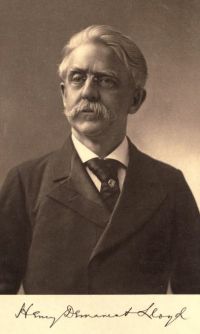 Henry Demarest Lloyd,
Wealth against commonwealth
Henry Demarest Lloyd,
Wealth against commonwealth
“ Many practical men, real refiners, who have been forced to give up their business to refiners of railroad privileges, have testified to the same effect as the manufacturer who said to Congress in 1872: "I believe a refinery of 100 barrels can be run cheaper than the larger establishments." ”
United States. Congress, Energy Independence and Security Act of 2007…
“ EXCLUSION.— The term “planned refinery outage” does not include any necessary and unplanned removal of a refinery, or any unit of a refinery, from service as a result of a component failure, safety hazard, emergency, or action reasonably anticipated to be necessary to prevent such events. (3) REFINED PETROLEUM PRODUCT.— The term “refined petroleum product” means any gasoline, diesel fuel, fuel oil, lubricating oil, liquid petroleum gas, or other petroleum distillate that is produced through the refining or processing of crude oil or an oil derived from tar sands, shale, or coal. ”
George P. Marsh, The Earth as Modified by Human Action
“ The slags front silver refineries, and even from smelting houses of the coarser metals, have not unfrequently yielded to a second operator a better return than the first had derived from dealing with the natural ore; and the saving of lead carried off in the smoke of furnaces has, of itself, given a large profit on the capital invested in the works. ”
John J. McLaurin, Sketches in Crude-oil
“ With wondrous speed and unfailing certainty it conveys crude-oil from the wells to the refineries in or out of the region, climbing hills, descending ravines, fathoming rivers and traversing plains and forests. Methods of refining have kept pace with progress in transportation. The smoky, dangerous, inconvenient kettle-still of the pioneer on Oil Creek has given place to the mammoth refinery of to-day, with its labor-saving appliances, its hundreds of skilled employés and 332its improved processes. ”
 George W. Bush,
Presidential Radio Address
(2008)
George W. Bush,
Presidential Radio Address
(2008)
“ Finally, we need to expand and enhance our refining capacity. It has been 30 years since a new refinery was built in our Nation, and lawsuits and red tape have made it extremely costly to expand or modify existing refineries. ”
Jacques W. Redway, Commercial Geography
“ Sugar Manufacture.—Sugar manufacture includes three processes—expressing the sap, evaporating, and refining. The first two are carried on at or near the plantations; the last is an affair requiring an immense capital and a most elaborately organized plant. The refining is done mainly in the great centres of population at places most convenient for transportation. The raw sugar may travel five or ten thousand miles to reach the refinery; the refined product rarely travels more than a thousand miles. ”
Popular Science Monthly (1880)
“ In 1869 Chandler began his work on this subject, his first report to the Board of Health bearing date January 11th of that year. It was a simple statement of the chemical nature of petroleum and its products, explained the process for refining the oil, and clearly established the fact that the dangerous character of the oils in use was due to the fact that the refiners, in order to realize a profit of two or three cents per gallon, left a certain quantity of the highly inflammable naphtha in it. ”
1911 Encyclopædia Britannica (1911)
“ Petroleum refineries, iron-foundries, chemicals, soap-boiling, silk-spinning and the production of ships' fittings, as marine steam boilers, anchors, chains, cables, are the other principal branches of industry. ”
Ida Tarbell,
The History of the Standard Oil Company…
(1904)
“ There is a large number of refineries in the country—a great deal larger than is required for the manufacture of the oil produced in the country, or for the want of the consumers in Europe and America; the capacity of the oil refineries in the country is, I think, 45,000 or 50,000 barrels a day ”
Ida Tarbell,
The History of the Standard Oil Company…
(1904)
“ Affiant says the said Standard Oil Company owns and operates its refineries at Cleveland, Ohio, and its refinery at Bayonne, New Jersey; that it has no other refineries nor any interest in any other refineries, nor does the Standard Oil Company operate or control in the United States any other refineries of crude petroleum ”
George Morrison Rolph, Something about sugar (1917)
“ In connection with every refinery there are many shops, where mechanical work incidental to repairs and construction is carried on. These shops are equipped with the necessary tools and implements for quick repairs and are under the supervision of the chief engineer. ”
Ida Tarbell,
The History of the Standard Oil Company…
(1904)
“ A.—If in any calendar month the refineries named in Schedule "A" shall receive more than their said percentage of the said aggregate of crude petroleum received except for export in its crude state, the party of the first part hereto will pay to the party of the second part hereto, twenty (20) cents per barrel on the quantity so received in excess of their said percentage. ”
