Rhinoceros

Definition and stakes

Phil Robinson Under the Sun — The Elephants’ Fellow-Countrymen (1882)

The great carnivora never troubled their heads about such a preposterous victim, and the nations of the deer kind, couching by day in the forest depths and feeding by night in the open plain, saw nothing of the bulky rhinoceros. He lived therefore in virtual solitude, — for water-fowl and weasels were hardly worth calling companions, — and was indeed so vigilant in guarding his concealment that he remained a secret for ages.
The rhinoceros, therefore, figures nowhere in folk-lore, and neither fairy tale nor fable has anything to tell us of it. Art owes little to it, and commerce nothing.
Source: Wikisource

Winston Churchill My African Journey

Our oryx led us a mile or more over rocky slopes, always promising and never giving a good chance for a shot, until at last he drew us round the shoulder of a hill—and there, abruptly, was the rhinoceros. The impression was extraordinary. A wide plain of white, withered grass stretched away to low hills broken with rocks. The rhinoceros stood in the middle of this plain, about five hundred yards away, in jet-black silhouette; not a twentieth-century animal at all, but an odd, grim straggler from the Stone Age.
Source: Gutenberg

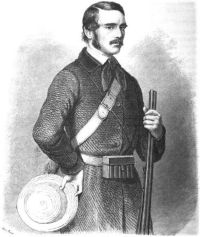
Portrait of Mayne Reid Mayne Reid The Young Yagers: A Narrative of Hunting Adventures in Southern Africa

Instead of the bold brutal nature of the rhinoceros—rushing out without provocation, attacking and butting at whatever comes in its way—here we have a shy timid creature, that takes to flight on the slightest suspicion of danger, and seems to be frightened at its very shadow. Why, it affords the most absolute proof of the uncertainty of the teeth and bones as a guide to the mode of life of any animal.
Source: Gutenberg

Get perspective with Kwize: daily news enlightened by great literature