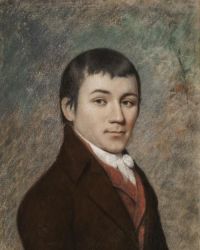
 Charles Brockden Brown,
Wieland; Or, The Transformation…
Charles Brockden Brown,
Wieland; Or, The Transformation…
“ Ruffian or devil, black as hell or bright as angels, thenceforth he was nothing to me. ”
The term "ruffian" denotes a rough, violent, or lawless individual, often linked with criminality or anti-social behavior. From Charles Brockden Brown’s dismissal of a ruffian as “nothing to me” in Wieland to Dashiell Hammett’s examination of ruffianhood as a code of hardened courage in Ruffian’s Wife, authors have employed the term to depict figures ranging from historical outlaws to morally ambiguous anti-heroes.
Whether in Edward A. Freeman’s medieval intrigues or Oliver Optic’s nautical encounters, the ruffian represents a liminal figure straddling chaos and survival. These portrayals reveal a recurring literary concern with the tension between societal order and the appeal of transgressive defiance.
Charles Brockden Brown,
Wieland; Or, The Transformation…
“ Ruffian or devil, black as hell or bright as angels, thenceforth he was nothing to me. ”
 David Christie Murray,
In Direst Peril
David Christie Murray,
In Direst Peril
“ When at last Ruffiano left us, the count detained me. “The world is full of changes,” he said, “and no man knows what may happen. We may never meet again, Fyffe, and I have a solemn charge to leave you. If I am caught again they will make short work of me. I do not mean to be caught if I can help it, but I know the risk I run. If anything should happen to me, I counsel you, for Violet's sake, to retire from The Cause. She cannot spare us both, and Italy has no claim on you.” ”
 Oliver Optic,
On Time; or, Bound to Get There
Oliver Optic,
On Time; or, Bound to Get There
“ They will keep their faces covered up while you are around; for being found out would be almost as bad as being drowned to them.”The ruffians, probably seeing the sail on the Belle reefed, found that they could do a similar thing with their own canvas. They had fastened the reef-points in some manner, and were running before the gale toward the rocky point. I did not understand what they intended to do; but it did not occur to me that they would be stupid enough to attempt a landing on a lee shore in such a sea as raged at the time. ”
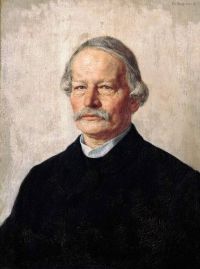 Gustav Freytag,
Pictures of German Life
in the XVth XVIth and XVIIth Centuries…
(September 22,
2010 [EBook #33795]
[Most recently updated December 31, 2022])
Gustav Freytag,
Pictures of German Life
in the XVth XVIth and XVIIth Centuries…
(September 22,
2010 [EBook #33795]
[Most recently updated December 31, 2022])
“ Ruffiana from Padua, the Zany from Bergamo, the Gratianus from Bologna, and they must lurk about for certain days, till they have begged and obtained permission if they wish to maintain themselves and carry on their profession; they can with difficulty obtain lodgings where they are known, every one being disgusted with their filth, as they leave for a length of time a bad smell behind them. ”
 Arthur Morrison,
The Strand Magazine
(1892)
Arthur Morrison,
The Strand Magazine
(1892)
“ The ruffs are small, but there is character about them. See two approach each other from opposite directions—looking, perhaps, for something to eat. They meet, stop, straddle wide their legs, and blow up their neck-feathers. Regarding each other fixedly, they rock solemnly to and fro. Then they let fall their collars and go off, each on his way, as though nothing had happened. It is a rude courtesy—a sort of ruff etiquette, in fact. Sometimes, however, this putting on of frills—as the same thing will do in other places—leads to fights. ”
John Campbell, Two Knapsacks: A Novel of Canadian Summer Life
“ I went home and I says, 'Rufus, my son,' and he says, 'Yes, fayther!' Says I, 'Rufus, am I a Christian man, though frail and human, am I a Christian man or am I not?' Rufus says, 'You are a Christian, fayther.' Then says I, 'What is the praycher, Rufus, my boy?' and Rufus, that uses tobackka in no shape nor form, says, 'He's a consayted, ignerant, bigitted bladderskite of a Pharisee!' Sir, I was proud of that boy!'"That was very fine of your son to stand up for his father like that. You can't say that your foes were those of your own household. ”
Harriet Prescott Spofford, John-a-Dreams (1910)
“ Rufus? What you talkin' about!" "Rufus. And the girl he is engaged to marry." Rufus's father wheeled about, to the imminent danger of his eyes and the points of the open scissors. "What in the name of common sense— Why, Elviry, what you mean?" "I mean w'at I say, father." "Rufus? Why, you can't! It's—it's redic'lous. He ain't growed up. He's—he's—" "Now, father, 'tain't no use to sputter this way. You set still! How can I cut 'ith you dancin' round like a teetotum? Rufus is a man—" "A man! He ain't never hed a freedom suit." ”
 Edward A. Freeman,
The Reign of William Rufus and the Accession of Henry the First…
(1882)
Edward A. Freeman,
The Reign of William Rufus and the Accession of Henry the First…
(1882)
“ He could not bear that any man, least of all a man of a spirit so much higher than his own, should be so near the throne as Helias threatened to be. The men of Maine, said the Count of Meulan, were a cunning and faithless race. All that the captive Helias sought by his offers was to insinuate himself into the King’s favour, to learn his secrets, that he might be able, when a fitting moment came, to rise up against him with more advantage and join himself to his enemies with greater power. The purpose of Rufus was changed by the malignant counsel of Count Robert. ”
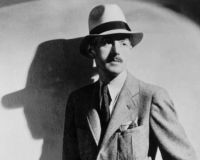 Dashiell Hammett,
Ruffian's Wife
(1925)
Dashiell Hammett,
Ruffian's Wife
(1925)
“ They had to do with pride in a man’s courage and hardihood: courage and hardihood that could make of thefts, of murder, of crimes dimly guessed, wrongs no more reprehensible than a boy’s apple-stealing. They had to do with the existence or non-existence of this gilding courage, without which a rover might be no more than a shoplifter on a geographically larger scale, a sneak-thief who crept into strangers’ lands instead of houses, a furtive, skulking figure with an aptitude for glamorous autobiography. ”
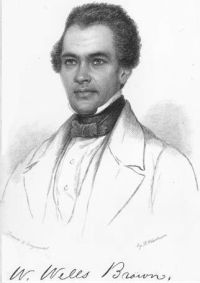 William Wells Brown,
The Rising Son; or, the Antecedents and Advancement of the Colored Race
William Wells Brown,
The Rising Son; or, the Antecedents and Advancement of the Colored Race
“ Ruffin’s elevation, is that he studied law while he was at his barber’s chair, and dependent upon it for a living.As a member of the Massachusetts Legislature, Mr. Ruffin exhibited scholarly attainments in his speeches that placed him at once amongst the foremost men of that body. As a speaker, he is interesting, for his addresses show that he gives his subjects a thorough canvassing before he delivers them. Mr. Ruffin is a good [Pg 542] student, and is destined, we think, to rise still higher in his profession. ”
 E. Phillips Oppenheim,
Peter Ruff and the Double Four
E. Phillips Oppenheim,
Peter Ruff and the Double Four
“ Peter Ruff answered. “I thought of wearing my brown, with a brown overcoat. What do you suggest?” “I like you in brown,” she answered, simply. “I should change, if I were you.” He smiled faintly. “I believe,” he said, “that you have a sort of superstition that as I change my clothes I change my humors.” “Should I be so very far wrong?” she asked. “Don’t think that I am laughing at you, Peter. The greatest men in the world have had their foibles.” Peter Ruff frowned. “We shall be away for several days,” he said. “Be sure that you take some wraps. It will be cold, crossing.” ”
Edward A. Freeman,
The Reign of William Rufus and the Accession of Henry the First…
(1882)
“ The words of the Chronicle. The dark words of the Chronicle are in truth more impressive than the tale, true or false, of Walter Tirel. Rufus was shot in his hunting from his own men. That is enough; his day was over. End and character of Rufus. A life was ended, stained with deeds which, in our history at least, stand out without fellow before or after, but a life in which we may here and there see signs of great powers wasted, even of momentary feelings which might have been trained into something nobler. ”
E. Phillips Oppenheim,
Peter Ruff and the Double Four
“ Ruff,” he said, “are easily manifest in you. Now hear our decision. Your wife shall be restored to you on the day when you take up this position to which you have become entitled. Sit down and listen.” Peter Ruff was a rebel at heart, but he felt the grip of iron. “During these four years when you, my friend, have been growing turnips and shooting your game, events in the great world have marched, new powers have come into being, a new page of history has been opened. ”
Edward A. Freeman,
The Reign of William Rufus and the Accession of Henry the First…
(1882)
“ Possibly the importance of Orderic, long growing, grows yet greater at the very end of our tale. And we still make a certain use of Wace. The story of the death of William Rufus is one of those in which it is desirable to look in all manner of quarters to which we should not commonly think of turning, not so much in search of facts, as to see how such a story impressed men’s minds, and what forms it took in various hands. ”
E. Phillips Oppenheim,
Peter Ruff and the Double Four
“ Peter Ruff answered. “Please take a chair.” Sir Richard took the easy-chair, and discovering a box of cigarettes upon the table, helped himself. Then his eyes fell upon Miss Brown. “Can’t do without your secretary?” he remarked. “Impossible!” Peter Ruff answered. “As I told you before, I am her guarantee that what you say to me, or before her, is spoken as though to the dead.” Sir Richard nodded. “Just as well,” he remarked, “for I am going to talk about a man who I wish were dead!” “There are few of us,” Peter Ruff said, “who have not our enemies.” ”
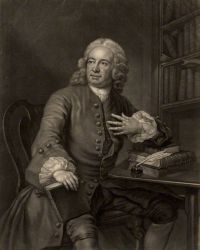 Archibald Bower,
The History of the Popes: From the Foundation of the See of Rome…
Archibald Bower,
The History of the Popes: From the Foundation of the See of Rome…
“ Baronius is certainly mistaken, and so was Ruffinus [1100] , whom he follows, in asserting the Heresy of Apollinaris to have been first condemned by the Council of Rome, since it is manifest, that the Doctrine of that Heresiarch had been condemned long before by Athanasius, Basil, and Epiphanius, in their Writings, and by the Council held at Alexandria in 362. But Ruffinus probably meant no more, than that those Errors were first condemned by the Council of Rome, under the Name, and together with the Person, of Apollinaris; which is undeniable. ”
E. Phillips Oppenheim,
Peter Ruff and the Double Four
“ At my last visit here, you were in Italy.” “I grow old,” she answered. “I leave Paris but little now. Where one has lived, one should at least be content to die.” “Madame speaks a philosophy,” Peter Ruff answered, “which as yet she has no need to learn.” The old lady turned to a man who stood upon her right: “And this from an Englishman!” she exclaimed. There were others who took Peter Ruff by the hand then. The servants were handing round coffee in little Sevres cups. On the sideboard was a choice of liqueurs and bottles of wine. ”
Archibald Bower,
The History of the Popes: From the Foundation of the See of Rome…
“ He maintained the Souls to have been created before the World; to have been confined to the Bodies, which they animated, as so many Prisons, to expiateexpiate there the Sins which they had committed; to be in perpetual Motion passing from one Body to another, and at last to become Angels. With the Three last Errors chiefly Ruffinus was charged by St. Jerom; and it was to clear himself from such an Imputation, that, in his Answer to Anastasius summoning him to Rome, he declared his Belief with respect to those Articles, styling his Answer on that Account an Apology. ”
Archibald Bower,
The History of the Popes: From the Foundation of the See of Rome…
“ To meddle in Disputes concerning Faith or Religion, is not at all the Province (says he, with the Words of St. Paul) of silly Women, laden with Sins, led away with divers Lusts, ever learning, and never able to come to the Knowlege of the Truth [1357] . But he speaks here of Melania, who was no less attached to Ruffinus than Marcella was to him.Jerom’s Chargeagainst Ruffinus. In the Periarchon were contained, without all doubt, many unfound and unwarrantable Notions, and Ruffinus corrected those only that related to the Trinity. ”
Edward A. Freeman,
The Reign of William Rufus and the Accession of Henry the First…
(1882)
“ Abbot Ralph, afterwards Archbishop of Canterbury. He underwent excommunication from the zeal of Bishop Serlo, and by the wrongs done by him to Abbot Ralph of Seez, which drove that prelate to seek shelter in England, he unwittingly gave England a worthy primate and Anselm a worthy successor. [498] One is inclined to wonder how such a man gained the special favour of the Conqueror, whose politic sternness had nothing in common with the fiendish brutality of Robert. [499] Perhaps, as in William Rufus, the worst features of his character may for a while have been hidden. ”
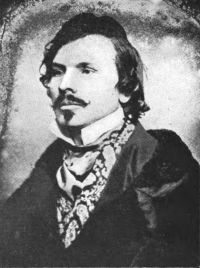 Mayne Reid,
The Quadroon: Adventures in the Far West
Mayne Reid,
The Quadroon: Adventures in the Far West
“ The encounter with Ruffin had ruined all our prospects. Whether the hunter were yet dead or alive, his presence would guide the pursuit. The way we had got off would easily be conjectured, and our hiding-place could not long remain undiscovered.What had passed would be likely to aggravate our pursuers, and strengthen their determination to capture us. Before Ruffin came up, there was yet a chance of safety. Most of those engaged in the pursuit would regard it as the mere ordinary affair of a chase after a runaway negro—a sport of which they might get tired whenever they should lose the track. ”
 Harold Lamb,
Rusudan — IV. Snow
(1927)
Harold Lamb,
Rusudan — IV. Snow
(1927)
“ When she had finished the prayer, Rusudan drew the fur hood over her head and went to the door; nor did she again offer her hand to guide the crusader. “I believed thy tale, when others did not,” she said, when he strode to her side. “Now I go to Tphilis. Thy road is clear—to the west, to Constantinople and thy home, once thy message is delivered. Wait, and one will come to guide you.” When he had opened the door and would have followed her out to the sledge, she motioned for him to remain in the chapel. ”
1911 Encyclopædia Britannica (1911)
“ He never became a priest. Ruffo went to Naples, where he was named administrator of the royal domain of Caserta, and received the abbey of S. Sophia in Benevento in commendam. When in December 1798 the French troops advanced on Naples, Ruffo fled to Palermo with the royal family. He was chosen to head a royalist movement in Calabria, where his family, though impoverished by debt, exercised large feudal powers. ”
Mayne Reid,
The Quadroon: Adventures in the Far West
“ They were going to Lynch me!The significant interrogatory, on account of the manner in which it was put, was hailed by the boys with a shout of laughter. Ruffin continued—“No; I guess you han’t heerd ov that ar justice, since yur a stranger in these parts, an’ a Britisher. You han’t got sich a one among yur bigwigs, I reckin. He’s the fellar that ain’t a-goin’ to keep you long in Chancery. No, by God! he’ll do yur business in double-quick time. ”
Amy Le Feuvre, Her kingdom (1929)
“ Ruffie will never be a prig. I remember, as a child, I always thought every grown-up person was naturally good, with the exception perhaps of thieves, drunkards and murderers. Don't you think it would be possible to raise your ideals above Ruffie's head and keep them there?"Justin looked at her with a smile. They were sitting together on the terrace, as they generally did after dinner, he smoking, she with a bit of work between her busy fingers. ”
 Anthony Hope,
The Prisoner of Zenda
(1921)
Anthony Hope,
The Prisoner of Zenda
(1921)
“ It is my belief that, given the necessary physical likeness, it was far easier to pretend to be king of Ruritania than it would have been to personate my next-door neighbor. ”
“ Cleric said he thought Virgil, when he was dying at Brindisi, must have remembered that passage. After he had faced the bitter fact that he was to leave the ‘Aeneid’ unfinished, and had decreed that the great canvas, crowded with figures of gods and men, should be burned rather than survive him unperfected, then his mind must have gone back to the perfect utterance of the ‘Georgics,’ where the pen was fitted to the matter as the plough is to the furrow; and he must have said to himself, with the thankfulness of a good man, ‘I was the first to bring the Muse into my country.’ ”
 John Ruskin,
Fors Clavigera (Volume 1 of 8)
John Ruskin,
Fors Clavigera (Volume 1 of 8)
“ You think it a great triumph to make the sun draw brown landscapes for you. That was also a discovery, and some day may be useful. But the sun had drawn landscapes before for you, not in brown, but in green, and blue, and all imaginable colours, here in England. Not one of you ever looked at them then; not one of you cares for the loss of them now, when you have shut the sun out with smoke, so that he can draw nothing more, except brown blots through a hole in a box. There was [10] a rocky valley between Buxton and Bakewell, once upon a time, divine as the Vale of Tempe; ”
 Howard Pyle,
The Merry Adventures of Robin Hood
Howard Pyle,
The Merry Adventures of Robin Hood
“ The Knight shook his head with a faint smile, but for all that, Robin's words made him more blithe of heart, for in truth hope, be it never so faint, bringeth a gleam into darkness, like a little rushlight that costeth but a groat. ”
 Niccolò Machiavelli,
The Art of War — Book 1
(1675)
Niccolò Machiavelli,
The Art of War — Book 1
(1675)
“ As I believe that it is possible for one to praise, without concern, any man after he is dead since every reason and supervision for adulation is lacking, I am not apprehensive in praising our own Cosimo Ruccelai, whose name is never remembered by me without tears, as I have recognized in him those parts which can be desired in a good friend among friends and in a citizen of his country. ”
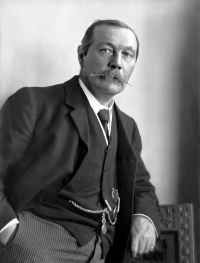 Arthur Conan Doyle,
Micah Clarke
Arthur Conan Doyle,
Micah Clarke
“ There was not a cloud in the sky, but the great heat had caused a haze to overlie the valley, gathering thickly along the winding course of the river, and hanging in little sprays and feathers over the woodlands which clothe its banks. Through this filmy vapour there broke from time to time fierce sparkles of brilliant light as the sun’s rays fell upon breastplate or headpiece. Now and again the gentle summer breeze wafted up sudden pulses of martial music to our ears, with the blare of trumpets and the long deep snarl of the drums. ”
 Frances Hodgson Burnett,
The Secret Garden
Frances Hodgson Burnett,
The Secret Garden
“ The robin flew from his swinging spray of ivy on to the top of the wall and he opened his beak and sang a loud, lovely trill, merely to show off. Nothing in the world is quite as adorably lovely as a robin when he shows off—and they are nearly always doing it. ”

