“ Among these persecuted denizens of the forest, the sable (Martes zibellina) , which closely resembles the pine-marten (Martes abietum) in shape and size, deserves to be particularly noticed, both for the beauty of its pelt, and its importance in the fur-trade. Sleeping by day, the sable hunts his prey by night; but though he chiefly relishes animal food, such as hares, young birds, mice, and eggs, he also feeds on berries, and the tasteful seeds of the Pinus cembra. His favorite abode is near the banks of some river, in holes of the earth, or beneath the roots of trees. ”
Sable (animal)
Definition and stakes
Quotes about “sable (animal)”
Homer B. Hulbert, In Search of a Siberian Klondike
“ If the sables are frozen they thaw them out by putting them under the bedclothes with them. When the skins are taken off, all present sit down and are silent, being careful that nothing is hanging on the stakes. The body of the sable is laid upon dried sticks, and these are afterward lighted, the body of the animal smoked, and then buried in the snow or the earth. ”
The Circle of Knowledge: A Classified…
“ Sable (Martes zibellina) , a species of Marten. The feet are covered with fur, even on the soles, and the tail is rather more bushy than in the martens. The length, exclusive of the tail, is about eighteen inches. The fur is brown, grayish yellow on the throat, and small, grayish-yellow spots are scattered on the sides of the neck. The whole fur is extremely lustrous, and hence of the very highest value. The sable is a native of Siberia, widely distributed over that country, and found in its coldest regions, at least wherever forests extend. It is a very wary animal, and not easily captured. ”
William Bingley, Useful Knowledge: Animals (1825)
“ As soon as a sable touches this to seize the piece of meat or fish which is placed for a bait, the beam falls and kills it. Sables are also caught by a kind of snares that are usually laid for grouse and hares, being peculiarly partial to the seeds that are employed as bait for these animals. Nets are sometimes used. When the hunter has discovered the trace of a sable in the snow, he pursues it till he arrives at the burrow of the animal, over the mouth of which he places his net, and then by smoke compels the animal to come out, when he is secured in the net. ”
James Augustus St. John, The Lives of Celebrated Travellers…
“ Such are the great sable hunters of Siberia, who feed indifferently on the bear, the fox, and the wolf. The sables, says Bell, are not caught in the same manner as other animals. The fur is so tender, that the least mark of an arrow, or ruffling of the hair, spoils the sale of the skin. In hunting them they only use a little dog and a net. When a hunter discovers the track of a sable upon the snow, he follows 146it sometimes for several days unintermittingly, until the poor animal, quite tired, takes refuge in some tall tree, for it can climb like a cat. ”
Mrs. Loudon,
Mrs. Loudon's Entertaining Naturalist
“ It lives in holes under the ground, and especially under the roots of trees; but sometimes makes its nest, like the squirrel, in the hollows of trees. The skin of the Sable is more valuable than that of any other animal of equal size. One of these skins, not more than four inches broad, has sometimes been valued at as high a rate as fifteen pounds; but the general price is from one to ten pounds, according to the quality. The Sable’s fur is different{65} from all others, its peculiarity being, that the hair turns with equal ease either way ”
Sir William Francis Butler,
The Wild North Land
“ Every now and again he finds one of his guillotines down, and underneath it lies a small, thick-furred animal, in size something larger than a ferret, something smaller than a cat. It is needless201 to describe the colour of the animal; from childhood upwards it is familiar to us. Most persons can recall the figure of maiden aunt or stately visitor, muffed, cuffed, boa’d and pelissed, in all the splendour of her sables. Our little friend under the dead fall is none other than the sable—the marten of North America, the sable of Siberia. ”
George Kennan,
Tent Life in Siberia
“ The sable rises upon his hind legs, puts his head into the hole, and the heavy log, set free by the dropping of the figure-four, falls and crushes the animal's skull, without injuring in the slightest degree the valuable parts of his skin. ”
The Living Animals of the World…
“ They are also gifted with magnificent coats, and constitute the most valuable source of choice furs. Sable, Marten, Mink, Wolverine, Ermine, Otters, and several others are among the most highly prized. Their claws are sharp, but not retractile. It is indeed fortunate that these creatures are so small in size, otherwise they would be among the greatest enemies of animal life. ”
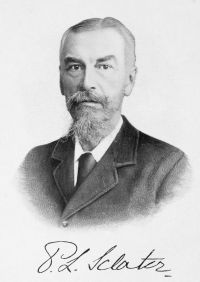
Philip Lutley Sclater,
The book of antelopes, vol. 4…
(1899)
“ The tail is long, and has a good wisp of hair at the end, which, like the tails of the Roan Antelope and the Waterbuck, swings from side to side as the animal gallops away. Like the Koodoo, the horns of the Sable are its chief glory, and the noble manner in which the head is carried by the buck when on the move is a splendid thing to see. Unlike all Deer, and nearly all Antelope, the Sable when running arches the neck instead or raising the chin ”
Gordon Stables,
Aileen Aroon, A Memoir
“ It is very wrong and unfair to bring home any animal, whether bird or beast, to one’s house without having previously made everything needful ready for its reception. Sable’s comfort had not been forgotten, and on her arrival we turned her into the back yard, where, in a small wooden house, was a bed of the cleanest straw, to say nothing of a dish of wholesome food, and a bowl of the purest water. The doors to the yard were locked, but no chain was put on the new pet, for the walls were seven feet high or nearly so, and her safety was thus insured. ”
Edmund Selous, The romance of the animal world (1905)
“ A sable antelope is a larger animal, I should say, than the Basuto pony I was riding—it stands higher, at any rate, and has a very formidable pair of horns, which it can use most adroitly, and with deadly effect. ”
Alfred Russel Wallace,
Darwinism (1889)
“ Whenever we find arctic animals which, from whatever cause, do not require protection by the white colour, then neither the cold nor the snow-glare has any effect upon their coloration. The sable retains its rich brown fur throughout the Siberian winter; but it frequents trees at that season and not only feeds partially on fruits or seeds, but is able to catch birds among the branches of the fir-trees, with the bark of which its colour assimilates. ”
Edward William Nelson, Wild Animals of North America
“ The martens are circumpolar in distribution, and the several species occupy northern lands from England, Europe, and northern Asia to North America. Of the Old World species, the Siberian sable is best known on account of the beauty of its fine, rich fur, which renders it the most valued of all in the fur markets of the world. ”
Gordon Stables,
Aileen Aroon, A Memoir
“ We had yet to learn what Sable’s jumping capabilities were. When I wrote next day, and told her old master that Sable had leapt the high wall and fled, the reply was that he regretted very much not having told me, that she was the most wonderful dog to jump ever he had seen or heard tell of.Meanwhile Sable was gone. But where or whither? The country is well-wooded, but there are plenty of sheep in it. Judging from Sable’s pig-fighting qualities, I felt sure she would not starve, if she chose to feed on sheep. ”
William Henry Giles Kingston,
With Axe and Rifle
“ The sable was evidently bent on having some porcupine meat for breakfast, and kept moving backwards and forwards, meditating a spring at the nose of its formidable antagonist; but, aware of the power of the latter’s tail, was waiting for a favourable opportunity to seize it. The porcupine, though so much larger, and naturally moving only at a slow pace, seemed aware of the superior agility of the sable, which would enable it to spring from side to side, or dash forward and attack it in front, when its armed tail would have been of no avail. ”
“ These are generally pitfalls, with loose boards placed over them, baited with fish or flesh; fire-arms or cross-bows are more rarely used, as they damage the skins. The traps must be frequently visited, and even then the hunter often finds that a fox has preceded him, and left but a few worthless remnants of the sable in the snare. Or sometimes a snow-storm overtakes him, and then his care must be to save his own life. Thus sable-hunting is a continual chain of disappointments and perils, and at the end of the season it is frequently found that the expenses are hardly paid. ”
John Guille Millais,
Life of Frederick Courtenay Selous…
“ When the hunter got up and killed the sable it was found that the gallant antelope in defending itself with its scimitar-like horns had killed outright four valuable dogs and badly wounded four more. The strength and rapidity with which a sable bull uses its horns is a wonderful thing to see. When cornered either by a lion or dogs the sable lies down and induces the enemy to attack its flanks. ”
James George Frazer,
The Golden Bough: A Study in Magic and Religion…
“ Respect shewn to dead sables. Bones of sables and beavers kept out of reach of dogs, lest the spirits of the dead animals should be offended. When Siberian sable-hunters have caught a sable, no one is allowed to see it, and they think that if good or evil be spoken of the captured sable no more sables will be caught. A hunter has been known to express his belief that the sables could hear what was said of them as far off as Moscow. ”
Henry Wood Elliott,
Our Arctic province
(1906)
“ All such ornaments are carefully preserved and handed down from generation to generation, some of them being made of white sable—an exceedingly rare skin—for which high prices are paid, as much as twenty or thirty beavers or otters for one small skin. The women hold in their hands one or two eagle-feathers, and tie around the head a narrow strip of white sable. Each family, grouping itself behind its own stone lamp, chants in turn in mournful measure a song composed for the occasion. ”
Alfred Edmund Brehm,
From North Pole to Equator: Studies of Wild Life and Scenes in Many Lands
(1896)
“ As a beast of the chase, only the sable takes higher rank. For the sake of the fox alone professional hunters undertake winter expeditions which often take them as far into the heart of the forest as the sable-hunters are wont to penetrate. Especially for it do the Ostiaks and Samoyedes set their spring-bows, and they spare no trouble in their search for the burrow where the young are hidden, not in order to kill them, but that they may rear them carefully and tenderly till they become large and strong, and gain, in their first or second winter, their beautiful fur. ”
James George Frazer,
The Golden Bough: A Study in Magic and Religion…
“ Another, though minor, cause of the diminished take of sables was, he alleged, that the world is now much worse than it used to be, so that nowadays a hunter will sometimes hide the sable which he has got instead of putting it into the common stock. This also, said he, the sables cannot abide.686 A Russian traveller happening once to enter a Gilyak hut in the absence of the owner, observed a freshly killed sable hanging on the wall. ”
Washington Irving,
Astoria
(1890)
“ The rich dark shades of the sable, and the snowy whiteness of the ermine, the great depth, and the peculiar, almost flowing softness of their skins and fur, have combined to gain them a preference in all countries, and in all ages of the world. ”
William Bingley, Useful Knowledge: Volume 3. Animals
“ There is a mode of dyeing the light-coloured furs darker, and also of dyeing other furs to imitate sables; but these are easily discovered by their having neither the smoothness nor the gloss of furs in a natural state.Sables are very sprightly and active little animals. They form holes or burrows under ground in forests, and the banks of rivers, and subsist on small quadrupeds, birds, eggs, and other animal substances of different kinds.56. The FERRET (Mustela furo) is a species of weasel, which, in shape, somewhat resembles the martin (54) ”
My Strange Rescue, and Other Stories of Sport and Adventure in Canada
“ Besides the rabbits, there have been, at different times, the following animals upon Sable Island—namely, the black fox, white bear, walrus, and seals; wild horses, cattle, and swine; rats, cats, and dogs. ”
Gordon Stables,
From Squire to Squatter: A Tale of the Old Land and the New
“ Towards the horizon to-night there was a deep saffron or orange fading above into a kind of pure grey or opal hue, with over it all a light blush of red, and hurrying away to the south, impelled by some air-current not felt below, was a mighty host of little cloudlets of every colour, from darkest purple to golden-red and crimson.There was now and then the bleating of sheep—sheep without a shepherd—and a slight tinkle-tinkle, as of a bell. It was in reality the voice of a strange bird, often to be found in the neighbourhood of creeks and pools. ”
baron de Jean-Baptiste-Barthélemy Lesseps, Travels in Kamtschatka, During the Years 1787 and 1788…
“ They chuse for their chace the seasons when the fur of the animal is in its greatest perfection. Sables are hunted in the beginning of winter. These animals live commonly in trees, and are called after their name; a part of the fur nearest the skin being of the same colour as those which they most frequent, as the birch, the fir, &c. ”
Cassell's Natural History, Vol…
“ The Sable is found in the northern parts of Asia, being especially abundant between the Lena and Kamstchatka. It differs markedly from the true Martens in the form of its head, which is conical, the apex of the cone being formed by the pointed snout, while from its base project the pointed, and, for a Mustela, large ears. The legs and feet, too, are larger and stronger than in the other species of this genus.Sable-hunting is, naturally, a very important branch of industry, and forms the chief occupation of many of the Siberian tribes. The work is by no means an easy one ”
Richard Lydekker, Animal portraiture (1912)
“ In the forest martens and sables are much less difficult to approach than many other wild animals; but they nevertheless display a keen aversion to the neighbourhood of human dwellings, which they never voluntarily approach. Martens and sables, unlike their smaller relative the stoat or ermine, do not turn white in winter; for the very sufficient reason that, on account of being arboreal animals, they would be extremely conspicuous in such a livery. ”
Various, Robert Merry's museum, Volumes III-IV… (1842)
“ The Siberian Sable-Hunter. CHAPTER VIII. A weary journey.—Meeting with Tungusees.—Grand attack of wolves.—The first sables killed.After securing the skin of the bear, the travellers proceeded on their journey, the weather still continuing clear, but intensely cold. They were, however, well secured by furs, and they plodded cheerfully on, over the snow-crust. There was little variety, for the country was generally level, and often they marched on for hours without meeting a single object of the least interest. No villages were to be seen over the wide wastes; not a human being met the view ”
Virgil,
Eclogues and Georgics
(1910)
“ The great Sabellian boar charges with whetted tusks, tramples the earth before him and chafes his flanks on a tree, and on this side and that hardens his shoulders against wounds. What of the youth, through whose frame unrelenting love darts his mastering fire? ”
Gilbert White,
The Natural History of Selborne…
“ Avenues, and long walks under hedges, and pasture-fields, and mown meadows where cattle graze, are her delight, especially if there are trees interspersed; because in such spots insects most abound. When a fly is taken a smart snap from her bill is heard, resembling the noise at the shutting of a watch- case; but the motion of the mandibles are too quick for the eye.The swallow, probably the male bird, is the excubitor to house- martins, and other little birds, announcing the approach of birds of prey. ”
Philip Henry Gosse,
A Year at the Shore
“ In general, the Sabellæ inhabit tubes which are not calcareous or shelly; they are composed of a soft flexible substance somewhat resembling wet parchment, made [Pg 295] of a secretion from the animal’s body, in which the impalpable muddy sediment which the waves agitate, consisting of decomposed organic matter for the most part, is interwoven. The tissue so made is sufficiently tough and enduring, retaining its form long after the animal has died out of it. ”