“ In the ensuing spring the grass mounts anew; is again covered with sand in the winter; and thus a hill or ridge continues to ascend as long as there is a sufficient base to support it, or till the circumscribing sand, being also covered with beach-grass, will no longer yield to the force of the winds.” Sand-hills formed in this way are sometimes one hundred feet high and of every variety of form, like snow-drifts, or Arab tents, and are continually shifting. The grass roots itself very firmly. ”
Sand ridge
Definition and stakes
Quotes about “sand ridge”
Arnold Henry Savage Landor,
Across Coveted Lands; or, a Journey from Flushing…
“ The great expanse of irregular surface soil, with its innumerable obstacles and undulations, was, of course, bound to give curious results in the sand accumulations south of it, where the sand could deposit itself in a more undisturbed fashion and was affected by purely natural causes. Of course, sand hills do not accumulate in the flat desert unless some obstacle—a mere pebble, a tamarisk shrub, a ridge, or a stone, is the primary cause of the accumulation. ”
James Cook, Captain Cook's Journal During His First Voyage Round the World (1893)
“ It is in general low, except the Mountain just Mentioned, and the Soil to all appearance nothing but white sand thrown up in low irregular hills, lying in Narrow ridges parrallel with the shore; this occasioned me to name it Sandy Bay. [46] The first ridge behind the Sea beach is partly cover'd with Shrubs, Plants, etc., but the second ridge hath hardly any green thing upon it, which induced me to think that it lies open to the Western Sea. [47] As barren as this land appears it is not without inhabitants. ”

Randall Parrish,
The Strange Case of Cavendish
“ Because there is a swale there of hard sand, which is easily followed, and leaves no trail. On either side for miles the sand is in drifts, and no two horses would ever pull a wagon through it. This hard ridge, which is more rock than sand, goes straight south to Badger Springs, the only place to get water. ”
Andrew Lang,
The Secret of the Totem
“ If he consents, other men make two adjacent ridges of sand, and level them into one larger ridge, while a man, usually the selected lover, pours sand from the ridge over the upper part of his thighs, "buries the Pirrauru in the sand." ”
David Carnegie, Spinifex and Sand (1898)
“ Immediately to the North of the outcrop runs a high sand-ridge, covered sparsely with acacia and spinifex. On the top of the ridge are three conspicuously tall dead mulga trees. From the ridge looking West, North, North-East, and East nothing is visible but parallel sand-ridges running N.E. To the South-West can be seen the high ground on which is the rock-hole (Mulundella) . ”
David Carnegie, Spinifex and Sand (1898)
“ The troughs and waves seem to be corrugations in the surface of greater undulations; for during a day's march or so, on reaching the top of one ridge, our view forwards was limited to the next ridge, until a certain point was reached, from which we could see in either direction; and from this point onwards the ridges sank before us for a nearly equal distance, and then again they rose, each ridge higher than the last. Words can give no conception of the ghastly desolation and hopeless dreariness of the scene which meets one's eyes from the crest of a high ridge. ”
David Wynford Carnegie,
Spinifex and Sand
“ Future experience showed us that further North the gravel becomes small and smaller until it disappears, the rolling sandhills giving place to regular ridges. If this is the case viz., that the hills and ranges are gradually rotting away until they disappear, leaving only gravel behind, which, in its turn, decays and decays until only sand remains, then in the course of ages the whole of this region will be covered with ridge upon ridge of sand formed by the wind, whose powers so far have been checked by the weight of the gravel. ”
Thomas C. Chamberlin,
Geology
(1906)
“ Sand is blown up the gentler windward slope to the crest of the ridge and falls down on the other side. The moment it falls below the crest of the ridge to leeward, it is protected against the wind, and is likely to lodge. Wear on the windward side is about equal to deposition on the leeward, and the result is the orderly progression of the ripples in the direction in which the wind is blowing, just as in the case of dune ridges. ”
Ernest J. Chambers,
The Unexploited West
“ Farther up the general character of the country changes into rolling plains of sand, with more or less vegetation. In places bare sand ridges are seen of fine yellow colour. This again changes at the upper end of the lake. There the formation is more broken, solid rock ridges are few, but large boulders are numerous, and sand gets coarser, I might say gravelly, a mixture of clay and gravel, with boulders more or less numerous. All the country is comparatively flat; there are no high hills anywhere more than two hundred to three hundred feet above water. ”
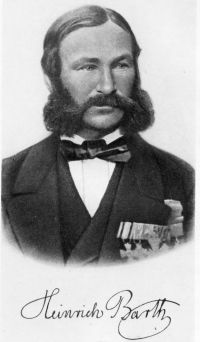
Heinrich Barth,
Travels and discoveries in North and Central Africa
(1890)
“ Then followed another narrow range of sand-hills, succeeded by a barren open plain, and then another very considerable bank of sand, leaning on a granite ridge. After a steep ascent of forty-five minutes, we reached the highest crest, and obtained an extensive prospect over the country before us—a desert plain, interspersed by smaller sand-hills and naked ledges of rock, and speckled with ethel-bushes half overwhelmed by sand, at the foot of a higher range of sand-hills. ”
David Wynford Carnegie,
Spinifex and Sand
“ I noticed a considerable change in the country to the East, over which there spread a forest of desert oak, and near the sandhills thickets of ti-tree. The well seems to be at the head of an ill-defined watercourse, which, lower down, runs between an avenue of bloodwoods. Close to the well are several large ant-heaps, and from the sandhill above it little can be seen; but north of the well one mile distant is a high ridge of sand, from which is visible a prominent square hill, bearing 334° distant eighteen miles ”
David Wynford Carnegie,
Spinifex and Sand
“ Permanent pools are numerous, and occur wherever a ridge of sandstone rock runs across the course of the creek. On either side of the creek fine grass-plains spread East and West. The further South the creek goes, the less good is the country on the East side ”
David Carnegie, Spinifex and Sand (1898)
“ Between the foot of the ridge and a stony slope the well was situated — the usual little round hole in the sand — a small patch of roly-poly grass making a slight difference in the appearance of the country immediately surrounding the hole. As well as this roly-poly, we were delighted to see a few scattered plants of parakeelia, and lost no time in unloading and hobbling the camels, who in their turn made all haste to devour this life-giving vegetation. Camp made, we set to work on the well, sinking our boxes as before, our black friends watching us with evident interest. ”
David Carnegie, Spinifex and Sand (1898)
“ On the inner slopes of these can be seen the crowning glory of the spot viz., an abundance of splendid green thistle (Trichodesma zeylanicum) , tall and juicy, growing amongst acacia and other bushes. Outside this, beyond this area of perhaps four hundred yards in diameter, stretching away to the horizon, ridge upon ridge of desolate sand, black and begrimed by the ashes of recently burnt spinifex, from which the charred stumps of occasional gum trees point branchless to the sky. What chance of finding such a place without the help of those natives to whom alone its existence was known? ”
David Carnegie, Spinifex and Sand (1898)
“ What a brute I felt as he turned his great eyes reproachfully upon me! "Never mind, Misery, old chap, it must be done to save your life!" At last I reached a ridge within one hundred yards of the camp, and here Breaden met me, bringing with him four gallons of water and the welcome news that the others had captured two bucks who had shown a well three miles north.This water saved Misery's life, and was just in time. We reached camp as the camels were reloaded and ready to start for the well under the guidance of the two bucks. ”
David Carnegie, Spinifex and Sand (1898)
“ Same miserable country — roasting sun — no feed for camels — camp on crest of high ridge in hopes of getting a breath of air — thousands of small ants worry us at night — have to shift blankets half a dozen times. ”
David Carnegie, Spinifex and Sand (1898)
“ The sand has been formed (blown, I suppose) into irregular ridges, running more or less parallel, but in no one fixed direction. From the edge of the desert to Mount Worsnop, a distance of nearly two hundred miles in a straight line, the country presented the same appearance. First a belt, eight to ten miles wide, of sand-ridges from thirty to fifty feet high, with a general direction of E. by S. and W. by N.; then a broad sand-flat of equal breadth, either timbered with desert gums, or open and covered with spinifex breast-high, looking in the distance like a field of ripe corn ”
Augustus Charles Gregory,
Journals of Australian Explorations
“ Left the camp at 7.0 a.m. and continued a south-easterly course, crossing a succession of sandy valleys and broken sandstone hills; the strata horizontal, and lamina dipping to the north and east generally, but sometimes in the opposite direction; the soil poor and sandy, producing little besides white-gum and triodia. At noon ascended a high ridge, from which we saw a broad valley to the south-east, beyond which was a range of flat-topped hills terminating abruptly at the northern end, which bore east by north. ”
David Wynford Carnegie,
Spinifex and Sand
“ A steep gorge, not very easy for camels to pass along, led up to the rock-hole, which lies under a sheltering projection of rock. From the rock above a good view is obtained; sand-ridges to the West, to the North and East tablelands. ”
David Livingstone,
Missionary Travels and Researches in South Africa
“ The soil is dark loam, as it is every where on spots reached by the inundation, while among the trees it is sandy, and not covered so densely with grass as elsewhere. A sandy ridge covered with trees, running parallel to, and about eight miles from the river, is the limit of the inundation on the north; there are large tracts of this sandy forest in that direction, till you come to other districts of alluvial soil and fewer trees. The latter soil is always found in the vicinity of rivers which either now overflow their banks annually, or formerly did so. ”
Augustus Charles Gregory,
Journals of Australian Explorations
“ As our route was at a greater distance from the creek than in tracing it down, it gave a better opportunity of ascertaining the nature of the country beyond the influence of inundation; to the north-west a vast plain traversed by low ridges of gravel and drift sand, clothed with a scanty growth of triodia and a few hakea bushes, rose gradually from the creek, but on the south-east a more abrupt sandstone slope terminated in a similar plain of somewhat greater elevation, and showed that we were still within the bounds of the desert. Moderate breeze from the north-west changing to north-east ”
Ludwig Leichhardt,
Journal of an Overland Expedition in Australia
“ I passed some gentle well-grassed slopes of narrow-leaved Ironbark and spotted gum; and also several basaltic ridges, which head out into small plains gently sloping to the east and north-east. They are formed of a rich black soil, and generally a shallow creek meanders through them: sandstone ridges formed their boundary lower down, where, at their foot, water-holes generally existed, either with a constant supply of water, or readily filled by thunder-showers. The basaltic ridges, as well as the plains, were covered with a fine crop of dry grass ”
Various, Popular Science Monthly (1893)
“ First, a breakwater or dike is constructed—occasionally a mere plank fence—against which the sand from the beach soon forms long rows of dunes. These sand-hills, usually the enemies of the land, being thus hindered from drifting inland, are impressed into the service of the land, and become its coast-guard against the invading waves. The second step is to plant them with beach grass, or some other sand-loving plant, to bind the sand together, and, by the succession of growth and decay, finally to form a soil. ”
John C. Van Dyke,
The desert
(1901)
“ The heave of the enormous ridge, the loom of the domed top, the bulk and body of the whole are colossal. Rising as they do from flat sands they give the impression of things deep-based—veritable islands of porphyry bent upward from a yellow sea. They are so weather-stained, so worn, that they are not bright in coloring. Usually they assume a dull garnet-red, or the red of peroxide of iron; but occasionally at sunset they warm in color and look fire-red through the pink haze. ”
Grenville A. J. Cole, Rocks and Their Origins (1912)
“ The flint gravels that cover much of the upland in the New Forest may also be borne in mind, as presenting the worst features of highly siliceous lands.In a semi-arid climate, or one with only seasonal rains, the processes by which sandstone begets sandstone tend to develop desert wastes. The soils produced by weathering do not cake together, and are carried away by wind during the drier months. The bare rock appears over broad surfaces, just as it does in storm-swept limestone areas, and any hollow where shelter is afforded tends to become filled with sand (see Fig. 5) . ”
Raymond John Pool, Popular Science Monthly (1912)
“ In the phim thickets near the river the vegetation often becomes so dense that it is almost impossible to penetrate to the river's edge. The soil in these places is very rich and moist, so that many species of the shade plants of moist rich woodlands find in such thickets very favorable conditions. On the open areas of the river flats buffalo grass and grama grass constitute the best forage known in the Sand Hills. These low, sod-forming grasses are especially valuable as winter forage. ”
T. L. Mitchell,
Three Expeditions into the Interior of Eastern Australia…
“ The hills, if the bare eminences might be so-called, were composed of a red sandy soil producing only salsolae and composite plants, but no grass. This red sand was so loose that the wheels of the carts sank in it at some places to the axles. There were bold undulations where we encamped; all declining towards the hollow connected with the river. There was also a little hill overlooking plains to the north and west. ”
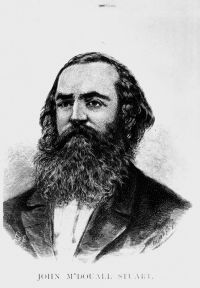
John McDouall Stuart,
Explorations in Australia
“ As to surface water, my men have neither the strength nor the appliances for digging. There is plenty of water under this sand, but having only a small tin dish, the labour is too great. My men have now lost all their former energy and activity, and move about as if they were a hundred years old; it is sad to see them; our horses, too, suffer very much from their sore backs. On the south side of the creek are some isolated hills, chiefly composed of limestone, ironstone, quartz, and granite. ”
Augustus Charles Gregory,
Journals of Australian Explorations
“ To the south the country was slightly depressed for ten or fifteen miles, and then rose into an even ridge or plain, the whole country appearing to be covered with acacia and eucalyptus scrub. To the west and north the view was more extended; the low ridge of sandstone hills extended to the west-north-west, on the northern side of the grassy flats for thirty miles, and only broken by a large valley from the north. Throughout its whole extent this range appeared to rise to 150 or 200 feet above the plain, and had the appearance of being the edge of a level tableland. ”
John Davis, Tracks of McKinlay and party across Australia (1863)
“ To north, termination of sand hills with stony flats; north-west, unbroken horizon; from west-north-west round towards south-west, a sand hill in the distance; altogether a dreary spot. A heavy timbered creek comes in from south-west into the desert, and appears in the distance to have a tributary from east-south-east; the timber ceases as it comes on to the open desert plain, between four and five miles from this. Quite an unbroken horizon to the west of north-west for some distance. The sand hills that are in view are small and detached. ”
David Livingstone,
The Last Journals of David Livingstone…
“ Then the ridges on which they planted maize, beans, cassava, and sorghum, and which they find necessary to drain off the too abundant moisture of the rains, still remain unlevelled to attest the industry of the former inhabitants; the soil being clayey, resists for a long time the influence of the weather. These ridges are very regular, for in crossing the old fields, as the path often compels us to do, one foot treads regularly on the ridge, and the other in the hollow, for a considerable distance. ”