
“ Accordingly after breakfast, having rubbed some oil upon my leg, which was very sore from the cub’s tongue, I took the driver, Tom, who did not half like the business, and having armed myself with an ordinary double No. 12 smoothbore, the first breechloader I ever had, I started. I took the smoothbore because it shot a bullet very well; and my experience has been that a round ball from a smoothbore is quite as effective against a lion as an express bullet. The lion is soft, and not a difficult animal to finish if you hit him anywhere in the body. A buck takes far more killing. ”
Quotes about “smoothbore”
 Mary Hallock Foote,
In Exile, and Other Stories
Mary Hallock Foote,
In Exile, and Other Stories
“ Young sycamores and cottonwoods shut out the sun above; their tangled roots, interlaced with vines still green and growing, trailed over the edge of the rock, where a mass of earth had fallen; green moss lined the hollows of the rock, and water-plants grew in the dark pools below. The strollers had left behind them the heat and glare; only the breeze followed them into this green stillness, stirring the boughs overhead and scattering spots of sunlight over the wet stones. ”
 Albert Bigelow Paine,
The Hollow Tree and Deep Woods Book
Albert Bigelow Paine,
The Hollow Tree and Deep Woods Book
“ It was a beautiful light, and Smoothe fastened it to the tip top of the tall tree, so that it would swing in any direction, and the bright round thing behind it threw the light just where he wanted it. It burned oil, and he used to fill it up with chicken oil in the evening and it would [Pg 76] burn all night and make a better light than the fire ever did. So all he had to do was to keep it filled and turned in the direction that my folks were harvesting their chicken crop, and then he could go to bed and sleep all night if he wanted to. ”
United States. National Park Service, Great Smoky Mountains National Park…
“ Going up the side of the knob, we quickly leave the forest and begin tunneling through dense thickets of rhododendron and mountain-laurel. Trees don’t grow here at all. On top, the shrubs become smaller and we can look out over them. Perched on the end of a spur from the side of a giant valley, we look up to high ridges on both sides and down to a stream far below. Is it our imagination, or do we really hear that stream whispering to us of the humid, secret world way down there under the big trees? For many minutes we are lost in contemplation of the Smokies’ green-blue spaces. ”
 William J. Long,
How animals talk
(1919)
William J. Long,
How animals talk
(1919)
“ Soon the moss grows deeper underfoot, with a coolness that speaks of perpetual moisture. The forest becomes dense, almost bewildering; here a “black growth” of spruce or fir, there a tangle of moosewood, yonder a swale [241] where impenetrable alder-thickets make it impossible to hold a straight course. Because all this growth is useless to the lumberman, there is no cutting to be seen; but because I have passed this way before, instinctively following the same course like an animal, a faint winding trail begins to appear, with a bent twig or a blazed tree at every turn to give direction. ”
Charles J. Herr, See America First
“ The ground on each side of the stream was a very garden of wild bloom. The sumac made a low border of glowing color; back of this flaming mass grew dogwood and Judas trees; while walnut, maple and linden, overrun with wild grape and woodbine, made mounds of bright green foliage, from which the ringing notes of the cardinal came to us above the song of the water.Every rock and ledge was cushioned with moss and ferns, intermingled with long green ropes of woodbine, Here were vast hanging gardens of many gradations of green, softened by gleams of pale light from the afternoon sun. ”
United States. National Park Service, Great Smoky Mountains National Park…
“ Each, through its interaction with plants and animals, affects the total fabric of Smokies life. Far below, the trees of a cove forest march up a stream valley; on the slopes above them spreads a mantle of oaks. A narrow ridge far down and off to the right bears the dark green of pines. Nearer, we see the ragged lower edge of the spruce-fir forest, where it fingers into the northern hardwoods below it. But we sense an overall unity because each kind of forest merges into the next, creating an unbroken mantle that lies over all the ridges as far as the eye can see. ”
 Frank Bolles,
At the North of Bearcamp Water
Frank Bolles,
At the North of Bearcamp Water
“ Anything more in contrast with the gloom of a northern forest would be hard to discover. Much of the ground near the brook was covered by yew bushes, on which, brilliant as jewels, gleamed their pendent and slightly attached red berries. The mosses and lichens were the glory of the wood. Never parched by thirst in these perpetual shades, they grew luxuriantly on boulders, fallen logs, standing trees, the faces of ledges, and over the moist brook banks and beds of leaf mould. What the great forest was to us, that the mosses must be to the minute insects which live among them. ”
 Fridtjof Nansen,
Farthest North, Vol. I
Fridtjof Nansen,
Farthest North, Vol. I
“ I can feel the damp moss in which my foot sinks softly and noiselessly; the brook, released from the winter bondage, is murmuring through the clefts and among the rocks, with its brownish-yellow water; the air is full of the scent of moss and pine-needles; while overhead, against the light-blue sky, the dark pine-tops rock to and fro in the spring breeze, ever uttering their murmuring wail, and beneath their shelter the soul fearlessly expands its wings and cools itself in the forest dew. ”
 Charmian London,
Our Hawaii
(1917)
Charmian London,
Our Hawaii
(1917)
“ A pest of moss has overspread and destroyed great numbers of the large growth. Among living trees, I saw a few of the naia, false sandalwood, pricked out bright-green by stray sunbeams.Over the tussocks of grass we raced, senses aching with very pleasure of motion in so boundless a survey. The declining earth stretches in an unbroken expanse; then suddenly, under a clearing sky, an unguessed deep serration yawns at our feet. The little horses drop easily from the prairie into tropic ferns and flowering lehua, where the ground is lush, the air hot as a greenhouse. ”
 Harriet Beecher Stowe,
The Pearl of Orr's Island: A Story of the Coast of Maine
Harriet Beecher Stowe,
The Pearl of Orr's Island: A Story of the Coast of Maine
“ She was cowering down, on a loose, spongy bed of moss, which was all threaded through and through with the green vines and pale pink blossoms of the mayflower, and she felt its fragrant breath streaming up in the moist moonlight. As she leaned forward to look through a rocky crevice, her arms rested on a bed of that brittle white moss she had often gathered with so much admiration, and a scarlet rock-columbine, such as she loved to paint, brushed her cheek,—and all these mute fair things seemed to strive to keep her company in her chill suspense of watchfulness. ”
Harriet Beecher Stowe,
Dred: A Tale of the Great Dismal Swamp
“ Climbing vines, and parasitic plants, of untold splendor and boundless exuberance of growth, twine and interlace, and hang from the heights of the highest trees pennons of gold and purple,—triumphant banners, which attest the solitary majesty of nature. A species of parasitic moss wreaths its abundant draperies from tree to tree, and hangs in pearly festoons, through which shine the scarlet berry and green leaves of the American holly.What the mountains of Switzerland were to the persecuted Vaudois, this swampy belt has been to the American slave. ”
Phil Robinson, Under the Sun — Hunting of the Soko (1882)
“ The ground itself was bare of vegetation, except where, here and there, monster fungi clustered, like a condemned invoice of umbrellas and parasols, round some fallen giant of the forest, or where, in a screen of blossom, wonderful air-plants filled up great spaces from tree-trunk to tree-trunk. At intervals we crossed rivulets of crystal water, icy cold, finding their way as best they might from hollow to hollow over the centuries’ layers of fallen leaves, and along their courses grew in rich profusion masses of a broad-leafed sedge, that afforded the panther safe covert and easy couch ”
Leo E. Miller, In the Wilds of South America
“ One result of the great amount of moisture is that there is an increase in density of the lower growth, and the branches are covered with hanging moss.As one moves quietly along the narrow lanes, enclosed on both sides by walls of trees, the lofty tops of which form a leafy vault overhead, he cannot fail to be impressed with the great breathless silence of the forest. The gloomy solitude seems pregnant with mysterious forces that draw the thoughts of the lonely wayfarer to far-off regions of blissful oblivion. ”
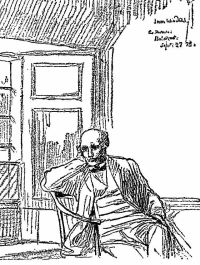 John Richard de Capel Wise,
The New Forest: its history and its scenery
(1863)
John Richard de Capel Wise,
The New Forest: its history and its scenery
(1863)
“ For the botanist, along the hedge banks, the blue and slate-coloured soapwort is growing throughout the summer and autumn, with purple cat-mint and wild clary. In the waste places the thorn-apple shows its white blossoms; whilst red stacks of fern and black turf ricks stand by every cottage door to remind us how close we are to the Forest. ”
Harriet Beecher Stowe,
Palmetto-Leaves
“ FTER a cold, damp, rainy week, we have suddenly had dropped upon us a balmy, warm, summer day,—thermometer at eighty; and every thing out of doors growing so fast, that you may see and hear it grow.The swampy belt of land in front of the house is now bursting forth in clouds of blue iris of every shade, from the palest and faintest 138 to the most vivid lapis-lazuli tint. The wild-rose-bushes there are covered with buds; and the cypress-trees are lovely with their vivid little feathers of verdure. This swamp is one of those crooks in our lot which occasions a never-ceasing conflict of spirit. ”
 Charles Warren Stoddard,
Over the Rocky Mountains to Alaska
Charles Warren Stoddard,
Over the Rocky Mountains to Alaska
“ Out of the fruitful dust of these deposed monarchs of the forest sprang a numerous progeny—lusty claimants, every one of them,—their foliage feathery and of the most delicate green, being fed only by the thin sunshine that sifts through the dense canopy, supported far aloft by the majestic columns that clustered about us. Under foot the russet moss was of astonishing depth and softness. One walks with care upon it, for the foot breaks through the thick matting that has in many cases spread from log to log, hiding treacherous traps beneath. ”
Adele E. Thompson, Nobody's Rose (1912)
“ Its thick crowding bushes gleamed with coral-hued berries, its tangled depths were rich with every tone of tint or color, and through the centre a little river, set thick with lily pads, loitered along with the laziest possible current. Not a few of the trees and shrubs which bordered the narrow roadway, made, [Pg 124] as Ben explained, by filling in earth through the swamp—were draped with festoons of wild clematis vines in their autumn beauty, set with fluffy masses of filmy, smoke-hued fringe. ”
 Sabine Baring-Gould,
Arminell, a social romance
(1896)
Sabine Baring-Gould,
Arminell, a social romance
(1896)
“ Down a rocky cranny fell a dribbling stream, the drainage of the wood above; in summer it was but a distillation, sufficient to moisten the beds of moss and fern that rankly grew on the hedges beneath it, and in winter never attaining sufficient volume to dislodge the vegetation it nourished. ”
United States. National Park Service, Great Smoky Mountains National Park…
“ When we sense the end of the storm, we head toward our day’s goal, the top of the Smokies. The deciduous forest rapidly turns into a coniferous one, the beech, birch, maple, buckeye, and others giving way to a nearly solid stand of spruce and fir. ”
 Mary Jane Holmes,
Meadow Brook
(1858)
Mary Jane Holmes,
Meadow Brook
(1858)
“ Weeds choke the garden walks, and the moss grows green and damp on the old stone wall. Even the brook which ran so merrily past our door has been stopped in its course, and its sparkling waters, bereft of freedom, now turn the wheel of a huge saw-mill, with a low and sullen roar. ”
Once a Week, New Series, Volume VII… (1871)
“ The feeling did not leave her through the day, and she wandered out into the woods that lay above the house, up to the pine grove, which was her favourite retreat; where, through the tall, straight stems, the sun quivered in amber streaks, and changed the moss from palest azure green to deepest emerald, or from flaming yellow to glowing crimson-brown. ”

“ Soon the ground is green with mosses and liverworts and dotted with small fungi, making the first crop of the season. Then the grass leaves weave a new sod, and the exceedingly slender panicles rise above it like a purple mist, speedily followed by potentilla, ivesia, bossy orthocarpus, yellow and purple, and a few pentstemons. Later come the daisies and goldenrods, asters and gentians. Of the last there are three species, small and fine, with varying tones of blue, and in glorious abundance, coloring extensive patches where the sod is shallowest. ”
 Juliana Horatia Ewing,
Last Words: A Final Collection of Stories
Juliana Horatia Ewing,
Last Words: A Final Collection of Stories
“ If the weather is hot and the soil light, it is well occasionally to leave the short clippings of one mowing upon the lawn to protect the roots. [117] I do not know if it becomes unmanageable, but, in moderation, I think chamomile a very charming intruder on a lawn, and the aromatic scent which it yields to one's tread to be very grateful in the open air. It is pleasant, too, to have a knoll or a bank somewhere, where thyme can grow among the grass. But the subject of flowers that grow well through grass is a large one. ”
John S. Robb, The Swamp Doctor's Adventures in The South-West
“ An extensive arbour was in the middle of the garden—the finest and most extensive in the swamp—and this was literally covered with the ruddy clusters of grapes, now in the fullest tide of ripeness. “Now or never,” I say, was the word with Jerry. Making a desperate effort, he faltered out, “Miss Mary, your father has a very fine garden! shall we go look at the grapes? I am very fond of them, Miss Mary! do you like grapes, Miss Mary? Ha! ha!”—the cold sweat bursting out from every pore. ”
 W. H. Hudson,
Green Mansions: A Romance of the Tropical Forest
W. H. Hudson,
Green Mansions: A Romance of the Tropical Forest
“ I was entombed in thick blackness—blackness of night and cloud and rain and of dripping foliage and network of branches bound with bush ropes and creepers in a wild tangle. I had struggled into a hollow, or hole, as it were, in the midst of that mass of vegetation, where I could stand upright and turn round and round without touching anything; but when I put out my hands they came into contact with vines and bushes. ”
Harriet Beecher Stowe,
Dred: A Tale of the Great Dismal Swamp
“ The trees shoot up in vast columns, fifty, seventy-five, and a hundred feet in height; and below are clusters of evergreen gall-bushes, with their thick and glossy foliage, mingled in with swamp honeysuckles, grape-vines, twining brier, and laurels, and other shrubs, forming an impenetrable thicket. The creeping plants sometimes climb seventy or eighty feet up the largest tree, and hang in heavy festoons from their branches. It would seem impossible that human feet could penetrate the wild, impervious jungle ”
Harriet Beecher Stowe,
The Chimney-Corner
“ At first we see only what is uprooted and ploughed in,—the daisy drabbled, and the violet crushed,—and the first trees planted amid the unsightly furrows stand dumb and disconsolate, irresolute in leaf, and without flower or fruit. Their work is under the ground. In darkness and silence they [Pg 283] are putting forth long fibres, searching hither and thither under the black soil for the strength that years hence shall burst into bloom and bearing. ”
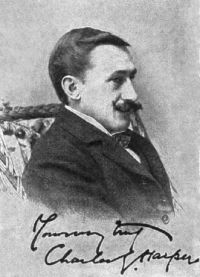 Charles G. Harper,
The Somerset Coast
Charles G. Harper,
The Somerset Coast
“ Plantations of fir and larch partly clothe the rounded hills on the left hand, and a farmhouse (since the publication of “Lorna Doone” named “Lorna’s Bower,” in big letters that, painted on its whitewashed garden-wall, stare across the stream) is perched comfortably half-way up the hillside.The footpath that winds ribbon-like beside 295the stream comes presently to Badgworthy Wood, a wood of stunted oaks, whose limbs are bearded with a grey-green moss that tells sufficiently of the humid atmosphere and the mists that drift from Exmoor. ”
Sabine Baring-Gould,
Yorkshire Oddities, Incidents and Strange Events…
(1900)
“ I slipped down, and the windlass was slowly unwound. Click, click, click! I heard each sound of the crank as it descended. The air about me was cold and damp. Beautiful ferns and mosses flourished on every ledge; presently, however, I got beyond the fern zone. I was in darkness. The spray of the falling stream was so finely comminuted that it was more like mist than spray. The walls of the pot were green with lichen, and now I was below the region of mosses. ”
 Susan Fenimore Cooper,
Rural Hours
(1851)
Susan Fenimore Cooper,
Rural Hours
(1851)
“ The mossy roots of these mouldering old stumps are choice places for the early flowers; one often finds the remains of an old oak, or pine, or chestnut, encircled by a beautiful border of this kind, mosses and flowers blended together in a way which art can never equal. During many successive springs, we have been in the habit of watching the flowers as they unfold upon these mossy hillocks. As usual, they are now daintily sprinkled with blossoms, for the soil is rich as possible in such spots. ”
