
“ The wooden house itself also was picturesque in the old fashion when men builded their dwellings slowly and for love; common with all its countless carvings black by age, its jutting beams shapen into grotesque human likeness and tragic masks; its parquetted work run over by the green cups of stoneworts, and its high roof with deep shelving eaves bright with diapered tiles of blue and white and rose, and alive all day with curling swallows, with pluming pigeons, with cooing doves. ”
Wooden house
Definition and stakes
The theme of “wooden house” has been addressed by authors such as E. C. Gardner, Mary Harrod Northend, Lewis Falley Allen, Various and Charles Dickens. It is often associated with terms like wood, kitchen, cottage, stone and building.
Quotes about “wooden house”
 Bret Harte,
Tales of the Argonauts
“ The house upon which I had stumbled, or, rather, to which my horse—a Jersey hack, accustomed to historic research—had brought me, was low and quaint. Like most old houses, it had the appearance of being encroached upon by the surrounding glebe, as if it were already half in the grave, with a sod or two, in the shape of moss thrown on it, like ashes on ashes, and dust on dust. A wooden house, instead of acquiring dignity with age, is apt to lose its youth and respectability together. ”
Various, Popular Science Monthly (1908)
“ Behind the central wooden house, with the windows, was a high rick-like roof composed of turf and green with grass surmounted by a small square chimney, and this roof covered a crypt-like kitchen. This extraordinary troglodytal abode was entered over a stone pavement which, rising slightly, conducted the sightless visitor to the penetralia of gloom and cooking. Inside of this semi-subterranean passage, forming its walls, was a formidable structure of stone and turf. Turf and stone houses for sheep and cows and horses were scattered about. ”
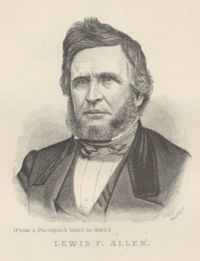 Lewis Falley Allen,
Rural Architecture
“ A wooden country house, together with its out-buildings, should always be of a cheerful and softly-toned color—a color giving a feeling of warmth and comfort; nothing glaring or flashy about it. And yet, such buildings should not, in their color, any more than in their architecture, appear as if imitating either stone or brick. Wood, of itself, is light. One cannot build 45 a heavy house of wood, as compared with brick or stone. ”
 E. C. Gardner,
The House That Jill Built, after Jack's Had Proved a Failure
“ Accordingly, every wooden house has from one hundred to one thousand wooden flues of a highly inflammable character arranged expressly to carry fire from the bottom to the top, valiantly consuming themselves in the operation. Furthermore, they are frequently charged with shavings and splinters of wood, which, becoming dry as tinder, will respond at once to a spark from a crack in the chimney, an overheated stove or furnace-pipe, or a match in the hands of an inquisitive mouse. ”
Ernest Young, The Kingdom of the Yellow Robe
“ Each house represents very strikingly the social grade of its owner, whether it be the low hut of the labourer in which a man of average height may scarcely stand upright, or the brick and stone palace with carpets and electric lights of the prince or nobleman. Most of the houses are of wood, and are made of either bamboo or teak. They stand upon wooden platforms about six feet from the ground, being supported in that position by strong teak pillars. ”
 Nathaniel Hawthorne,
House of the Seven Gables
(1851)
“ HALFWAY down a by-street of one of our New England towns stands a rusty wooden house, with seven acutely peaked gables, facing towards various points of the compass, and a huge, clustered chimney in the midst. The street is Pyncheon Street; the house is the old Pyncheon House; and an elm-tree, of wide circumference, rooted before the door, is familiar to every town-born child by the title of the Pyncheon Elm. ”
 William Howitt,
Homes and Haunts of the Most Eminent British Poets…
“ Not a bit of wood is to be seen, except the doors, water-spouts, and huge water-butts, which are often hoisted in front of the house, on the level of the second floor, on strong stone rests. The walls, as well as wooden frames in the fields, are clothed with long pieces of cloth, like horses, and women stand mending holes or smoothing off knots in them, as they hang. ”
William Worthington Fowler, Woman on the American Frontier
“ The architecture of the body of the house is sufficiently obvious, but it is curious to notice the ingenuity with which the wooden fireplace and chimney are protected from the action of the fire by a lining of clay, to see a smooth floor formed from the plain surface of hewed logs, and a door made of boards split from the log, hastily smoothed with the drawing-knife, united firmly together with wooden pins, hung upon wooden hinges, and fastened with a wooden latch. ”
“ The house is made of wood, for that retains heat better than stone, and allows of freer ventilation. It was important that I should erect an appropriate and tasteful wooden building as a model for the people. ”
W. G. Wood-Martin, The Lake Dwellings of Ireland
“ Upon clearing the foundation, the framework of the house was shown to be composed of well-squared beams of oak, grooved for the reception of planks, and mortised for the insertion of uprights, the angles dovetailed together, and fastened with wooden pins. ”
Joseph H. Adams, Harper's Outdoor Book for Boys
“ Fig. 11 shows the house-tent closed in stormy weather or at night, while in Fig. 12 the house is open for fair-weather living. One wooden side is let down to form a piazza, and the canvas side above it is propped out with poles so as to act as a canopy or sunshade.305The frame is twelve feet long, eight feet wide, and nine feet high from the roof to the peak. The wood sides are three feet and six inches above the floor, and out beyond the sides of the house the joist may extend to support one or both of the wooden sides, which can be let down by means of hinges along the bottom. ”
George P. Marsh, The Earth as Modified by Human Action
“ Wooden field and garden fences are very generally used in America, and some have estimated the consumption of wood for this purpose as not less than that for architectural uses.Fully one-half our vast population is lodged in wooden houses, and barns and country out-houses of all descriptions are almost universally of the same material. ”
Various, The Atlantic Monthly, Volume 14…
“ But if all my wood-work were to be without groove or moulding, if my mantels were to be of simple wood, if my doors were all to be machine-made, and my lumber of the second quality, I would have my bath-rooms, my conservatory, my sunny bow-windows, and my perfect ventilation,—and my house would then be so pleasant, and every one in it in such a cheerful mood, that it would verily seem to be ceiled with cedar. ”
 George Edward Woodberry,
North Africa and the desert
(1914)
“ An old house, set in some deep forest, is not more retired. And, if one passes within—silence, and soft footfalls, and refinement of all sense-impressions, the constant presence of delicately moulded handiwork, tiles cooling to the eye, wrought stucco, carved wood; and in those interiors, with their beautiful ceilings and wainscoting, are columns that seem of pagan purity, fountains as of woodland solitude, courts of garden peace. It is wonderful, how this effect of harborage and seclusion has been attained by an art so simple—flowers, water, plaster, wood, traceries, colored tiles. ”
 Mary Harrod Northend,
Historic Homes of New England
“ At the right are double parlors which may have been used for dining-room, or living-room and dining-room, combined. Here are also found wonderful panellings, but very little of the elaborate hand-carving. All of the wood in this house, as in most of the houses of the same period, is of white pine, for this wood is considered one of the best wearing kinds that has ever grown. The timbers are of solid oak and are as staunch as they were in the days when the house was built. ”
 Hugh Walpole,
The Wooden Horse
“ The clocks struck five—he heard their voices echo through the house; and, at the last, the tiny voice of the cuckoo clock sounded and the little wild flap of his wings came quite clearly through the silence; his voice was answered by a chorus from the garden, the voices of the birds seemed to grow ever louder and louder; in that strange dark room, with its shaded lights and heavy airs, it was clear and fresh like the falling of water on cold, shining stone. ”
 Will Levington Comfort,
Down among men
(1913)
“ A fine unfolding—this love of Morning’s for wood itself, and woods. Over a half-hundred trees were his own—elm, beech, hickory, oak, ash, and maple—and like a fine clean colony of idealists they stood meditating.... One never knows the quality of wood until one builds his own house. Opening the timbers for the big mortices—each was a fresh and fragrant discovery. Jake and he lingered long, after the cabin was roofed, over the heavy oak flooring, and the finishing of windows and doors and frames. ”
“ The mansion is built and decorated within; artists fit the tiles together in a mosaic of cool colours, and carve, and gild, and paint the little pieces of cedar-wood, and glue them into the light and pointed arches; the rich curtains are hung, and the master enters into his possession. There follows the procession of the generations. The tiles crack, the woodwork of the arches splits and falls, and the walls break and crumble. The householder sits indifferent, and the whole house corrodes. ”
Lewis Falley Allen,
Rural Architecture
“ The large forest trees, always grand, graceful, and appropriate, would become such a house, throwing a protecting air around and over its quiet, unpretending roof. Vines, or climbing roses, might throw their delicate spray around the columns of the modest veranda, and a varied selection of familiar shrubbery and ornamental plants checker the immediate front and sides of the house looking out upon the lawn; through which a spacious walk, or 126 carriage-way should wind, from the high road, or chief approach. ”
F. W. Woodward, Woodward's Country Homes
“ We were about to say that it should never be attempted in any other material than stone, but as many of us cannot command the means for such permanent buildings, we will concede that it may be allowable for us to put our wooden buildings into the cottage form, using the best taste and the most beautiful and picturesque styles, even if the material is objectionable. ”
 George Hamlin Fitch,
The Critic in the Orient
“ At other times the windows are slid into the walls, and thus nearly the whole side of the house is open to the cool night air. Many of these houses are finished in the finest hardwoods, and not a few have polished mahogany floors. Bamboo and rattan furniture may be seen in some of these houses, while in others are dressers and wardrobes in the rich native woods. ”
Lewis Falley Allen,
Rural Architecture
“ A raised platform passes from the wash-room in, past the bath-room, to a water-closet, which may be divided into two apartments, if desirable. The vaults are accessible from the rear, for cleaning out, or introducing lime, gypsum, powdered charcoal, or other deodorizing material. At the extreme corner of the wood-house, a door opens into a feed and swill-room, 20×8 feet, which is reached by steps, and stands quite eighteen inches above the ground level, on a stone under-pinning, or with a stone cellar beneath, for the storage of roots in winter. ”
Lewis Falley Allen,
Rural Architecture
“ We are aware that 40 unburnt bricks have been strongly recommended for house-building in America; but from observation, we are fully persuaded that they are worthless for any permanent structure, and if used, will in the end prove a dead loss in their application. Cottages, out-buildings, and other cheap erections on the farm, for the accommodation of laborers, stock, or crops, may be made of wood, where wood is the cheapest and most easily obtained ”
 Gertrude Jekyll,
Some English Gardens
(1904)
“ It was satisfying and beautiful because every bit of ornamental detail grew out of the necessary structure. The plainer framing of cottage and farmhouse became enriched in the manor-house into a wealth of moulding and carving and other kinds of decoration. External panel ornament gained a rich quality by the repetition of symmetrical form, while the overhanging of the successive stories and the indentations between projecting wings and porches threw the various faces of the building into interesting masses of light and shade. ”
 Dorothy Canfield Fisher,
What Shall We Do Now?: Five Hundred Games and Pastimes
“ The cottage can then be fixed to a piece of wood or paste-board, to form its garden and add to convenience in moving it about. A cardboard fence and gate can be cut out and painted green. A path to the front door is made by covering a narrow space of the cardboard with very thin glue over which, while it is wet, sand is sprinkled to imitate gravel. Moss will do for evergreens, and grass plots can be made of green cloth. A summer-house, garden chairs and tables are easily cut out of cardboard. So also are a rabbit-hutch, pump, dove-cot, and dog-kennel. ”
Esther Singleton, The Shakespeare Garden
“ The brick wall forms a shelter for plants that love shade and a fine support for climbing plants, especially ivy. The hedge makes a rich and distinguished wall of living green, which can be artistically clipped; and arches can be made through it. The pleached alley, formed of wooden trellis, lattice-work, or rustic, or wire arches painted an attractive color, or left in the natural wood, will, if they are covered profusely [Pg 278] with roses, honeysuckle, rosemary, and other roving flowers, give the effect of the old leafy tunnels of greenery and blossoms. ”
Authors at home: Personal and biographical sketches of well-known American writers (1902)
“ The variety of color so obtained, with the drab woodwork of the upper story and the red Virginia vine, keeps the house, at all seasons, in harmony with its surroundings. It is no less so within; for doors, wainscots, window-frames, joists, sills, skirting-boards, floor and rafters are all of native woods, left of their natural colors, and skillfully contrasted with one another; one door being of Georgia pine with oak panels, another of chestnut and curled maple, a third of butternut and cherry, and so on. ”
Mary Harrod Northend,
Remodeled Farmhouses
“ Few estates show so many beautiful trees; they add greatly to the pictorial effect of the place. Graceful elms with swaying branches are on every side, while on the opposite side of the road pine trees are in evidence, and on either side of the stone wall wild shrubs have been planted. There has been no attempt at formal arrangement of the grounds, not even with the garden which is at the side of the house. There has been built simply a picturesque lattice that separates house from barn and over which have been trained attractive vines. ”
 William Henry Giles Kingston,
The Two Supercargoes; Or, Adventures in Savage Africa
“ Longer than that we must not stay in this horrible place, we shall have wood enough for our purpose in the building, by pulling down part of the rear of our house, where it won’t be missed, or from the trees in our garden, or part of the fencing. ”
William Coxe, Account of the Russian Discoveries between Asia and America
“ The houses are spacious, uniformly built of wood, of only one story, not more than fourteen feet high, plaistered and white-washed; they are constructed round a court yard of about seventy feet square, which is strewed with gravel, and has an appearance of neatness. Each house consists of a sitting room, some warehouses and a kitchen. ”
Mary Harrod Northend,
Remodeled Farmhouses
“ On either side of the main dwelling, outdoor living-rooms were secured by the introduction of screened [Pg 9] piazzas, the roofs of which were painted with water-proof paint. One of these living-rooms opens on to a water-garden with its arches of roses at one side of the house. It is fitted up with willow furniture, in the coverings of which is introduced the prevailing flower, the iris, which is also shown in the table cover and the shape of the vase filled with the same flowers. ”
William Duthie, A Tramp's Wallet
“ There are still two floors above, but as they are both contained in the huge gable roof of the house, they are more useful as store-rooms than as habitable apartments. The quantity of wood we see about us is frightful when associated with the idea of fire. ”
E. C. Gardner,
The House That Jill Built, after Jack's Had Proved a Failure
“ Your economical arguments are always worth considering. I think the happy compromise for us will be to use hard wood in the first story and painted pine in the chambers, with various combinations and exceptions. The bath-rooms, halls and dressing-rooms of the second story should of course be without paint, and we may relieve the solid monotony of the hardwood finish with occasional fillets or bands of color, painted panels or any other irregularities we choose to invent. ”
Related terms
Authors who wrote about “wooden house”
E. C. GardnerMary Harrod NorthendLewis Falley AllenVarious Charles DickensNathaniel Hawthorne
 Henry David Thoreau
 Alexander Pope
 Walt WhitmanH. N. HutchinsonAdelia B. BeardWilliam WinterKarl F. Haugen
 Peter KropotkinFrank Thomas BullenRenee Richmond Huntley OrmsbeeCharles Franklin WarnerRobert Buist
 Rolf Boldrewood
 Candace Wheeler
