AI-generated from sources
Sign or Destiny, the Old Border Between the Hippocratic Face and Physiognomy
In Brief
- In the Hippocratic tradition, the face of a dying patient is a sign of a passing bodily state, read over days, qualified by exceptions, and meant to guide a physician who knows he cannot cure every patient.
- Physiognomy looks at the same face but reads a fixed moral character in features that never change, such as the shape of the forehead or the nose, so its verdicts have no later outcome against which they could be checked.
- The same signs, such as rolling eyes, a pinched nose or a staring gaze, were read by physicians, priests and folk custom alike; what changed was what the face was allowed to mean.
- The school of Cesare Lombroso, which claimed to recognize “born criminals” by marks on the skull and face, borrowed the language of disease to turn a sign into a sentence; its critics found the marks only somewhat more frequent in some groups and useless for judging an individual.
Main authors
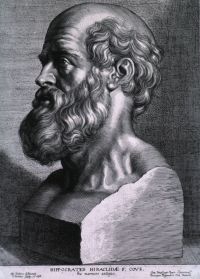
A physician leans over a sleeping patient and studies the eyes. If a strip of white shows between lids that fail to close, the Hippocratic Book of Prognostics counts it as a “very deadly symptom” [1]. Yet the same sentence fences the verdict in at once. The sign counts only if the patient has had no diarrhea, has taken no purge, and does not sleep that way out of habit . Only when a livid or pale eyelid, lip or nose joins the other symptoms does the text allow certainty that death is near. The face speaks, but under conditions, and about the present state of a body.
Many centuries later, the Pocket Lavater reads another face. A plump, round contour, small raised eyebrows, blue and vacant eyes: these mark the phlegmatic, whose convex forehead, the book asserts, “proclaims them incapable of energy” [2]. The two readers look with the same care at the same surface. What separates them is not the method of looking but what the face is allowed to mean. For one, it is a passing state of the body, read in order to act or to warn. For the other, it is a character stamped on a person once and for all. Clinical reading turns into divination when the sign leaves the disease and settles on the person. And a sign that merely correlates, without being able to say what it marks, erases the border altogether.
The Book of Prognostics, a Face Read Against the Clock
Hippocratic prognosis is born of an admission of powerlessness. The Book of Prognostics states plainly that it is impossible to make all the sick well, and that curing them would be better than foretelling [3]. Some patients die before the physician is even called; others die a day after, before his art can counteract the disease . Foretelling is therefore a second-best duty. It lets the physician stand before death without pretending to defeat it. The face is read precisely because the cure may fail.
The sign is never read alone, and never outside time. If the disease has advanced by the third or fourth day and the countenance looks as described, the physician must repeat his inquiries and survey the whole face, the body and the eyes [4]. Do the eyes shun the light, weep involuntarily, squint, turn red or livid, sink into their sockets? Each detail is a dated observation, compared with the previous one. Even the bleakest forecast keeps an exit. A certain expectoration announces death on the fourteenth day “unless something favorable supervene” [5]. The same passage lists the signs that reverse the verdict: easy breathing, no pain, a body evenly warm and soft, no thirst .
Method serves here as a guardrail against charlatanism. A treatise summarized in the 1886 English edition of the Hippocratic works asks that prognostics not be made “in a charlatan manner,” but with caution and close attention to the patient’s circumstances [6]. The physician who feels the belly and the pulse, watches the breathing at the nostrils and listens to the voice is less likely to be deceived . The face is one witness among several. The same edition claims that the prognostic signs hold in Libya, in Delos and in Scythia, in every season of every year [7]. The universality is real, but it belongs to the course of a disease. What holds everywhere is that bad symptoms bode ill, not that a given type of person is doomed.
Even the last sign of all remained a fallible reading, and medicine knew it. An entry in Cooley’s Cyclopædia warns that a body is too often hurried into the grave as soon as breathing seems to stop and the face takes on a ghastly hue; the signs of death, it insists, are deceptive enough for the semblance to be mistaken for the reality, and burial should wait for putrefaction [8]. Writing in 1873, Fernand Papillon notes that positive signs of death exist, yet doubt about them ran so deep that a philanthropist offered twenty thousand francs to whoever found an infallible one [9]. A. Dastre describes the same quest as the search for a prognostic sign proving that the life of the brain is extinguished for good [10]. The clinical face is a hypothesis held open to revision, even at the threshold of the coffin.
From the Bedside to the Beyond
The signs themselves were common property. The 19th-century traveller Ármin Vámbéry reports that in Central Asia the rolling of the eyes and the contraction of the nose are taken as symptoms of death [11]. The nose is the very feature that the ancient Prognostics lists among its decisive signs, more than two thousand years earlier . What differs is the frame. In Vámbéry’s account, the reading triggers no treatment but a rite: the jaws are tied, the body stripped and covered . The face announces a passage, not a prognosis to be checked.
Religious texts move the face further, from evidence for a physician to evidence for a soul. In a passage of Hebrew literature, the soul hovers about the body for three days, hoping to return, until it sees “the appearance of the face changed” and departs [12]. The face here is a message read from within. Alphonsus Liguori, in an 1868 edition of his Preparation for Death, paints the corpse in clinical detail: sunken eyes, hollow cheeks, an ashen face, leaden lips [13]. But the inventory serves a sermon. Many, he writes, have changed their lives and left the world upon such a sight . The face no longer informs a diagnosis; it summons a conscience.
The staring eyes of the dying show how one feature can carry two opposite meanings. The folklorist Wirt Sikes records the belief, held by numberless Christians, that the dying see something more than living eyes can see, a belief resting on their exclamations and their fixed gaze [14]. James Monroe Buckley, writing in 1892, offers a bodily account of the same scene. An intense emotion briefly breaks through nature’s anaesthetic, the features become transfigured, a name is spoken, and the dying person falls back [15]. The gaze is identical in both texts. The quarrel concerns only what it is permitted to signify.
The Hippocratic line was drawn against such readings, and drawn from within. On the Sacred Disease declares that the cause of the affliction is human, not divine, and accuses the purifiers of deceiving mankind with lustrations while speaking of the godhead [16]. A modern history of Greek thought, The Legacy of Greece, sees the best Hippocratic works as a task of observing symptoms and separating essentials from accidents, one that could proceed whatever view of man and the world was held [17]. Yet the border also ran through the corpus itself. The 1886 editor of a treatise on dreams doubts that it is genuine, and notes that the interpretation of dreams has been entirely abandoned by the profession [18]. The line was a conquest, not a given.
Lavater and the Face as a Fixed Character
Physiognomy presented itself as science, and even as philanthropy. The Pocket Lavater opens by deploring that a displeasing face is often enough to provoke aversion, and calls for such prejudices to be exploded [19]. Lavater’s design, it says, was to show “how far the moral character is capable of being traced upon the visage” . The paradox is plain. The book sets out to correct snap judgements by turning them into a system. And its object has shifted. It no longer reads the course of an illness, but the permanent nature of a person.
The catalogue that follows reads features, not states. The phlegmatic type is known by a round contour, soft thick lips, a round head, pale skin, hair that curls of itself . A popular magazine of 1829 recounts with amusement how Lavater made the nose the fulcrum of the brain, a piece of Gothic architecture, and how a sharp nose came to be taken for the visible mark of a shrew [20]. None of these traits changes between the third and the fourteenth day. No passage asks whether the subject has taken a purge or sleeps that way from habit. Without a date and without an exception clause, the sign has nothing left to be checked against.
The sharpest critics of physiognomy drew the border exactly where state meets structure. An article in Popular Science Monthly in 1915 ranks physiognomy with palmistry and fortune-telling, sustained by a mix of interests rather than by evidence [21]. Its one redeeming feature, the author concedes, is Lavater’s attention to facial expression, which is more generic and more readily interpreted than peculiarities of feature . The orientalist Morris Jastrow credits Lavater with another advance. He threw the study back onto human features alone, dropping the comparisons with animals that had brought the older theory to absurdity [22]. Both judgements point the same way. What can be read in a face is what moves in it, not what is fixed.
A clinical sign is checked by what happens next; a character reading meets only anecdotes. As early as 1827, J. S. Forsyth granted that Lavater had brought physiognomy to great perfection, yet doubted that it could be taught like other sciences, and found much in it whimsical and unfounded [23]. He conceded that everyone has something of the science by nature, starting with the suspicion of a man who never looks his neighbour in the face . That concession reveals the problem. Physiognomy formalizes an everyday intuition without giving it a test. A collection of literary portraits describes a writer with laughing eyes whose looks were wholly at odds with his character, “one of the most striking refutations” of Lavater [24]. One counterexample can embarrass the system; no outcome can ever confirm it.
Lombroso’s Stigmata, When the Sign Becomes a Sentence
Prediction turns into destiny when it detaches from the disease and attaches to the person. Jean-Marie Guyau still describes a clinical forecast. In a protracted illness such as consumption or cancer, a patient with scientific training can calculate his chances and fix within a few days the time of his death [25]. The forecast rests on the course of an identified disease. Orison Swett Marden warns against something else entirely. Some people set a date for their own death because a parent died at that age, or because they fear an inherited disease, and in doing so cut off precious years [26]. The prediction has slid from the illness to the lineage, and Marden sees it working like a curse.
The school of Cesare Lombroso, as his daughter Gina Lombroso presents it, carried that slide to its end. It speaks of born criminals “doomed even before birth” to a career of crime, whom no education can redeem and who should be segregated at once [27]. The vocabulary is medical. Crime becomes a form of epilepsy, a cerebral malady that leaves signs of physical degeneration in the skull, the face, the teeth and the brain, and that the book describes as a return to the brutal egotism it attributes to primitive races [28]. The Hippocratic face showed a disease passing through a person. Here the person has become the disease, and the consequence of the reading is not care but confinement.
The criticism that undid the stigmata was a criticism of what a sign can say. The psychologist Harry L. Hollingworth sums up the outcome. Lombroso’s marks turned out to be only somewhat more frequent among the groups he called vicious, degenerate and defective than among others [29]. Faced with a single individual, the stigmata alone cannot tell whether he is an imbecile, a criminal, a genius, or an ordinary man with an excess of physical infirmity [30]. A frequency is not a reading. The Hippocratic sign named a precise outcome, near in time, with its exceptions. The stigma marks a person without being able to say what it marks.
Reading death in a face and reading character in it long relied on the same gaze, trained on the same eyes, lips and nose. The difference lay in meaning. The physician’s face was a passing state of a sick body, read over days, set against the pulse and the breathing, qualified by exceptions, and aimed at warning or acting. It stayed fallible even at the final sign, to the point that a prize was offered for an infallible mark of death. The physiognomist’s face, and then the criminologist’s, was a fixed structure that spoke of a person’s nature, admitted no exceptions and ended, in its most extreme form, in a call to segregate the born criminal.
Once the clinical reading loses its conditions, it becomes an oracle again. That happens when it no longer says what the sign stands for, when it might fail, or by what later fact it could be proved wrong. Numbers do not save it. Lombroso’s stigmata were counted, and they still could not tell a criminal from a genius. The border was never a matter of instruments, only of what the face was allowed to promise. The Hippocratic face said: this body, now, unless. The physiognomic face said: this person, always.