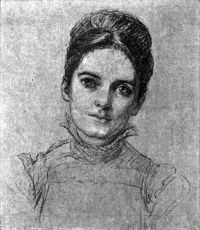
A. Mary F. Robinson

Biographical details

Portrait of A. Mary F. Robinson A. Mary F. Robinson,  Emily Brontë (1883)

“ Truly better, to leave her soul to speak in the world for aye, for the wind to be stronger for her breath, and the heather more purple from her heart; better far to be lost in the all-embracing, all-transmuting process of life, than to live in cramped and individual pain. So at least, wrong or right, thought this woman who loved the earth so well. She was not afraid to die. The thought of death filled her with no perplexities; but with assured and happy calm. She held it more glorious than fame, and sweeter than love, to give her soul to God and her body to the earth. ”
Source: Wikisource

Portrait of A. Mary F. Robinson A. Mary F. Robinson,  The fields of France (1905)

“ The scent of the game will not lie across these miles of blossom. The hunters are in despair, and the deer, still deafened with the winter’s yelp of the hounds—the deer, who sets his back against the sturdiest oak, and butts at the pack with his antlers, who swims the lakes, and from his island refuge sells his life as hard as he can—the deer, accustomed to be always vanquished, beholds himself at last befriended by an ally more invincible than water or forest oak, by the sweet innumerable white lily, innocent as himself, that every May-time sends the huntsmen home. ”
Source: Gutenberg

Portrait of A. Mary F. Robinson A. Mary F. Robinson,  Twentieth Century French Writers… (1920)

“ Asmus is a good young bear, a friendly and cordial young bore. It is his first contact with the Spirit of France—with ease, measure, liberty, and grace—qualities which the young German begins by admiring as French, but soon ends by loving as peculiar to Colette Baudoche.
Asmus is the most generous of conquerors, for his heart is filled by a tender admiration for the vanquished. He listens to, looks at, admires all that springs from the trampled soil. His love of Nature—which at first is vague and pantheistic—takes on the tone of France and becomes human, historical, and scientific.
”
Source: Gutenberg

Get perspective with Kwize: daily news enlightened by great literature