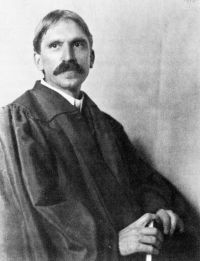
Charles Horton Cooley

Biographical details

Portrait of Charles Horton Cooley Charles Horton Cooley Human nature and the social order (1902)

One who feels it leaves the precarious self; his boat glides out upon a wider stream; he forgets his own deformity, weakness, shame or failure, or if he thinks of them it is to feel free of them, released from their coil. No matter what you and I may be, if we can comprehend that which is fair and great we may still have it, may transcend ourselves and go out into it. It carries us beyond the sense of all individuality, either our own or others’, into the feeling of universal and joyous life.
Source: Gutenberg

Portrait of Charles Horton Cooley Charles Horton Cooley Social organization (1909)

These also are symbols, and the most potent and least illusive of all.
It is indeed a general truth that sentiment is nearer to the core of life than definable thought. As the rim of a wheel whirls about its centre, so ideas and institutions whirl about the pivotal sentiments of human nature. To define a thing is to institutionize it, to draw it forth from the pregnant obscurity of the soul and show just how it appears in the transient color of our particular way of thinking. Definitions are, in their nature, short-lived.
We need religion, probably, as much as any age can have needed it.
Source: Gutenberg

Portrait of Charles Horton Cooley Charles Horton Cooley Human nature and the social order (1902)

Injustice and personal wrong of all sorts, as between one’s self and others, commonly consist, not in imagining the other man’s point of view and refusing to give it weight; but in not imagining it, not admitting him to the tribunal at all. It is in exerting the imagination that the effort of virtue comes in. One who entertains the thought and feeling of others can hardly refuse them justice; he has made them a part of himself. There is, as we have seen, no first or second person about a sentiment; if it is alive in the mind that is all there is to the matter.
Source: Gutenberg

Get perspective with Kwize: daily news enlightened by great literature