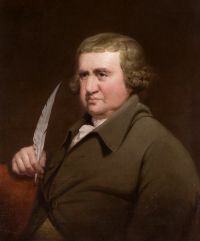
Herbert Wildon Carr

Biographical details

Herbert Wildon Carr The Problem of Truth

To imagine that ideas can correspond with realities is to forget that ideas simply are the knowledge of realities; it is to slip into the notion that we know two kinds of different things, first realities and secondly ideas, and that we can compare together these two sorts of things. But it is at once evident that if we could know realities without ideas, we should never need to have recourse to ideas. It is simply ridiculous to suppose that the relation between consciousness and reality which we call knowing is the discovery of a correspondence between mental ideas and real things.
Source: Gutenberg

Herbert Wildon Carr Why the Mind Seems to Be, and yet Cannot Be… (1914)

If we recognize this fact that in mind and brain we have two realities that are incommensurable by their very nature, but which function only in union with one another, we may understand why everything happens just as if the one were produced by the other. Why it is that when the Titan cleaves the head of Zeus the fully armed Athene springs into existence. To understand it we must see what it is that consciousness does, the purpose it fulfils. What we call consciousness is not the whole of mind.
Source: Wikisource

Herbert Wildon Carr The Problem of Truth

Clearly, then, if this view be true, the whole world, as it is presented to us and thought of by us, is an illusion. Our science is not unreal, but it is a transformed reality. The illusions may be useful, may, indeed, be necessary and indispensable, but nevertheless it is illusion.
But here there arises a new difficulty in regard to truth. If the usefulness of the intellect consists in the active production of an illusion, can we say that the intellect leads us to truth? Is it not only if we can turn away from the intellect and obtain a non-intellectual intuition that we can know truth?
Source: Gutenberg

Get perspective with Kwize: daily news enlightened by great literature