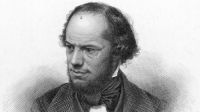
William Brackett

Biographical details

William Brackett Popular Science Monthly (1879)

Whether they are the luxurious palace cars, like poetry and history, furnished with all the elegance which man's inventive genius has been accumulating for centuries, and which only the richly-endowed may enter, or whether they are the plainer passenger-cars, like fiction and eloquence, filled with a group of motley characters, of greater or less pretensions and importance, and tricked out in a variety of costumes—they are all whirled along over the same road, obedient to the impulse given them by the mighty machine which stands, or rather flies, at the head of the train.
Source: Wikisource

William Brackett Popular Science Monthly (1879)

Besides opening up such an avenue to men of real genius, the pursuit of science, when properly understood, is far more attractive and more in harmony with their tastes than can possibly be the cultivation of an art already touched by the hand of decay, and passing into the limbo of faded and effete systems. In the pursuit of science we go in quest of natural laws that there is every reason for believing are almost innumerable and inexhaustible; in poetry, the search is for phantoms of the imagination which, ten to one, have already flitted across other minds and been appropriated by them.
Source: Wikisource

William Brackett Popular Science Monthly (1879)

On the contrary, these are so common as to give license for believing in the existence of a law, akin to that of evolution if not a part of it, by virtue of which, in the progress of knowledge, certain new truths dawn upon the world, receiving expression simultaneously from more than one mind. Given the age which is ripe for any discovery, and it breaks out in many different quarters of the globe at the same moment. Men seem to be watching for it, and, like a meteor glancing across the heavens, it is witnessed by several observers from many points of the compass.
Source: Wikisource

Get perspective with Kwize: daily news enlightened by great literature