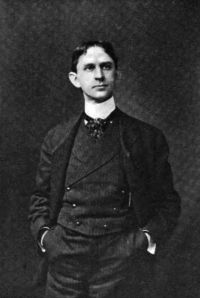
Albert Bigelow Paine

Albert Bigelow Paine

Summary

Portrait of Albert Bigelow Paine Albert Bigelow Paine Life and Lillian Gish

From the moment she enters the picture, her whole attitude, her face, her hands, her feet, her bowed shoulders and bent back—every part and feature of her, tell her crushed, stunted, trampled life.
Of course, her wistful beauty added to the pathos of it all, but Lillian without beauty—if one can conceive that possibility—would have achieved a triumph. When she crosses the street, stoops to pick up the tin foil which she gathers to sell, looks into the shop window, touches the flower she wants, one’s heart turns fairly sick for the broken child.
Source: Gutenberg

Portrait of Albert Bigelow Paine Albert Bigelow Paine Life and Lillian Gish

Griffith’s group of players was a notable one. Besides Mary, Lillian and Dorothy, he had Blanche Sweet, “the Biograph blonde,” a real star, melting, luscious; Miriam Cooper, Mary Alden, Robert Harron, Henry Walthall, Lionel Barrymore—most of them young twenty years ago—had to be, to play anything like youthful parts, for all the indoor lightings were from overhead, the shadows were harsh and black—every line and wrinkle showed. There could be no retouching of the tiny film faces—the screen presented them not only as they were, but worse than they were, their defects magnified.
Source: Gutenberg

Portrait of Albert Bigelow Paine Albert Bigelow Paine Life and Lillian Gish

In no time, Lillian, like Dorothy and the others, went racing over the hills behind Los Angeles—an Indian, a cowboy, a settler, a pursued heroine—sometimes all of those things in one day; for there was no star aristocracy in Griffith’s troupe. One might be a star one hour, and an extra the next, and nobody cared, and everybody was happy, and Lillian grew well, and physically hardened to the demands of picture making—by no means light.
Source: Gutenberg

Get perspective with Kwize: daily news enlightened by great literature