Summary

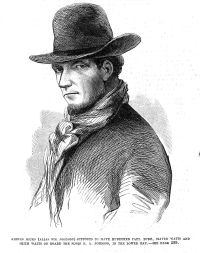
Portrait of Albert W. Hicks Albert W. Hicks The Life, Trial, Confession and Execution of Albert W. Hicks (1860)

I feel that after I have unburdened myself of the secrets of my life, I can die easier, and meet my fate like a man; and though I may go to the gallows without hope, without repentance, without any evidence of aught but misery hereafter, the thought that the sale of this, my Confession, will perhaps keep the mother of my child from dependence on such cold charity as the world would show a murderer’s wife, will make me stronger to bear the inevitable doom which is now awaiting me.
Source: Gutenberg

Portrait of Albert W. Hicks Albert W. Hicks The Life, Trial, Confession and Execution of Albert W. Hicks (1860)

On Monday, the prisoner Hicks, alias Johnson, was transferred to the custody of the U. S. Marshal Rynders, and upon the filling of several affidavits, he was committed for examination.
Such is a brief account of this horrible tragedy, than which nothing more calculated to excite public wrath has occurred in the neighborhood of this city for a number of years. That Hicks is the man who committed the triple murder on board the sloop E. A. Johnson, no doubt is entertained, and no one will regret his speedy satisfaction to the claims of public justice.
Source: Gutenberg

Portrait of Albert W. Hicks Albert W. Hicks The Life, Trial, Confession and Execution of Albert W. Hicks (1860)

When the ship struck, I watched my opportunity and lashed myself to a large spar, on which I floated for two days, when I was picked up by a pilot boat and taken into port, as the American Consul at that time will certify. Of the eight hundred passengers on board of that ship not one save me escaped that I ever heard of. The only one whose loss I regretted was my partner, Tom Stone, with whom I had been associated for so many years. He was a brave fellow, with a ready wit and strong arm, ever on hand for any enterprise, no matter how desperate
Source: Gutenberg

Get perspective with Kwize: daily news enlightened by great literature