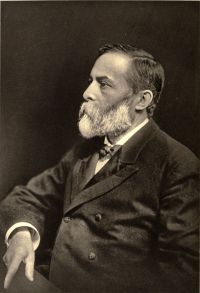
Alexander Francis Chamberlain

Alexander Francis Chamberlain

Summary

Portrait of Alexander Francis Chamberlain Alexander Francis Chamberlain The Child and Childhood in Folk-Thought

To the child language owes many of its peculiarities, and the multiplicity of languages perhaps their very existence. Religion has had the child long as its servant, and from the faith and confidence of youth and the undying mother-love have sprung the thought of immortality and the Messiah-hope that greets us all over the globe. Even among the most primitive races, it is the children who are "of the Kingdom of Heaven," and the "Fall of Man" is not from a fabled Garden of Eden, but from the glory of childhood into the stern realities of manhood.
Source: Gutenberg

Portrait of Alexander Francis Chamberlain Alexander Francis Chamberlain The Child and Childhood in Folk-Thought

The imagined, retrospect childhood of the past is twin-born with the ideal, prospective childhood of the world to come. Here the savage and the philosopher, the child and the genius, meet; the wisdom of the first and of the last century of human existence is at one. Childhood is the mirror in which these reflections are cast,—the childhood of the race is depicted with the same colours as the childhood of the individual. We can read a larger thought into the words of Hartley Coleridge:—
"Oh what a wilderness were this sad world,
If man were always man, and never child."
Source: Gutenberg

Portrait of Alexander Francis Chamberlain Alexander Francis Chamberlain The Child and Childhood in Folk-Thought

In the mythology of the Samoans of the Pacific, the Heaven-god, father of all things, and the Earth-goddess, mother of all things, once held each other in firm embrace, but were separated in the long ago. Heaven, however, retains his love for earth, and, mourning for her through the long nights, he drops many tears upon her bosom,—these, men call dewdrops. The natives of Tahiti have a like explanation for the thick-falling rain-drops that dimple the surface of the ocean, heralding an approaching storm,—they are tears of the heaven-god.
Source: Gutenberg

Get perspective with Kwize: daily news enlightened by great literature