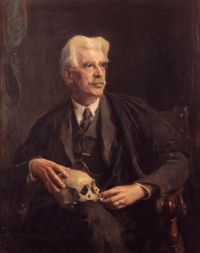
Alfred C. Haddon

Alfred C. Haddon

Summary

Portrait of Alfred C. Haddon Alfred C. Haddon History of anthropology (1910)

The phonologist should collect his evidence, arrange his classes, divide and combine as if no Blumenbach had ever looked at skulls, as if no Camper had ever measured facial angles, as if no Owen had ever examined the base of a cranium. His evidence is the evidence of language, and nothing else; this he must follow, even though in the teeth of history, physical or political.... There ought to be no compromise between ethnological and phonological science. It is only by stating the glaring contradictions between the two that truth can be elicited. [124]
Source: Gutenberg

Portrait of Alfred C. Haddon Alfred C. Haddon History of anthropology (1910)

And again: “La nature ne connait pas nos definitions; elle n’a jamais rangé ses ouvrages par tas, ni les êtres par genres.”
Nevertheless both rendered incalculable service to the science. Linnæus “found biology a chaos and left it a cosmos.” “L’anthropologie,” says Flourens, “surgit d’une grande pensée de Buffon; jusqu-là l’homme n’avait été étudié que comme individu, Buffon est le premier qui l’ait envisagé comme espèce.”
But Buffon was no believer in the permanent stability of species. “Nature is far from subjecting herself to final causes in the formation of her creatures.”
Source: Gutenberg

Portrait of Alfred C. Haddon Alfred C. Haddon History of anthropology (1910)

Concerning the present use of the term “Anthropology,” few will take exception to the definition given by Topinard in his l’Anthropologie (1876) : “Anthropology is the branch of natural history which treats of man and the races of man.” It may be yet more succinctly described as “the science of man,” which comprises two main divisions—the one which deals with the natural man (ανθρωπος, or homo) ; the other which is concerned with man in relation to his fellows, or, in other words, with social man (εθνορ, or socius) .
Source: Gutenberg

Get perspective with Kwize: daily news enlightened by great literature