Andrew Jackson

Andrew Jackson

Summary

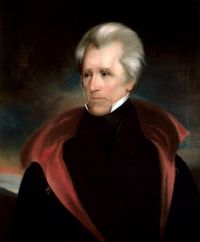
Portrait of Andrew Jackson Andrew Jackson Eighth State of the Union Address (1836)

Under our present revenue system there is every probability that there will continue to be a surplus beyond the wants of the Government, and it has become our duty to decide whether such a result be consistent with the true objects of our Government.
Should a surplus be permitted to accumulate beyond the appropriations, it must be retained in the Treasury, as it now is, or distributed among the people or the States.
To retain it in the Treasury unemployed in any way is impracticable; it is, besides, against the genius of our free institutions to lock up in vaults the treasure of the nation.
Source: Wikisource

Portrait of Andrew Jackson Andrew Jackson Eighth State of the Union Address (1836)

All will admit that the simplicity and economy of the State governments mainly depend on the fact that money has to be supplied to support them by the same men, or their agents, who vote it away in appropriations. Hence when there are extravagant and wasteful appropriations there must be a corresponding increase of taxes, and the people, becoming awakened, will necessarily scrutinize the character of measures which thus increase their burdens. By the watchful eye of self-interest the agents of the people in the State governments are repressed and kept within the limits of a just economy.
Source: Wikisource

Portrait of Andrew Jackson Andrew Jackson Eighth State of the Union Address (1836)

The influence of an accumulating surplus upon the credit system of the country, producing dangerous extensions and ruinous contractions, fluctuations in the price of property, rash speculation, idleness, extravagance, and a deterioration of morals, have taught us the important lesson that any transient mischief which may attend the reduction of our revenue to the wants of our Government is to be borne in preference to an over-flowing treasury.
Source: Wikisource

Get perspective with Kwize: daily news enlightened by great literature