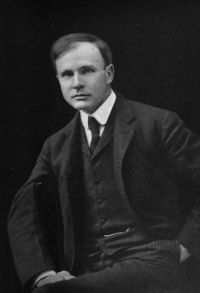
Bliss Perry

Bliss Perry

Summary

Portrait of Bliss Perry Bliss Perry A Study of Poetry

We need not agree with a certain modern school who would empty all poetry of poetical thought and etherealize it till it melts into a strain of music; who sing to us we hardly know of what, but in such a way that the echoes of the real world, its men and women, its actual stir and conflict, are faint and hardly to be discerned. The poetry, we are told, resides not in the ideas conveyed, not in the blending of soul and sense, but in the sound itself, in the cadence of the verse.
Source: Gutenberg

Portrait of Bliss Perry Bliss Perry A Study of Poetry

The poet is free, like every creative artist, to make a beautiful object in any way he can. And nevertheless criticism—watching countless poets lovingly for many a century, observing their various endowments, their manifest endeavors, their victories and defeats, observing likewise the nature of language, that strange medium (so much stranger than any clay or bronze!) through which poets are compelled to express their conceptions—criticism believes that poetry, like each of the sister arts, has its natural province, its own field of the beautiful.
Source: Gutenberg

Portrait of Bliss Perry Bliss Perry A Study of Poetry

The highest inspirations of poetry are resolvable into three ingredients: the rant of unregulated passion, the whining of exaggerated feeling, and the cant of factitious sentiment; and can therefore serve only to ripen a splendid lunatic like Alexander, a puling driveler like Werter, or a morbid dreamer like Wordsworth. It can never make a philosopher, nor a statesman, nor in any class of life a useful or rational man. It cannot claim the slightest share in any one of the comforts and utilities of life, of which we have witnessed so many and so rapid advances....
Source: Gutenberg

Get perspective with Kwize: daily news enlightened by great literature