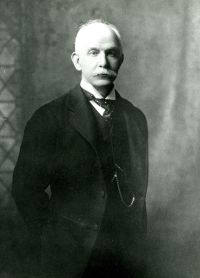
Brooks Adams

Brooks Adams

Summary

Portrait of Brooks Adams Brooks Adams The Law of Civilization and Decay… (1896 | notes)

When force reached the stage where it expressed itself exclusively through money, the governing class ceased to be chosen because they were valiant or eloquent, artistic, learned, or devout, and were selected solely because they had the faculty of acquiring and keeping wealth. As long as the weak retained enough vitality to produce something which could be absorbed, this oligarchy was invincible; and for very many years after the native peasantry of Gaul and Italy had perished under the load, new blood injected from more tenacious races kept the dying civilization alive.
Source: Wikisource

Portrait of Brooks Adams Brooks Adams The Law of Civilization and Decay… (1896 | notes)

Then economic competition began, and intensified as centralization advanced, telling always in favour of the acutest intellect and the cheapest labour. Soon, exchanges became permanently unfavourable, a steady drain of bullion set in to the East, and, as the outflow depleted the treasure amassed at Rome by plunder, contraction began, and with contraction came that fall of prices which first ruined, then enslaved, and finally exterminated, the native rural population of Italy.
Source: Wikisource

Portrait of Brooks Adams Brooks Adams The Law of Civilization and Decay… (1896 | notes)

This supremacy of the economic instinct transformed all the relations of life, the domestic as well as the military. The family ceased to be a unit, the members of which cohered from the necessity of self-defence, and became a business association. Marriage took the form of a contract, dissoluble at the will of either party, and, as it was somewhat costly, it grew rare. As with the drain of their bullion to the East, which crushed their farmers, the Romans were conscious, as Augustus said, that sterility must finally deliver their city into the hand of the barbarians.
Source: Wikisource

Get perspective with Kwize: daily news enlightened by great literature