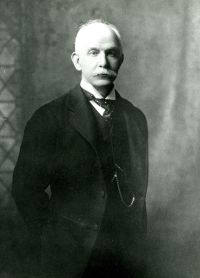
Brooks Adams

Brooks Adams

Summary

Portrait of Brooks Adams Brooks Adams The Law of Civilization and Decay… (1896 | notes)

From the sixteenth century downward, the man of imagination, unable to please the economic taste, has starved.
This mercenary quality forms the gulf which has divided the art of the Middle Ages from that of modern times—a gulf which cannot be bridged, and which has broadened with the lapse of centuries, until at last the artist, like all else in society, has become the creature of a commercial market, even as the Greek was sold as a slave to the plutocrat of Rome.
Source: Wikisource

Portrait of Brooks Adams Brooks Adams The Law of Civilization and Decay… (1896 | notes)

Decade by decade, for some four hundred years, these phenomena have grown more sharply marked in Europe, and, as consolidation apparently nears its climax, art seems to presage approaching disintegration. The architecture, the sculpture, and the coinage of London at the close of the nineteenth century, when compared with those of the Paris of Saint Louis, recall the Rome of Caracalla as contrasted with the Athens of Pericles, save that we lack the stream of barbarian blood which made the Middle Age.
Source: Wikisource

Portrait of Brooks Adams Brooks Adams The Law of Civilization and Decay… (1896 | notes)

Such uniformity of development in the most distant times, and among the most divergent peoples, points to a progressive law of civilization, each stage of progress being marked by certain intellectual, moral, and physical changes. As the attack in war masters the defence, and the combative instinct becomes unnecessary to the preservation of life, the economic supersedes the martial mind, being superior in breadwinning. As velocity augments and competition intensifies, nature begins to sift the economic minds themselves, culling a favoured aristocracy of the craftiest and the subtlest types
Source: Wikisource

Get perspective with Kwize: daily news enlightened by great literature