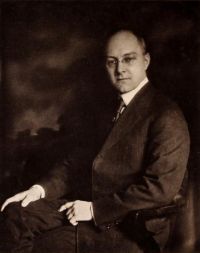
Claude Moore Fuess

Claude Moore Fuess

Summary

Portrait of Claude Moore Fuess Claude Moore Fuess Lord Byron as a satirist in verse (1912)

Men of the highest genius were soon to employ satire as a weapon. Moore, the Smiths, Praed, Hood, and Hook were to carry raillery and mockery almost to the point of perfection; Shelley was to unite satire with idealism and a lofty philosophy; and Byron himself, the last master in the school of Pope, was to introduce a new variety of satire, borrowed from the Italians, and to gain for himself the distinction of being perhaps the greatest of our English verse-satirists.
Source: Gutenberg

Portrait of Claude Moore Fuess Claude Moore Fuess Lord Byron as a satirist in verse (1912)

Others have had as much of passion and as much of humor; Dryden had perhaps as much of both combined. But here, and not elsewhere, a third quality is apparent—the sense of a high and clear imagination.—Above all, the balance of thought and passion is admirable; human indignation and divine irony are alike understood and expressed; the pure and fiery anger of men at the sight of wrong-doing, the tacit inscrutable derision of heaven.” Nichol, in his life of Byron, says:—“Nowhere in so much space, save in some of the prose of Swift, is there in English so much scathing satire.”
Source: Gutenberg

Portrait of Claude Moore Fuess Claude Moore Fuess Lord Byron as a satirist in verse (1912)

In matters of form and technique Pope’s art is unquestioned. He refined and condensed the couplet until it cut like a rapier. The beauty of his satire thus lies rather in small details than in general effect, in clear-cut and penetrating phrasing rather than in breadth of conception. With all this his work is marked by an air of urbanity, ease, and grace, which connects him with Horace rather than with Juvenal. His wit is constant and his irony subtle.
Source: Gutenberg

Get perspective with Kwize: daily news enlightened by great literature