Summary

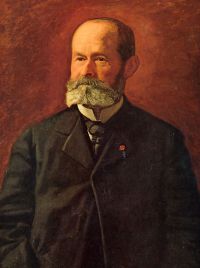
Portrait of Daniel G. Brinton Daniel G. Brinton An Ethnologist's View of History

This was long ago pointed out by the observant Machiavelli in his statement that every reform of a government or religion is in the popular mind personified as the effort of one individual.
In every nation or ethnos there is a prevailing opinion as to what the highest typical human being should be. This “Ideal of Humanity,” as it has been called, is more or less constantly and consciously pursued, and becomes a spur to national action and to a considerable degree an arbiter of national destiny. If the ideal is low and bestial, the course of that nation is downward, self-destroying
Source: Gutenberg

Portrait of Daniel G. Brinton Daniel G. Brinton An Ethnologist's View of History

But alas! their ideal is too evident to be mistaken. I call it the “divitial” ideal, that of the rich man, that which makes the acquisition of material wealth the one standard of success in life, the only justifiable aim of effort. To most American citizens the assertion that there is any more important, more sensible purpose than this, is simply incomprehensible or incredible.
Source: Gutenberg

Portrait of Daniel G. Brinton Daniel G. Brinton An Ethnologist's View of History

To apprehend what is noblest in a nation one must oneself be noble. Knowledge of facts and an unbiased judgment need to be accompanied by a certain development of personal character which enables one to be in sympathy with the finest tissue of human nature, from the fibre of which are formed heroes and martyrs, patriots and saints, enthusiasts and devotees.
Source: Gutenberg

Get perspective with Kwize: daily news enlightened by great literature