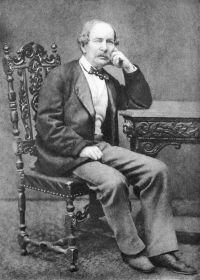
David Urquhart

David Urquhart

Summary

Portrait of David Urquhart David Urquhart The pillars of Hercules (1850)

The household works. There is no subdivision of labour—the household, not the man, is the mint of the state. It is so by its work, its varying cares, and interchanging toil. These impose discipline, nurture affection, knit and fortify that unit. Take away these cares, this industry, this dexterity, this power of standing alone, and what will—what can—a “home” become, save a crib to sleep in, with a trough to feed at, supplied from the butcher’s cart and the huckster’s stall? Take from the household its industrial character, and you take away its social charm, and its public worth.
Source: Gutenberg

Portrait of David Urquhart David Urquhart The pillars of Hercules (1850)

If you had broken through to a people dwelling beneath the Pyramids, you could not have firmer assurance of rest and immutability; yet they are alive and on the surface of the earth, and in sight of that giant of velocity, Europe, which has been bounding from precipice to precipice of years, spanning gulfs of centuries, and counting thousands of revolutions of the sun to arrive only at forgetfulness. These know nothing of Old Time. He cannot, indeed, be denied in private intercourse; but as regards the state and society, his glass has no sand, his scythe no edge, his arm no swing.
Source: Gutenberg

Portrait of David Urquhart David Urquhart The pillars of Hercules (1850)

Sheltered from the blasts of the sea, though inhaling its health and freshness, and from the damp wind that sweeps through the Gut of Gibraltar and infects the shores of Spain and Morocco,—this region enjoys the richest soil, the most fortunate site in a clime where barren sand upon a mountain-top can bear the choicest fruits and the fairest flowers; a clime which combines the charms of every other, and preserves throughout the year the luxury of every season.
Source: Gutenberg

Get perspective with Kwize: daily news enlightened by great literature