Summary

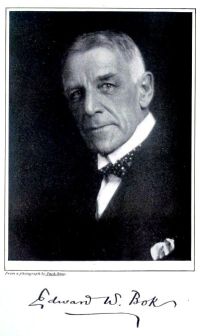
Portrait of Edward W. Bok Edward W. Bok The Americanization of Edward Bok (1921)

Just beyond the cannon’s roar, Thou art on the farther shore. For the passing souls we pray, Saviour, meet them on the way; Thou wilt hear our yearning call, Who hast loved and died for all.
Absolute stillness reigned in the room save for the half-suppressed sob from the nurse and the distant booming of the cannon. As Bok finished, he heard the boy at his right say slowly: “Saviour—meet—me—on—my—way”: with a little emphasis on the word “my.” The hand in his relaxed slowly, and then fell on the cot; and he saw that the soul of another brave American boy had “gone West.”
Source: Wikisource

Portrait of Edward W. Bok Edward W. Bok The Americanization of Edward Bok (1921)

It is this strong impulse that my Americanization has made the driving power of my life. And I ask no greater privilege than to be allowed to live to see my potential America become actual: the America that I like to think of as the America of Abraham Lincoln and of Theodore Roosevelt—not faultless, but less faulty. It is a part in trying to shape that America, and an opportunity to work in that America when it comes, that I ask in return for what I owe to her. A greater privilege no man could have.
Source: Wikisource

Portrait of Edward W. Bok Edward W. Bok The Americanization of Edward Bok (1921)

With an editor ever alive to the new message, the new note, the fresh way of saying a thing, the new angle on a current subject, whether in article or story—since fiction is really to-day only a reflection of modern thought—the foolish notion that an editor must be approached through “influence,” by a letter of introduction from some friend or other author, falls of itself. There is no more powerful lever to open the modern magazine door than a postage-stamp on an envelope containing a manuscript that says something.
Source: Wikisource

Get perspective with Kwize: daily news enlightened by great literature