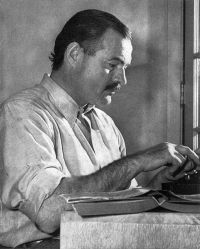
Ernest Miller Hemingway

Ernest Miller Hemingway

Summary

Portrait of Ernest Miller Hemingway Ernest Miller Hemingway The Sun Also Rises — Chapter XII (1954)

The bull, striking into the wood from side to side with his horns, made a great noise. Then I saw a dark muzzle and the shadow of horns, and then, with a clattering on the wood in the hollow box, the bull charged and came out into the corral, skidding with his forefeet in the straw as he stopped, his head up, the great hump of muscle on his neck swollen tight, his body muscles quivering as he looked up at the crowd on the stone walls. The two steers backed away against the wall, their heads sunken, their eyes watching the bull.
Source: Wikisource

Portrait of Ernest Miller Hemingway Ernest Miller Hemingway The Sun Also Rises — Chapter XII (1954)

Montoya could forgive anything of a bull-fighter who had aficion. He could forgive attacks of nerves, panic, bad unexplainable actions, all sorts of lapses. For one who had aficion he could forgive anything. At once he forgave me all my friends. Without his ever saying anything they were simply a little something shameful between us, like the spilling open of the horses in bull-fighting.
Source: Wikisource

Portrait of Ernest Miller Hemingway Ernest Miller Hemingway The Sun Also Rises — Chapter XII (1954)

What if Brett did sleep with you? She's slept with lots of better people than you."
"Shut up," Cohn said. He stood up. "Shut up, Mike."
"Oh, don't stand up and act as though you were going to hit me. That won't make any difference to me. Tell me, Robert. Why do you follow Brett around like a poor bloody steer? Don't you know you're not wanted? I know when I'm not wanted. Why don't you know when you're not wanted? You came down to San Sebastian where you weren't wanted, and followed Brett around like a bloody steer. Do you think that's right?"
Source: Wikisource

Get perspective with Kwize: daily news enlightened by great literature