Summary

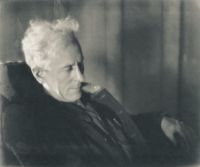
Portrait of Frederick R. Bechdolt Frederick R. Bechdolt When the West Was Young — How Death Valley Was Named (1922)

Now every driver lashed his oxen to a lumbering run, and the women lifted the canvas tops of the prairie-schooners to show their children the pretty lake. The whole train turned away from its course and went rumbling across the plain, one mile, then a second; and another followed before they found themselves in the midst of a glaring expanse of snow-white alkali, baked by the sun to rock-like hardness.
Source: Wikisource

Portrait of Frederick R. Bechdolt Frederick R. Bechdolt When the West Was Young — How Death Valley Was Named (1922)

The mothers lowered the canvas wagon-covers and soothed their crying children, and the drivers turned the oxen back toward the trail which they had forsaken for the lure of the mirage. There was no word of grief among the men, no outcry of despair; but the shoulders of some were sagging when they made their dry camp that night, and there was a new hardness in the eyes of all of them. For they had looked upon the desert and they knew it for what it was.
As they were sitting about their little fires a man came staggering among them out of the darkness.
Source: Wikisource

Portrait of Frederick R. Bechdolt Frederick R. Bechdolt When the West Was Young — How Death Valley Was Named (1922)

Dark ragged mountains of volcanic rock lay to the north, and to the south a tangle of naked ridges whose sides were discolored as though by fire. Between these scorched ranges a plain stretched for a good one hundred miles into the west, as level as a floor and gleaming white. Beyond that plain a low chain of mountains rose, as black as ink, and behind this gloomy range he saw a snow-clad peak that glistened in the morning sun.
They talked the situation over; all of them were convinced that Manley had found the peak described by the Williams map, and now they argued for different routes.
Source: Wikisource

Get perspective with Kwize: daily news enlightened by great literature