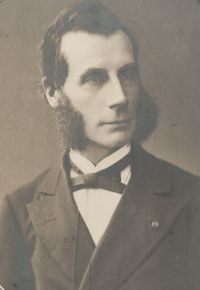
Fustel de Coulanges

Fustel de Coulanges

Summary

Portrait of Fustel de Coulanges Fustel de Coulanges The Origin of Property in Land (1891)

If the soil was originally the common property of the people, and the people maintained a kind of eminent domain over it (which is M. Viollet’s theory) , one cannot see why the law should have forbidden the sale of land to another member of the same people; one cannot see why the law should have prohibited any family from parting with it, even in favour of the people itself. The old rule, or rather the ancient custom which forbids a family to separate itself from its land, cannot be a proof of community in land. It only proves the ownership of property by the family.
Source: Gutenberg

Portrait of Fustel de Coulanges Fustel de Coulanges The Origin of Property in Land (1891)

National communism has been confused with the common ownership of the family; tenure in common has been confused with ownership in common; agrarian communism with village commons.
We do not maintain that it is inadmissible to believe in primitive communism. What we do maintain is that the attempt to base this theory on an historical foundation has been an unfortunate one; and we refuse to accept its garb of false learning.
Source: Gutenberg

Portrait of Fustel de Coulanges Fustel de Coulanges The Origin of Property in Land (1891)

History is not a science of speculation; it is a science of observation.
No one, moreover, but M. Viollet, considers that the [Pg 97] co-proprietorship of the family and the common ownership of the whole people “are two things which resemble one another.” It is clear to every careful observer that they are essentially different, both in character and in results. The co-proprietorship of the family is an ownership which is complete, absolute, hereditary, independent even of the State. If it is undivided, it is because the family at this time is itself still undivided.
Source: Gutenberg

Get perspective with Kwize: daily news enlightened by great literature