Summary

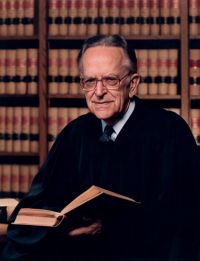
Portrait of Harry Blackmun Harry Blackmun Osborne v. Ohio — Opinion of the Court

Many would characterize a photograph of a seductive fashion model or alluringly posed adolescent on a topless European beach as "lewd," although such pictures indisputably enjoy constitutional protection. Indeed, some might think that any nudity, especially that involving a minor, is by definition "lewd," yet this Court has clearly established that nudity is not excluded automatically from the scope of the First Amendment. The Court today is unable even to hazard a guess as to what a "lewd exhibition" might mean
Source: Wikisource

Portrait of Harry Blackmun Harry Blackmun Osborne v. Ohio — Opinion of the Court

Even if the statute was not overbroad, our decision in Stanley v. Georgia, 394 U.S. 557, 89 S.Ct. 1243, 22 L.Ed.2d 542 (1969) , forbids the criminalization of appellant's private possession in his home of the materials at issue. "If the First Amendment means anything, it means that the State has no business telling a man, sitting alone in his own house, what books he may read or what films he may watch."
Source: Wikisource

Portrait of Harry Blackmun Harry Blackmun Osborne v. Ohio — Opinion of the Court

Nevertheless, we reasoned that although the States "retain broad power to regulate obscenity"-and child pornography as well-"that power simply does not extend to mere possession by the individual in the privacy of his own home." Id., at 568, 89 S.Ct., at 1249. Ferber did nothing more than place child pornography on the same level of First Amendment protection as obscene adult pornography, meaning that its production and distribution could be proscribed. The distinction established in Stanley between what materials may be regulated and how they may be regulated still stands.
Source: Wikisource

Get perspective with Kwize: daily news enlightened by great literature