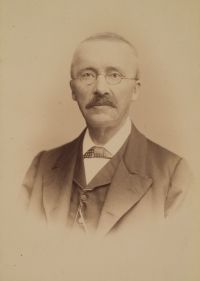
Heinrich Schliemann

Heinrich Schliemann

Summary

Portrait of Heinrich Schliemann Heinrich Schliemann Troy and Its Remains

I have no hope of finding plastic works of art. The single object of my excavations from the beginning was only to find Troy, whose site has been discussed by a hundred scholars in a hundred books, but which as yet no one has ever sought to bring to light by excavations. If I should not succeed in this, still I shall be perfectly contented, if by my labours I succeed only in penetrating to the deepest darkness of pre-historic times, and enriching archæology by the discovery of a few interesting features from the most ancient history of the great Hellenic race.
Source: Gutenberg

Portrait of Heinrich Schliemann Heinrich Schliemann Troy and Its Remains

I am extremely disappointed at being obliged to give so small a plan of Troy; nay, I had wished to be able to make it a thousand times larger, but I value truth above everything, and I rejoice that my three years’ excavations have laid open the Homeric Troy, even though on a diminished scale, and that I have proved the Iliad to be based upon real facts.
Homer is an epic poet, and not an historian: so it is quite natural that he should have exaggerated everything with poetic licence.
Source: Gutenberg

Portrait of Heinrich Schliemann Heinrich Schliemann Troy and Its Remains

To regard the heights of Bunarbashi as the site of Troy, contradicts, in every respect, all the statements of Homer and of tradition. My excavations of Bunarbashi, as well as the form of the rocks, prove that those heights, as far as the three sepulchral mounds, can never have been inhabited by men. As I have already said, behind those tumuli there are the ruins of a very small town, the area of which, surrounded on two sides by the ruins of an enclosing wall, and on the other side by precipices, is so insignificant, that at most it can have only possessed 2000 inhabitants.
Source: Gutenberg

Get perspective with Kwize: daily news enlightened by great literature