Summary

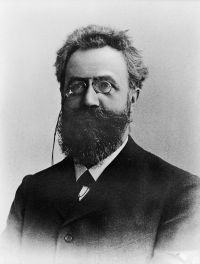
Portrait of Hermann Ebbinghaus Hermann Ebbinghaus Memory: A Contribution to Experimental Psychology… (1913)

In the first place, how are we to keep even approximately constant the bewildering mass of causal conditions which, in so far as they are of mental nature, almost completely elude our control, and which, moreover, are subject to endless and incessant change? In the second place, by what possible means are we to measure numerically the mental processes which flit by so quickly and which on introspection are so hard to analyse?
Source: Wikisource

Portrait of Hermann Ebbinghaus Hermann Ebbinghaus Memory: A Contribution to Experimental Psychology… (1913)

Whether, for a certain group of observations, the curve has a more steep or more flat form depends on the nature of those observations. The more exact they are, the more will they pile up around the central value; and the more infrequent the large deviations, the steeper will the curve be and vice versa. For the rest the law of formation of the curve is always the same. Therefore, if a person, in the case of any specific combination of observations, obtains any measure of the compactness of distribution of the observations, he can survey the grouping of the whole mass.
Source: Wikisource

Portrait of Hermann Ebbinghaus Hermann Ebbinghaus Memory: A Contribution to Experimental Psychology… (1913)

Our present knowledge is much too fragmentary, too general, too largely obtained from the extraordinary to enable us to reach a decision on this point by its aid; that must be reserved for experiments especially adapted to that purpose. We must try in experimental fashion to keep as constant as possible those circumstances whose influence on retention and reproduction is known or suspected, and then ascertain whether that is sufficient. The material must be so chosen that decided differences of interest are, at least to all appearances, excluded
Source: Wikisource

Get perspective with Kwize: daily news enlightened by great literature