Summary

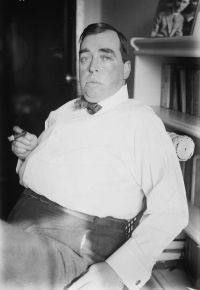
Portrait of Irvin S. Cobb Irvin S. Cobb Paths of Glory: Impressions of War Written at and Near the Front

To them it seemed well-nigh incredible that any nation should be their superiors in any department pertaining to the practice of war. They could not bring themselves fully to understand it. It remained as much a puzzle to them as the unaccountable obstinacy of the English in refusing to be budged out of their position by displays of cold steel, or to be shaken by the volleying, bull-like roar of the German charging cry, which at first the Germans counted upon as being almost as efficacious as the bayonet for instilling a wholesome fear of the German war god into the souls of their foes.
Source: Gutenberg

Portrait of Irvin S. Cobb Irvin S. Cobb Paths of Glory: Impressions of War Written at and Near the Front

Behind us, on the front of the hill, is a hedge, and beyond the hedge—just a foot or so back of it, in fact—is a deep trench, plainly dug out by hand, and so lately done that the cut clods are still moist and fresh-looking. At the first instant of looking it seems to us that this intrenchment is full of dead men; but when we look closer we see that what we take for corpses are the scattered garments and equipments of French infantrymen—long blue coats; peaked, red-topped caps; spare shirts; rifled knapsacks; water- bottles; broken guns; side arms; bayonet belts and blanket rolls.
Source: Gutenberg

Portrait of Irvin S. Cobb Irvin S. Cobb Paths of Glory: Impressions of War Written at and Near the Front

Even as someone who knew sang out to us that this was the balloon cannon in the German aviation field back of the town opening up, a tiny ball of smoke appeared against the sky, seemingly quite close to the darting flyer, and blossomed out with downy, dainty white petals, like a flower.
The monoplane veered, wheeled and began to drive in a wriggling, twisting course. The balloon cannon spoke again. Four miles away, to the eastward, its fellow in another aviation camp let go, and the sound of its discharge came to us faintly but distinctly.
Source: Gutenberg

Get perspective with Kwize: daily news enlightened by great literature