Summary

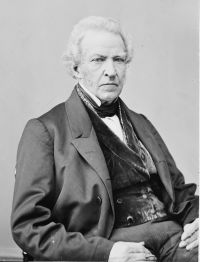
Portrait of James Moore Wayne James Moore Wayne Howard v. Ingersoll — Opinion of the Court

We repeat, 'along the bank thereof,' is the controlling call in the interpretation of the cession. It excludes the idea that a line was to be traced at the edge of the water as that may be at one or another time or at low water, or the lowest low water. Water is not a call in the description of the boundary, though the river is, and that, as we have shown, does not mean water alone, but banks, shores, water, and the bed of the river. If water, as one of the river's parts, had been meant, it would have been so expressed.
Source: Wikisource

Portrait of James Moore Wayne James Moore Wayne Howard v. Ingersoll — Opinion of the Court

Now without insisting on this recalled admission, I venture to submit to your honors, looking to the fact, that the defendant's eastern boundary is the State of Georgia, whose western boundary is a line drawn on and along the western bank of the Chattachoochee; that no surveyor's chain, acting under the authority of the United States, or Alabama, has ever been stretched east of that permanent or elevated bank.
Source: Wikisource

Portrait of James Moore Wayne James Moore Wayne Howard v. Ingersoll — Opinion of the Court

The recent treaty, too, with Spain, bound that nation and the United States to restrain the Indian tribes, in the territories of each, from war among themselves and from such as might lead to aggressions upon the territories of either nation. Added to such considerations, the people who had settled to the west of the Chattahoochee, between it and the Yazoo River, claimed from the United States the protection which Georgia could not give, and they asked for a securer and more definite political organization than they had had either under English or Spanish rule, or from Georgia legislation.
Source: Wikisource

Get perspective with Kwize: daily news enlightened by great literature