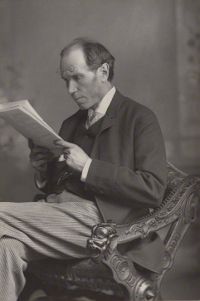
James Payn

James Payn

Summary

Portrait of James Payn James Payn,  Popular Science Monthly (1880)

“ Of Irving she naïvely remarks that his strokes of humor seem to her to owe much of their success to the rarity of their occurrence: the flashes of fun are spread over pages of dullness, which enhance them, just as a dark night is propitious to fireworks, or the atmosphere of the House of Commons, or a court of law, to a joke. She is often in error, no doubt, but how bright and wholesome such talk is as compared with the platitudes and commonplaces which one hears on all sides in connection with literature! ”
Source: Wikisource

Portrait of James Payn James Payn,  Popular Science Monthly (1880)

“ But why, then, do they praise the "Rambler" and Montaigne? That comforting word, "Mesopotamia," which has been so often alluded to in religious matters, has many a parallel in profane literature.
A good deal of this mock worship is of course due to abject cowardice. A man who says he doesn't like the "Rambler" runs, with some folks, the risk of being thought a fool; but he is sure to be thought that, for something or another, under any circumstances; and, at all events, why should he not content himself, when the "Rambler" is belauded, with holding his tongue and smiling acquiescence?
”
Source: Wikisource

Portrait of James Payn James Payn,  Popular Science Monthly (1880)

“ Since classical learning is compulsory with us, this bastard admiration is much more often excited with respect to the Greek and Latin poets. Men may not only go through the whole curriculum of a university education, but take high honors in it, without the least intellectual advantage beyond the acquisition of a few quotations. This is not, of course (good heavens!) , because the classics have nothing to teach us in the way of poetical ideas, but simply because to the ordinary mind the acquisition of a poetical idea is very difficult, and when conveyed in a foreign language is impossible. ”
Source: Wikisource

Get perspective with Kwize: daily news enlightened by great literature