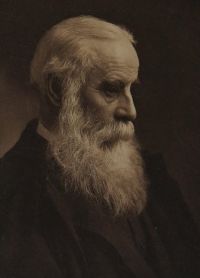
John Cook Wilson

John Cook Wilson

Summary

Portrait of John Cook Wilson John Cook Wilson On an Evolutionist Theory of Axioms (1889)

And thus the evolutionist, professing to have established the validity of the test of inconceivableness, has unwittingly shewn it to be consistent with the contradictory of what he supposes it to absolutely guarantee. It follows irresistibly that all that seems to us simplest, clearest, most self-evident, and more certain, according to the evolutionist himself, than anything else we can believe, may be an illusion.
The theory which was to have reconciled great philosophies has destroyed itself, and has ended in a scepticism which has not even the merit of being self-conscious.
Source: Wikisource

Portrait of John Cook Wilson John Cook Wilson On an Evolutionist Theory of Axioms (1889)

We may bow to it as an inevitable decree of nature; we deceive ourselves if we say we can see it is good and desirable. The pessimist would find another instance of Nature's unkindness. Even where she seems to confer a benefit, she has done us a deep injury. She has mutilated our minds with a refinement of cruelty. For instead of mercifully concealing a loss which could only be deplored and never repaired, she has evolved the philosophy which has betrayed the secret.
Source: Wikisource

Portrait of John Cook Wilson John Cook Wilson On an Evolutionist Theory of Axioms (1889)

For the moment a man is convinced that some one else can conceive what he cannot, he ceases to suppose that his own state of mind can determine the truth in the particular case. Thus a man without a musical ear nevertheless may believe that there is such a thing as a musical order. But the supposed history of the mind's modification implies that though we cannot conceive the contradictory of an axiom we might have been able, and our ancestors perhaps were able: and thus the mind's limitation in respect of the conceivable becomes as such entirely indifferent.
Source: Wikisource

Get perspective with Kwize: daily news enlightened by great literature